Caesar Hull
On 26 May 1940, Caesar Hull took off from a muddy airstrip near Bodo with barely enough fuel to fight. In the next hour, flying a biplane that was already obsolete, he destroyed four German aircraft without assistance -- a feat so improbable that it earned the 26-year-old Rhodesian the Distinguished Flying Cross and made him the RAF's first Gloster Gladiator ace. Three months later, he was dead, shot down over south London during the Battle of Britain, one week after being given command of the squadron he loved.
From the Shangani to the Skies
Caesar Barrand Hull was born on 26 February 1914 at Leachdale Farm near Shangani in Southern Rhodesia. His childhood moved between Rhodesia, South Africa, and Swaziland, and he grew up tough enough to box for South Africa in the lightweight division at the 1934 Empire Games in London. When he tried to join the South African Air Force in 1935, they turned him down because he did not speak Afrikaans. It was their loss. Hull enlisted in the RAF instead, completed his pilot's course by August 1936, and joined No. 43 Squadron at RAF Tangmere in Sussex. He quickly became known for an aerobatic routine in which he and fellow pilot Peter Hanks would swap seats in a two-seater Hawker Audax while airborne. At the 1937 Hendon air show, Hull flew the individual aerobatics display in a Hawker Fury to mark the coronation of King George VI.
The Hour Over Bodo
When Germany invaded Norway in April 1940, Hull was reassigned to No. 263 Squadron, flying Gloster Gladiator biplanes from the carrier HMS Furious to the frozen airstrip at Bardufoss, about 80 kilometers northeast of Narvik. On 26 May, Hull volunteered to fly south to an improvised strip at Bodo to cover retreating Allied troops. He arrived to find the field so muddy that his wingman's plane crashed on takeoff. Alone in the air, Hull spotted a Heinkel He 111 over the Saltdal valley and attacked from behind, setting it ablaze. He then destroyed a Junkers Ju 52 transport, chased another Heinkel unsuccessfully, and shot down two more Ju 52s that were ferrying paratroopers to reinforce the German garrison at Narvik. One transport managed to land before burning out; the other spiralled into the ground, killing eight paratroopers aboard. Hull attacked a fifth aircraft before running out of ammunition and returning to Bodo.
A Week in Command
Shot down the day after his Bodo triumph by an experienced Bf 110 pilot, Oberleutnant Helmut Lent, Hull crash-landed near the airfield with wounds to his head and knee. He was evacuated to Britain on a Sunderland flying boat, and spent two months recovering in Guildford. On 31 August 1940, he was given command of No. 43 Squadron, replacing Squadron Leader John Badger, who had been shot down and grievously wounded the previous day. Promoted to squadron leader, Hull reportedly suffixed his first written description of himself as commanding No. 43 Squadron with four exclamation marks. He led the squadron through several engagements over southern England, including a decisive victory against Bf 110s over coastal Sussex on 4 September. Three days later, on 7 September, Hull scrambled nine Hurricanes to intercept a massive German formation heading for London. He took six aircraft above the bombers and dived in, telling his pilots to "smash them up." In the dogfight that followed, Hull was killed while diving to aid a fellow pilot under heavy attack. His Hurricane crashed into the grounds of Purley Boys' High School in Surrey. He was 26.
The Memorials That Traveled
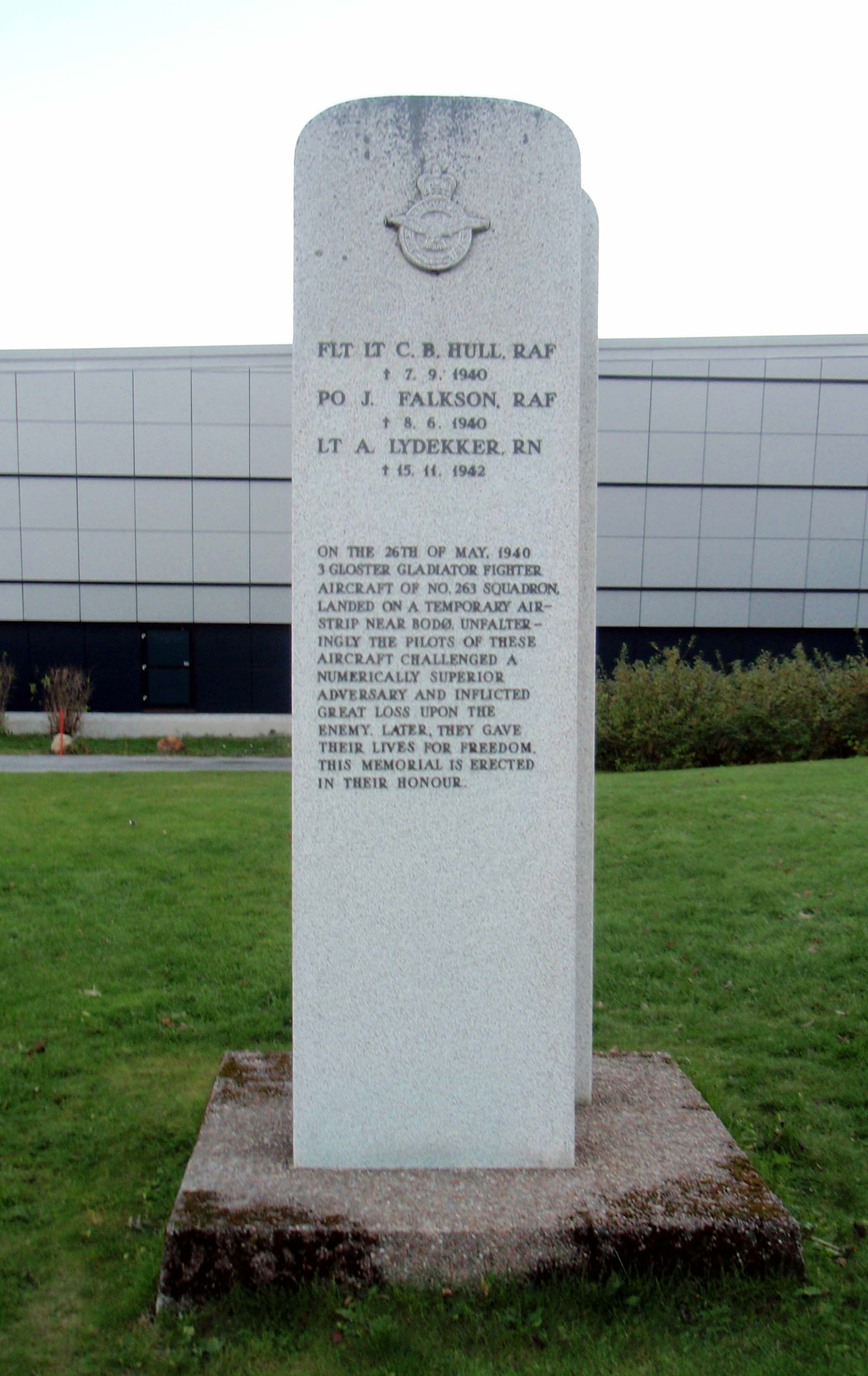
Hull was buried among fellow fighter pilots at St Andrew's Church in Tangmere, and the people of Shangani erected a granite memorial near his birthplace in Rhodesia. After Zimbabwe's independence in 1980, the Mugabe government disowned many colonial-era war monuments, including Hull's. In 2003, his family arranged for the brass plaque to be removed and flown to England free of charge by MK Airlines, a freight carrier owned by former Rhodesian Air Force pilot Mike Kruger. The plaque was ceremonially delivered to the Tangmere Military Aviation Museum in April 2004 by Hull's sister, Wendy Bryan. In Bodo, where Hull had fought his most remarkable action, a memorial was built at the airport in 1977 and inaugurated by Norway's Minister of Defence. A third monument was erected in 2013 at Coulsdon Sixth Form College, which now occupies the site of the school where his plane fell. It depicts an aeroplane and a dove intertwined.
From the Air
Bodo Airport (ENBO) at 67.27N, 14.40E is where Hull's memorial stands. His most famous action took place over the Saltdal valley south of Bodo. Bardufoss Air Station (ENDU) at 69.06N, 18.54E was the base from which No. 263 Squadron operated. The coordinates 69.06N, 18.54E mark Bardufoss. Best viewed from 3,000-5,000 ft to see the fjord and mountain terrain that shaped aerial combat in this theater. The approach from the Norwegian Sea toward Bodo gives a sense of what pilots flying from HMS Furious would have seen.