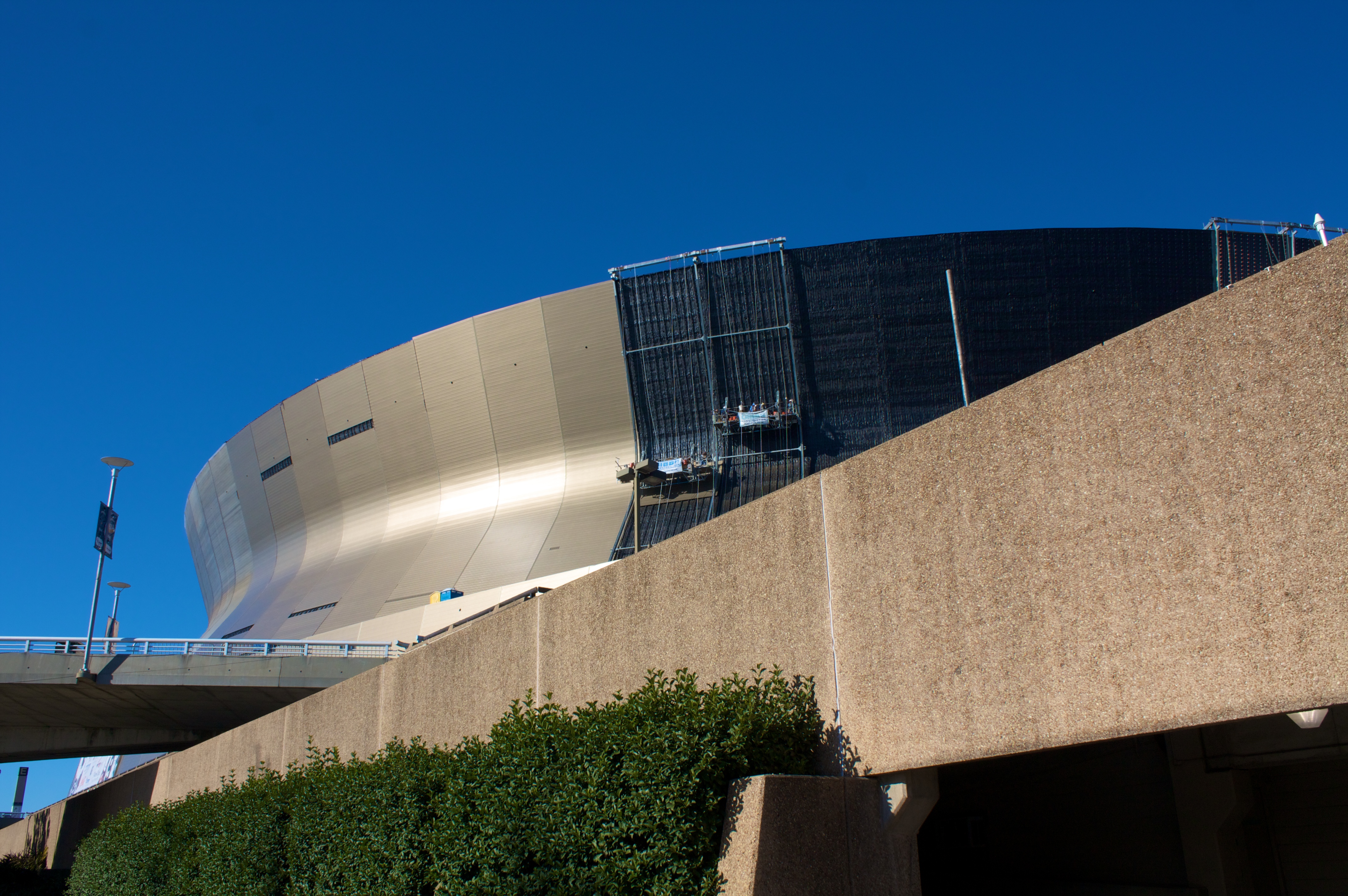
Caesars Superdome
The building is so large that someone once made a scale model of it out of 2,697 pennies. Another person built one from sugar. These eccentric tributes emerged while the Caesars Superdome was still under construction in the early 1970s, when New Orleanians watched the largest fixed domed structure in the world rise from a patch of land near the old Girod Street Cemetery. The project was born in 1966 when Louisiana Governor John McKeithen toured the Astrodome in Houston and declared, "I want one of these, only bigger." He got his wish -- though it took nine years, a tripled budget, and an oil crisis to deliver it.
A Dream That Kept Getting More Expensive
Local businessman David Dixon conceived the dome while trying to convince the NFL to bring a franchise to New Orleans. After several exhibition games at Tulane Stadium were drenched by typical New Orleans summer thunderstorms, NFL Commissioner Pete Rozelle told Dixon the league would never expand into the city without a domed stadium. Dixon persuaded Governor McKeithen, and voters approved construction bonds on November 8, 1966 -- seven days after Rozelle awarded New Orleans its franchise. The architects, the New Orleans firm Curtis and Davis, designed a multifunctional colossus with movable field-level stands for football, baseball, and basketball, dirt patches beneath metal plates for a baseball diamond, and even meeting rooms for rent. The original budget was $46 million, with completion targeted before the 1972 NFL season. Political delays pushed groundbreaking to August 11, 1971. The 1973 oil crisis sent transportation costs soaring. By the time the dome opened in August 1975, the final price tag had ballooned to $165 million. The original artificial turf, manufactured by Monsanto specifically for the facility, was christened "Mardi Grass."
A Stadium That Became a Shelter
When Hurricane Katrina bore down on New Orleans in August 2005, the Superdome became the city's refuge of last resort. Thousands of residents crowded inside as the storm peeled sections off the roof, knocked out power, and flooded the surrounding streets. The building's systems failed. For days, the Superdome was less a stadium than a survival story, its damaged interior broadcast around the world as a symbol of catastrophe and governmental failure. Repairs cost $185 million: $115 million from FEMA, $41 million from refinanced bonds, $15 million from the NFL, and $13 million from the state. The dome reopened on September 25, 2006, for the Saints' home opener against the Atlanta Falcons. U2 and Green Day performed a cover of "The Saints Are Coming" before the game. President George W. Bush handled the coin toss. The Saints won 23-3 in front of 70,003 fans and ESPN's largest audience to date. Outside the dome today, a bronze statue titled Rebirth depicts Steve Gleason's punt block from that game -- the play that told New Orleans its stadium, and its spirit, had survived.
Where Legends Punched, Dunked, and Danced
Eight Super Bowls have been played under this roof, more than any other venue. During Super Bowl XLVII in 2013, a relay device in an electrical vault knocked out half the stadium's power for 34 minutes, halting play between the Baltimore Ravens and San Francisco 49ers in what became known as the Blackout Bowl. The dome's own power system was never compromised -- the fault lay in an Entergy vault outside the building. Beyond football, the Superdome has hosted six NCAA Men's Final Fours, including the legendary 1982 championship where a young Michael Jordan hit the game-winning shot for North Carolina against Georgetown, introducing himself to a national audience. Muhammad Ali won the heavyweight title for the third time here in 1978, beating Leon Spinks before 65,000 fans. Two years later, Roberto Duran quit his rematch against Sugar Ray Leonard in the eighth round with the immortal words "No mas." The New Orleans Jazz set an NBA attendance record in 1977, with 35,077 fans watching Pete Maravich face Julius Erving's Philadelphia 76ers.
Names Change, the Dome Endures
The building has worn three names: Louisiana Superdome from its 1975 opening, Mercedes-Benz Superdome after naming rights were first sold in 2011, and Caesars Superdome since 2021. Through every rebranding, New Orleanians have simply called it the Superdome. A $450 million renovation designed by Trahan Architects, completed in phases from 2020 through early 2025, replaced the old ramp system with glass atriums, rebuilt the concourses, and added field-level end zone boxes -- all in time to host Super Bowl LIX. The dome has staged the Essence Music Festival nearly every year since 1995, hosted WrestleMania twice, welcomed Pope John Paul II to address 80,000 children in 1987, and once saw the Jets perform a full concert to an entirely empty arena due to a booking mixup. Pele played soccer here. Olga Korbut performed gymnastics. Forty thousand fans watched a motocross race on dirt piled inside the dome. The Superdome is not a stadium so much as a vessel for whatever New Orleans decides to do next.
From the Air
Located at 29.951N, 90.081W in the Central Business District of New Orleans. The Superdome is the most prominent landmark visible from the air in the New Orleans metro area -- its massive champagne-bronze dome dominates the skyline west of the French Quarter. The dome diameter is one of the largest in the world and is unmistakable from any altitude. Champions Square and the Smoothie King Center are adjacent to the south. Nearest airport is Louis Armstrong New Orleans International (KMSY), approximately 11 nm west. Lakefront Airport (KNEW) is about 7 nm northeast. Visible from 10,000+ ft AGL due to scale; best appreciated at 3,000-5,000 ft.
Sources
- Wikipedia - Caesars Superdome
- ESPN - Steve Gleason's 2006 blocked punt symbolized rebirth
- NFL.com - Superdome power outage delays Super Bowl XLVII
- History.com - Ali defeats Spinks for third heavyweight title
- Wikipedia - Roberto Duran vs Sugar Ray Leonard II
- NCAA.com - Michael Jordan's game-winning shot 1982
- NOLA.com - Jazz stymied by 76ers in front of NBA record crowd
- Trahan Architects - Caesars Superdome renovation