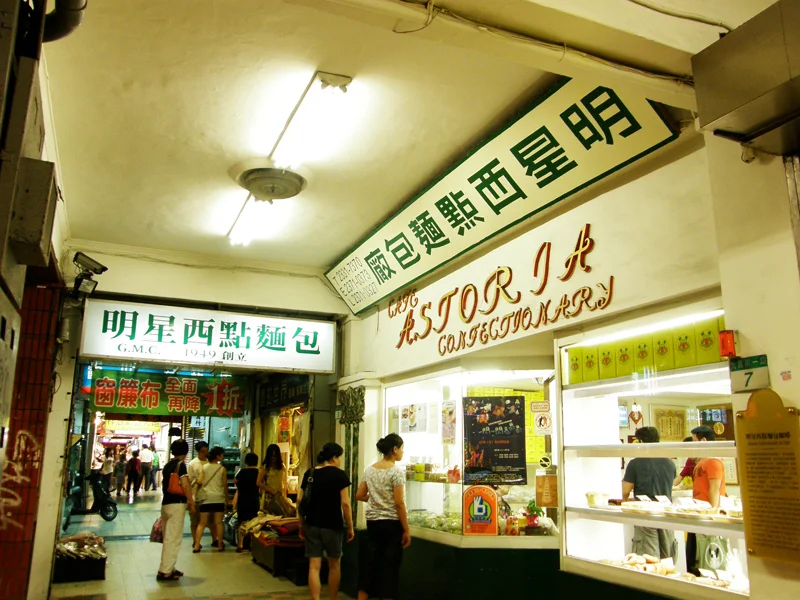

Cafe Astoria
Six Russian immigrants walked into a partnership with an eighteen-year-old Taiwanese businessman in October 1949, and the result was Taipei's first Western-style pastry shop. The Russians had fled Shanghai as the Communist revolution swept through China. Young Archibald Chien had capital and ambition. Together, on Wuchang Street in what is now Zhongzheng District, they opened the Cafe Astoria — and promptly found themselves at the center of one of the most turbulent, strange, and historically rich moments in the city's modern history.
October 1949: A Remarkable Convergence
The timing of the Astoria's opening was extraordinary. One month after the cafe first served pastries on its ground floor and coffee on its second, Chiang Kai-shek resumed the presidency of the Republic of China and officially relocated his government — and hundreds of thousands of soldiers and refugees — to Taiwan. The KMT's retreat from the mainland transformed Taipei almost overnight from a provincial city into the capital of a government in exile.
Into this compressed, displaced, intensely political world, the Astoria opened its doors. The White Russian partners who had already survived one revolution — the Bolshevik overthrow of the tsar — now found themselves refugees a second time, trading Shanghai's International Settlement for a narrow street in a subtropical Asian city. What they brought with them was a repertoire of European pastry techniques, a samovar tradition, and the social instincts of people who had built salons in difficult places before.
Power and Pastry
With the Korean War bringing a significant American military presence to Taiwan from 1950, Wuchang Street became a crossroads. The Astoria hosted foreign dignitaries and visiting celebrities, among them Jane Fonda. More consequentially for Taipei's political life, it became a regular haunt of Chiang Ching-kuo — son of Chiang Kai-shek, future President of the Republic of China, and a man who had spent years studying in Moscow and who married a Belarusian woman, Chiang Fang-liang. The Astoria's Russian atmosphere evidently suited him.
In 1950, the cafe hosted a Russian New Year celebration attended by Chiang Ching-kuo and his family. The intimacy between the Chiang family and this small émigré enterprise ran deep enough that chefs from the Astoria prepared Chiang Kai-shek's last birthday cake. These were not incidental connections; they reflect the strange condensations of history that exile produces — a Russian café on a Taiwanese street baking cakes for the man who had just lost mainland China.
The Literary Table
Alongside the officials and generals, a different kind of regular found their way to the Astoria's second-floor cafe. Writers and poets working in the difficult cultural conditions of 1950s and 1960s Taiwan — when martial law constrained political expression but literary culture still flickered — gathered here. The list of known regulars reads like a who's who of mid-twentieth-century Taiwanese literature.
Pai Hsien-yung, whose fiction explored the nostalgia and loss of the mainlander diaspora, came here. So did Chou Meng-tieh, the poet who lived for years in a newspaper stall, writing meditations on Buddhism and impermanence. Yu Guangzhong, the essayist and poet whose 'Nostalgia' became one of the best-known poems in the Chinese-speaking world, was a regular. The choreographer Lin Hwai-min, founder of Cloud Gate Dance Theatre — Taiwan's most celebrated modern dance company — also frequented the Astoria. These were people working through enormous questions of identity, belonging, and loss, and they found in this Russian-founded café a space that somehow held all those contradictions.
A Historic Building
The Cafe Astoria has remained on Wuchang Street across from the City God Temple for over seventy-five years. In 2011, the Taipei City Government designated it a historic building — recognition that a place can carry the weight of history not through monuments or battles but through the steady accumulation of conversations, encounters, and ordinary days.
The designation protects the physical structure, but the real heritage is harder to preserve: the particular atmosphere of a place where exile and creativity and political power happened to share the same cramped dining room. That the cafe exists at all — that it survived the Cold War, Taiwan's economic transformations, and the relentless appetite of the city for new development — is its own small miracle. The pastry cases are still stocked. The second floor still offers a place to sit. The history is simply there, if you know where to look.
From the Air
Cafe Astoria sits at approximately 25.04°N, 121.51°E in Zhongzheng District, in the heart of historic central Taipei. The Zhongzheng area encompasses the Presidential Office Building and other major civic institutions; from the air the district is identifiable by its formal boulevards and institutional-scale buildings. The nearest MRT access is Ximen Station to the southwest. Taipei Songshan Airport (RCSS) is approximately 6 km to the northeast; Taoyuan International Airport (RCTP) is about 34 km to the southwest.
Nearby Stories
- Dapu Incident 9.3 km away
- Shuanglianpi Wetland 18 km away
- Toufen 41 km away
- North Jiangsu Main Irrigation Canal 980 km away
- General Cliff Rock Paintings 1050 km away
- Sinking of MV Sewol 1061 km away
- Yellow Sea 1111 km away
- Twin Forts of Romblon 1358 km away