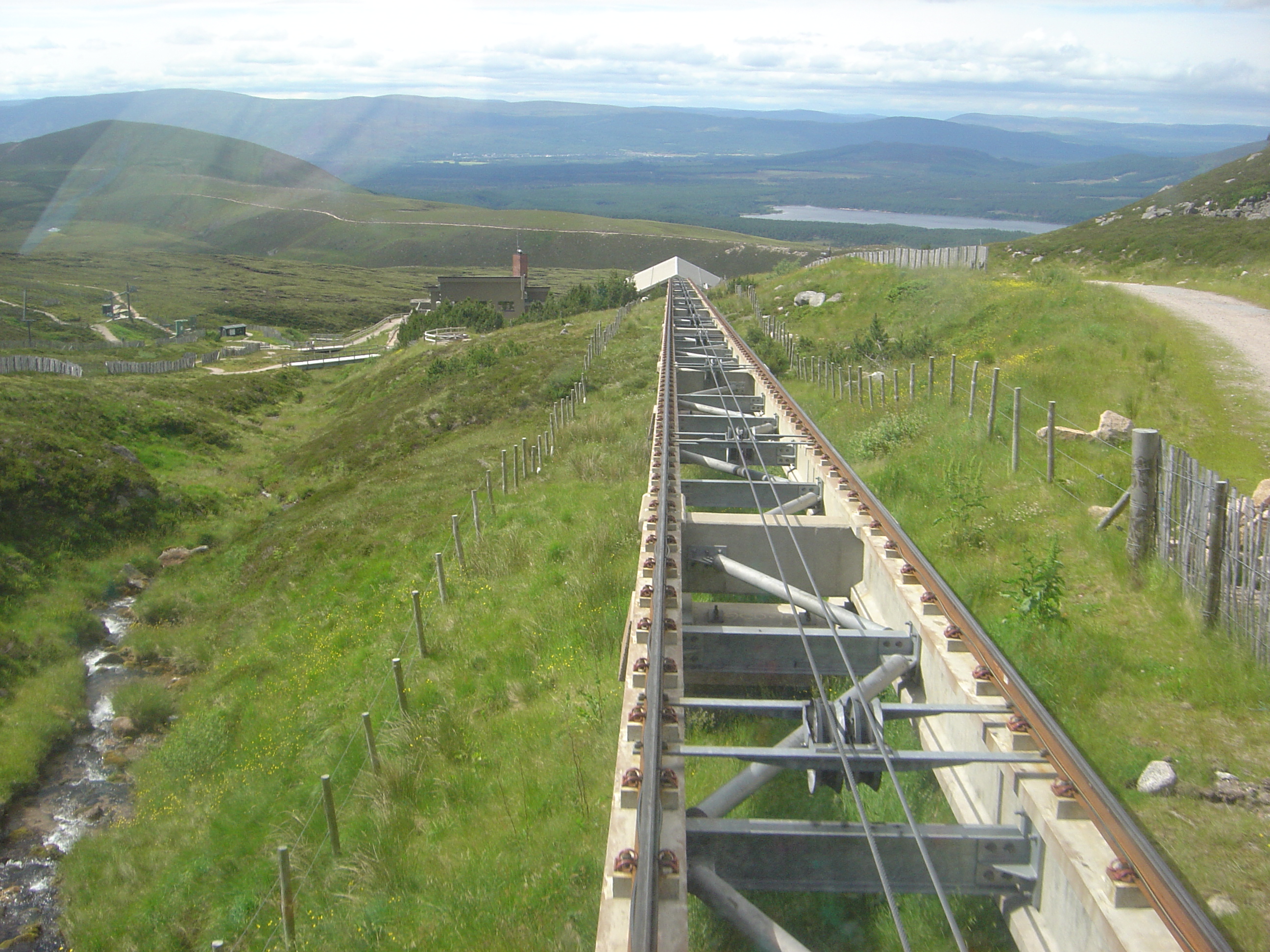
Cairngorm Mountain Railway
It has opened, closed, reopened, closed again, reopened again, and closed a third time. The Cairngorm Mountain Railway, a two-kilometre funicular that ascends the northern face of Cairn Gorm to the Ptarmigan Station at 1,097 metres above sea level, is the highest railway in the United Kingdom and one of its most troubled. Since opening in 2001, the funicular has spent years at a time shut down for structural repairs, entered administration, consumed tens of millions of pounds in public money, and become a case study in the challenges of building infrastructure in one of Britain's harshest mountain environments.
Engineering at Altitude
The funicular is a Doppelmayr 120-SSB system, climbing 462 metres over its 1,970-metre track from the Base Station at 635 metres to the Ptarmigan Station at 1,097 metres. Most of the route is single track, with a passing loop near the midpoint where the two carriages -- each carrying up to 120 standing passengers -- pass one another. Near the summit, the track enters a 250-metre cut-and-cover tunnel that conceals the arrival platform within the hillside. The system is powered by twin 500-kilowatt electric motors that haul one carriage up while the counterweight of the descending carriage assists. In good conditions, the railway can handle a thousand visitors per day during summer months. But conditions on Cairn Gorm are rarely good for long.
A History of Closures
The railway first shut down in October 2018, when cracking concrete was discovered in the viaduct structure. The operating company entered administration the following month, owing two million pounds. In 2020, the Scottish Government committed over 16 million pounds to reinstatement as part of a 20-million-pound project. The work was completed in late 2022 and the railway resumed service in January 2023. Seven months later, in August 2023, it closed again after scarf joints installed during the remedial works were found to be out of tolerance. It finally reopened in February 2025, shut down again from May to June 2025 for viaduct work, and closed for two additional brief periods in autumn 2025. The railway is owned by Highlands and Islands Enterprise, a Scottish Government agency, and the repeated failures have made it a political flashpoint.
A Mountain That Resists
Cairn Gorm is the sixth-highest mountain in the United Kingdom, and its northern flanks are exposed to some of the most extreme weather in the British Isles. Wind speeds at the summit have been measured at over 170 miles per hour. The mountain's subarctic conditions -- snow can fall in any month, and temperatures on the plateau can drop well below freezing even in summer -- impose relentless stress on any structure built into its slopes. The railway exists within the Cairngorms National Park, Britain's largest National Nature Reserve, and its operations are governed by a visitor management plan agreed with NaturScot. During summer, passengers are not permitted to exit the Ptarmigan building and walk onto the mountain -- a restriction designed to protect the fragile plateau environment but one that strikes some visitors as absurd: you can ride a train to the top of a mountain but not step outside when you get there.
The View from the Top
When it works, the Cairngorm Mountain Railway offers something that no other railway in Britain can match. The Ptarmigan Station sits above the treeline, above the corries where skiers carve turns in winter, in a landscape of granite boulders and sparse tundra vegetation. On clear days, the views extend across the Cairngorm plateau to Ben Macdui, the second-highest peak in the British Isles, and northward to the Moray Firth. The ski area that prompted the railway's construction has been part of the Cairngorms landscape since the 1960s, when lifts and tows were installed in the Northern Corries. The funicular was meant to be a modern, all-season replacement for ageing chairlifts. Instead, it has become a monument to the difficulty of imposing engineering certainty on a mountain that operates by different rules.
From the Air
Located at 57.13N, 3.66W on the northern slopes of Cairn Gorm (1,245m). The funicular track is visible as a line ascending the mountain from the car park area at Coire Cas. The Cairngorm ski area and Ptarmigan building near the summit are identifiable features. Aviemore is 8nm to the west. Nearest airport: Inverness (EGPE) 25nm northwest. Caution: significant mountain weather hazards including severe turbulence and rapid weather changes.