Cairngorm Plateau Disaster
On the morning of Monday, 22 November 1971, a helicopter pilot flying over the Cairngorm Plateau in near-whiteout conditions spotted what he thought was a red tent. Edging closer, without reference points in the blowing snow, the crew realised they were looking at a person on her hands and knees. Catherine Davidson, 20 years old, was trying to crawl for help. Her hands were frozen solid. Her legs were locked in a kneeling position and could not be straightened. She was in the advanced stages of hypothermia, barely able to speak -- but she managed to tell her rescuers that the rest of her group was close to where she had been found. When search teams reached the site, they discovered five teenagers and Davidson's assistant dead from exposure, buried under snow that had accumulated over two nights of blizzard.
An Ambitious Plan
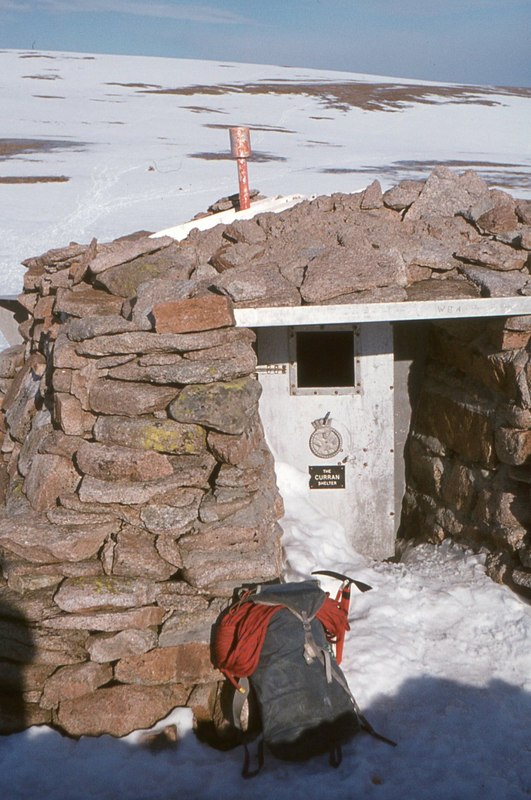
The expedition had been a two-day navigational exercise for students from Ainslie Park High School in Edinburgh, staying at the Lagganlia outdoor training centre in Kincraig. On Saturday, 20 November, 14 students set out with three leaders to cross the Cairngorm Plateau from Cairn Gorm south to Ben Macdui, then descend to Corrour Bothy in the Lairig Ghru. They were divided into two groups. Ben Beattie, 23, led the more experienced group. Catherine Davidson led the less experienced group of four girls and two boys, with 18-year-old trainee instructor Shelagh Sunderland assisting. The groups departed late -- nearly 11:00 -- and used the ski lift to reach the plateau edge. The plan, approved by the head of Lagganlia, called for the groups to meet at the Curran shelter in an emergency. John Duff, leader of the Braemar Mountain Rescue Team, would later describe it as "an appallingly over-ambitious expedition for teenage children."
Stranded Above the Clouds
As the groups set out, the weather deteriorated, as had been forecast. Beattie's group navigated successfully to the Curran shelter and spent the night inside. Davidson's group was not so fortunate. Unable to locate the shelter in whiteout conditions -- she knew it could be completely buried in snow -- Davidson decided on a forced bivouac at a dip near the head of the Feith Buidhe burn, roughly 500 yards from the shelter she could not find. The site was, unknown to her, a major snow accumulation zone. They built a snow wall and sheltered in sleeping bags and bivouac sacs. Through Saturday night, the snow deepened. There was panic about being buried alive. By Sunday, Sunderland was barely conscious. Davidson and a boy tried to go for help but were driven back after a few yards. That night, through the howling storm, they could see the flares of a search party but could not make themselves heard. Their own flares were buried under snow. The teenagers began dying.
The Rescue
Beattie's group struggled off the plateau on Sunday and reached safety that evening. At 19:00, he reported Davidson's party missing at the Aviemore police station. Fifty searchers with helicopter support deployed on Monday morning. The Whirlwind helicopter from RAF Leuchars attempted to reach the plateau via Glen Shee but was reduced to a hover by turbulence at the Pools of Dee. After a wide detour through Glenmore Lodge, the crew began checking shelters. At the Curran shelter there was nothing visible. Then they spotted Davidson. Two crew members were dropped 70 yards away -- the closest approach possible -- and reached her. She could not be carried because her legs were locked; the helicopter had to be guided in by a crewman walking ahead, using the winch wire as a lead. Davidson survived with severe frostbite. The other survivor, a student from Beattie's group who had remained at the Curran shelter, was brought down separately.
The Mountain's Rules
The Cairngorm Plateau has a subarctic climate. Snow can fall in any month. Wind speeds above 170 miles per hour have been recorded at the summit station. Even on days when conditions are moderate at lower elevations, the plateau can be engulfed in storm. The shattered granite terrain resembles arctic Canada more than the European Alps. After the disaster, a fatal accident inquiry led to formal requirements for leaders of school expeditions. The Curran shelter, which the military had erected without permission in the 1960s and which mountaineer Adam Watson had warned would attract inexperienced walkers to a dangerous location, was demolished in 1975. The disaster remains the worst mountaineering accident in British history. The five teenagers who died -- four girls and a boy, all fifteen years old -- and Shelagh Sunderland, eighteen, had trusted the adults who led them to a place where the margin for error was measured in yards and minutes.
From the Air
The disaster site is on the Cairngorm Plateau at approximately 57.09N, 3.67W, near the head of the Feith Buidhe burn at roughly 1,100m elevation. The plateau is featureless granite terrain, extremely exposed, and subject to rapid weather deterioration. Cairn Gorm summit (1,245m) is 1nm to the northeast. Ben Macdui (1,309m) is 3nm to the south. Nearest airport: Inverness (EGPE) 25nm northwest. WARNING: severe mountain weather hazards, extreme turbulence common.