CaixaForum Madrid
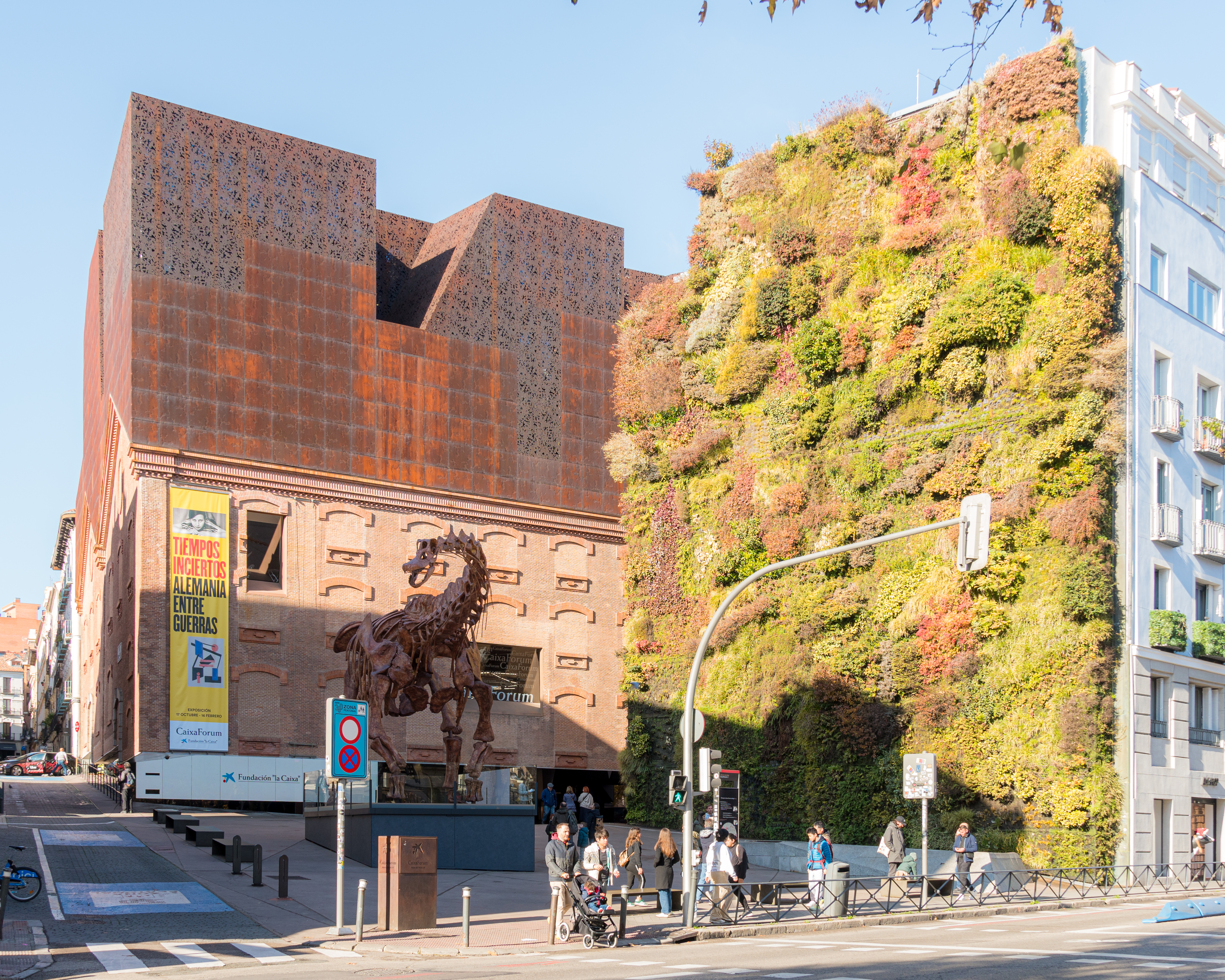
Walk along Madrid's Paseo del Prado and something catches your eye that shouldn't be possible: a massive brick building that appears to hover above the sidewalk, its base removed entirely, as if an architect had erased the ground floor and dared gravity to notice. This is CaixaForum Madrid, a cultural center that opened in 2008 inside the shell of a decommissioned early-1900s power station called Central Del Mediodia. The building's transformation, carried out by Swiss architects Herzog and de Meuron between 2001 and 2007, is one of the most audacious pieces of adaptive reuse in European architecture.
The Levitating Power Station
The original power station had a granite base that rooted it to the street like any other 19th-century industrial building. Herzog and de Meuron removed it. They excavated beneath the existing brick walls, inserted a structural core, and created a shadowed void at street level that makes the entire building appear to float. The effect is disorienting and deliberate: visitors pass beneath the hovering mass to enter a sunken plaza before ascending into the galleries above. The architects added a rusted cast-iron crown to the top of the building, its oxidized surface contrasting sharply with the original brickwork below. Inside, a central stairway of cast iron spirals upward through the building, connecting exhibition floors that host rotating shows of contemporary and historical art.
A Wall That Breathes
Adjacent to the building, covering the blank wall of a neighboring structure, French botanist Patrick Blanc installed one of his signature vertical gardens. Roughly 15,000 plants from 250 species grow on the wall without soil, their roots anchored in felt sheets irrigated by a drip system. The garden shifts with the seasons, its colors deepening in spring and thinning in winter, a living counterpoint to the inert brick and iron of the CaixaForum itself. The vertical garden has become as much a draw as the exhibitions inside, attracting visitors who come simply to stand on the Paseo del Prado and watch a wall grow.
Art in the Machine
CaixaForum is owned by the la Caixa banking foundation, one of Spain's largest charitable organizations. The center hosts temporary exhibitions that have ranged from Rodin sculptures to contemporary photography, drawing on loans from major international collections. A cast of Rodin's The Thinker and Pierre de Wissant from The Burghers of Calais have been exhibited on the plaza. The building also hosts concerts, lectures, film screenings, and family workshops, making it one of the most active cultural venues on the Paseo del Prado, a boulevard already lined with the Prado Museum, the Thyssen-Bornemisza, and the Reina Sofia. That CaixaForum holds its own in this company says something about what happens when an old power station meets architects willing to defy its weight.
Industrial Heritage Reimagined
Madrid's Central Del Mediodia was built in the early 1900s to generate electricity for the growing city. By the late 20th century it was obsolete and slated for demolition. The la Caixa foundation acquired the site and commissioned a transformation rather than a teardown, preserving the industrial brick shell while hollowing out and reinventing everything else. Construction by the firm Ferrovial lasted six years. The result sits on the Paseo del Prado like a provocation, an old building made new by subtraction rather than addition, its most dramatic architectural gesture being what was taken away rather than what was built.
From the Air
Located at 40.4109N, 3.6929W on the Paseo del Prado, in Madrid's museum district between the Prado Museum and the Reina Sofia. The building's distinctive rusted-iron crown and the adjacent green vertical garden wall are identifiable from low altitude. Nearest airport: Madrid-Barajas Adolfo Suarez (LEMD), approximately 13 km northeast. Recommended viewing altitude: 1,500-2,500 feet AGL.