Calabar
The Efik people settled on this hill above the Calabar River at least four centuries ago, and the city has been reinventing itself ever since. Slave port, palm oil emporium, capital of the Niger Coast Protectorate, and now the self-declared tourism capital of Nigeria -- Calabar wears its layered history in its architecture, its markets, and its famous December carnival, which packs the streets with enough color and noise to earn the title "Africa's Biggest Street Party." It is a city that has repeatedly found new reasons to draw the world's attention.
Centuries on the River
Calabar's position at the junction of the Calabar and Great Kwa Rivers made it a natural hub for trade. By the seventeenth century, the Efik-speaking community had established a flourishing commercial network, one that included, unavoidably, the transatlantic slave trade. Enslaved people were shipped from these riverbanks to the Americas for over a century. After abolition in the nineteenth century, the economy pivoted to palm oil, and Calabar's plantations -- unusual in the Niger Delta for resembling the plantation model of the Americas -- became the region's economic engine. Colonial administrators recognized the city's strategic importance. Between the late 1800s and 1914, Calabar served as the capital of first the Niger Coast Protectorate and then the Southern Nigeria Protectorate, making it one of the most significant administrative centers in British West Africa.
Where Duke Town Meets the Waterfront
The older quarters of Calabar reward exploration on foot. Duke Town and Henshaw Town preserve colonial-era architecture -- verandahed buildings with rusting corrugated roofs that speak of a time when European trading companies competed for riverfront advantage. The Slave Museum documents the city's role in the transatlantic trade with an unflinching directness. At Watt Market and Marian Market, the commerce is very much alive: stalls overflow with wax prints from Ghana, textiles from across West Africa, and fresh fish hauled straight from the sea. Professional tailors cluster nearby, turning bolts of linen and cotton into custom garments within hours. At Bogobiri Corner, also known as Suya Arcade, vendors grill spiced meat over open coals late into the evening -- a gathering point where Calabar's social life plays out over skewers and conversation.
The December Transformation
Every December, Calabar undergoes a transformation. The Calabar Carnival, revived in its modern form by Governor Donald Duke in 2004, fills the streets with competing bands distinguished by color -- green for Passion 4, red for Seagull, orange for Masta Blasta, blue for Bayside, yellow for Freedom. International musicians have headlined, from Lucky Dube to Akon to Kirk Franklin. The Ekpe Festival, rooted in centuries-old Efik masquerade traditions, runs alongside the modern spectacle, drawing thousands of visitors. Beyond the carnival, the nearby Tinapa Business and Tourist Resort and the Cultural and Civic Centre anchor a tourism infrastructure that Duke and his successors built to extend the city's appeal beyond the holiday season.
Beyond the City Limits
Calabar serves as a gateway to some of Cross River State's most striking landscapes. The Cross River National Park, home to sixteen primate species and Nigeria's most pristine remnant of tropical rainforest, offers ecotourism opportunities for those willing to plan ahead -- the park remains underdeveloped. The Agbokim Waterfall, north of the city near Ikom, tumbles over a precipice in six or seven separate channels, a sight that requires a local guide to find. The Obudu Mountain Resort, a few hours' drive into the highlands, has hosted presidential retreats and conferences. And the Kwafalls, just forty-five minutes from the city center, gained international attention when Miss World contestants were photographed scrambling across its rocks in 2002. To the south lies the Bakassi Peninsula, the subject of a territorial dispute between Nigeria and Cameroon that nearly sparked war in 1981 before being settled -- reluctantly, on Nigeria's part -- by international arbitration.
From the Air
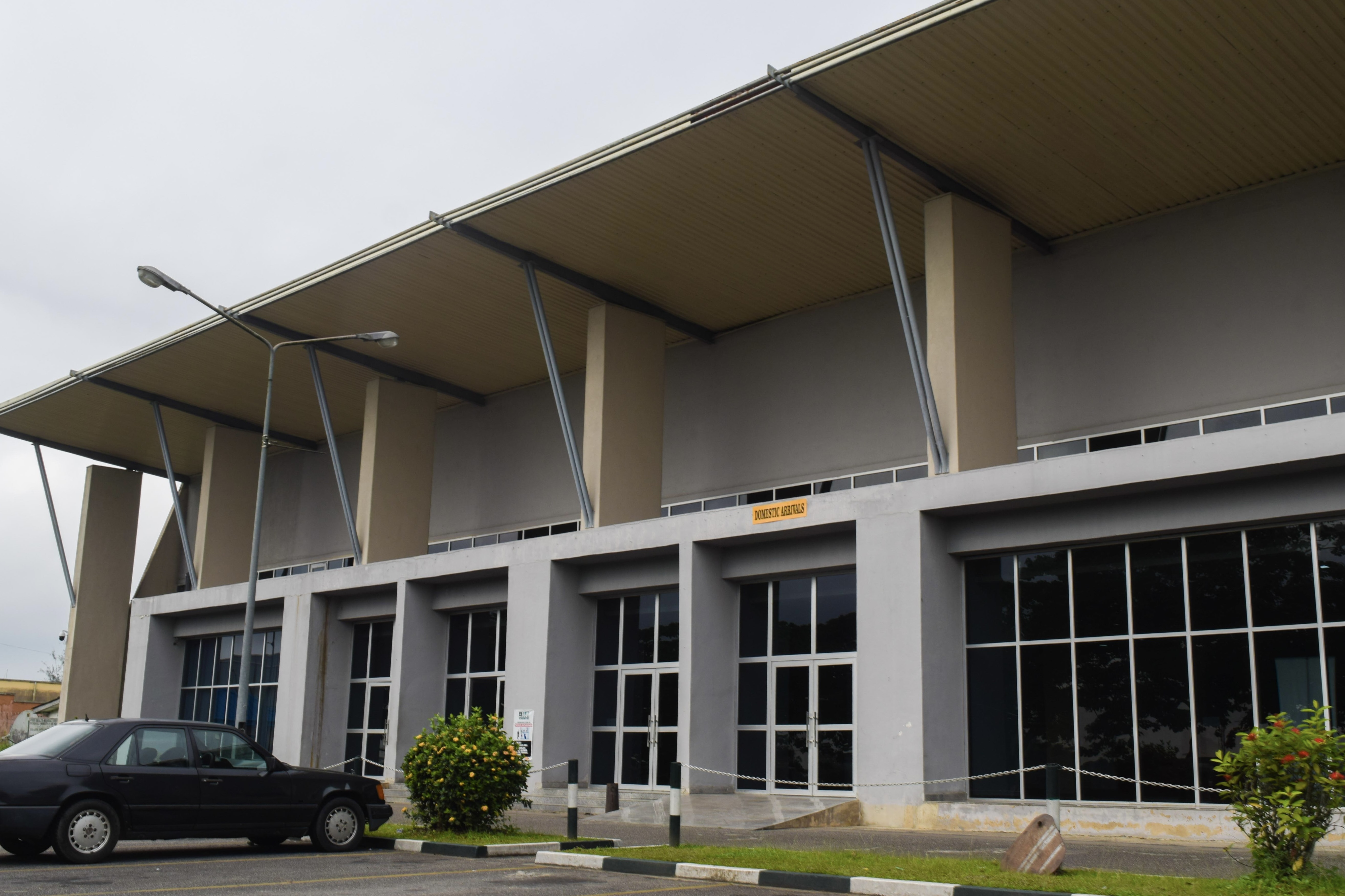
Located at approximately 4.95N, 8.33E, Calabar sits on a natural hill at the confluence of the Calabar River and the Great Kwa River, visible from altitude as a significant waterway junction near the southeastern Nigerian coast. Margaret Ekpo International Airport (DNCA) serves the city, with connections to Lagos (approximately one hour by air) and Port Harcourt (about 25 minutes). The city is roughly 470 km from Douala, Cameroon. Calabar has a tropical monsoon climate with heavy rainfall (over 3,000 mm annually) and consistent temperatures between 25-28 degrees Celsius. Visibility can be limited during the nine-month wet season.