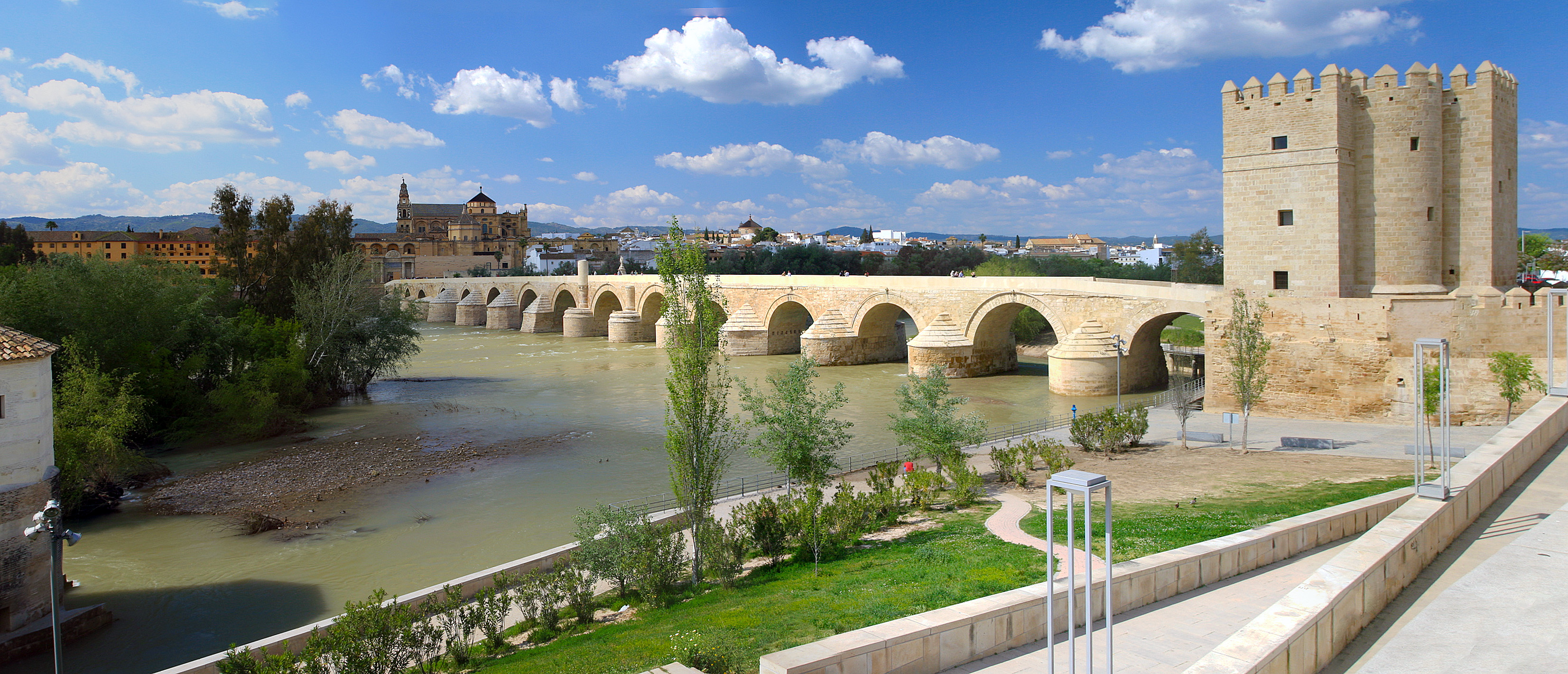
Calahorra Tower
Stand on the Roman Bridge of Cordoba and look south, and the Calahorra Tower blocks your path like a clenched fist. This fortified gate, built by the Marinids to defend the bridge's far bank, has been stopping people in their tracks since the 14th century -- first as a military checkpoint, then as a monument, and now as something harder to categorize: a stone guardian that has outlasted every power that built, besieged, or restored it. Its name derives from the Arabic qal'at al-hurra, meaning "free fortress," and there is something stubbornly independent about the way it holds its ground on the left bank of the Guadalquivir.
A Gate Between Worlds
The tower was first erected in 1333 under Abu'l-Hasan of the Marinid dynasty, positioned to protect the Roman Bridge -- the only crossing of the Guadalquivir at Cordoba for nearly two thousand years. The original structure consisted of an arched gate flanked by two towers, a design elegant in its simplicity: anyone crossing the bridge had to pass through the Calahorra's shadow. A third tower was later added, connecting the original pair with a distinctive cylindrical form that gave the fortification its recognizable silhouette. The tower's placement was strategic. Cordoba's wealth and significance as a center of Islamic culture made the bridge crossing a point of enormous military importance, and the Calahorra ensured that no army could simply walk across the river unchallenged.
Centuries of Reinvention
Like so much of Cordoba, the Calahorra Tower survived by adapting. When the city passed from Islamic to Christian control, the tower remained standing -- too useful as a defensive position to demolish, too solid to ignore. It was declared a national historical monument in 1931, recognition that the building's value had shifted from military utility to cultural memory. The tower today houses a museum dedicated to the convivencia -- the period of coexistence between Muslim, Christian, and Jewish communities in medieval Cordoba. It is a fitting use for a structure that has belonged to multiple civilizations and carries the architectural fingerprints of each.
Recognition and Renewal
In 2014, the restoration of the Calahorra Tower, together with the Roman Bridge, the Gate of the Bridge, and the surrounding area, was awarded the European Union Prize for Cultural Heritage, known as the Europa Nostra Award. The recognition honored not just the physical conservation work but the broader effort to preserve the relationship between these structures -- the way the tower, bridge, and gate function together as a single composition spanning the river. Walking across the bridge today, from the Mosque-Cathedral on the north bank toward the tower on the south, you traverse the same path that Roman legionaries, Umayyad governors, and Christian kings once traveled. The Calahorra waits at the end, as it has for nearly seven hundred years, its stone walls still warm from the Andalusian sun.
From the Air
Located at 37.876N, 4.777W on the south bank of the Guadalquivir River in Cordoba. The tower is visible as a compact fortification at the southern end of the Roman Bridge, with the Mosque-Cathedral complex across the river to the north. Nearest airport is Cordoba (LEBA), though Seville San Pablo (LEZL) is the nearest major international airport, about 140 km southwest. Best viewed at low altitude, when the bridge-tower-cathedral alignment along the river becomes clear.