Calanques National Park
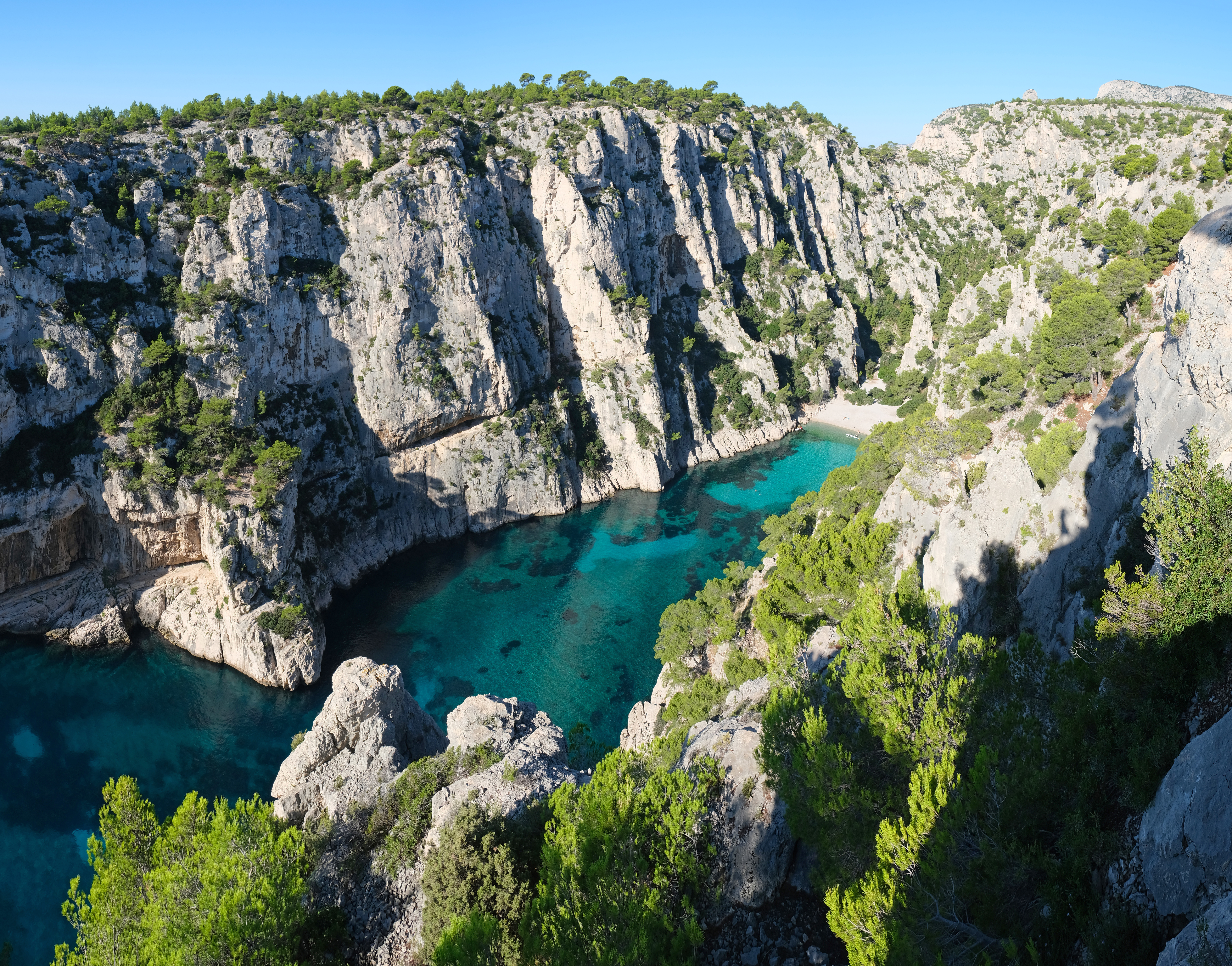
The white limestone cliffs drop straight into water so blue it looks synthetic. Between Marseille and Cassis, the Calanques slash into the coastline like fjords transplanted to the Mediterranean -- narrow, steep-walled inlets carved by ancient rivers and now flooded by the sea. Calanques National Park, established on April 18, 2012, is France's most unusual protected area: 8,500 hectares of land and 43,500 hectares of sea, the only national park in the country that encompasses suburbs, open water, and wild coast in a single boundary. Two million visitors come each year, drawn by the strange beauty of a landscape where a major city gives way to wilderness within walking distance.
Where the City Ends and Geology Begins
The Calanques massif is a world of contrasts. Hikers leave the 8th arrondissement of Marseille on Avenue de Hambourg, and within two hours of walking find themselves on trails suspended between sea and tortured rock with no water points and almost no shade. The paths are steep, some vertiginous, and the wind on the ridges can unbalance an inexperienced walker. From June through September, fire risk closes the roads and sometimes the trails entirely, leaving only the sea route -- and dozens of boats depart daily from Marseille and Cassis, ferrying sightseers and swimmers into the bays. The inhabited creeks of Callellongue, Sormiou, and Morgiou are accessible by road, offering a gentler entry into a landscape that does not forgive carelessness.
Treasures Beneath the Surface
The underwater world of the Calanques holds layers of history that the dry land cannot match. At the foot of the islet of Grand-Conglue, two Roman shipwrecks were excavated during one of Commander Cousteau's first major campaigns aboard the Calypso. Near Jarre Island, divers found the wreck of the ship that brought the plague to Marseille in 1720. Half a mile east of the island of Riou, a team from the Marseille-based company Comex recovered in 2003 the wreckage of a Lockheed P-38 Lightning -- the aircraft flown by Antoine de Saint-Exupery, the writer-aviator who vanished on July 31, 1944, during a reconnaissance mission preparing for the Allied landings in Provence. An identification bracelet confirmed the find.
The Cave That Sank
The park's most extraordinary secret lies beneath Morgiou point. The Cosquer Cave -- named for Henri Cosquer, the professional diver who discovered its submerged entrance in 1985 -- contains prehistoric paintings and engravings dating from 27,000 to 19,000 years ago. Its entrance sits 37 meters below current sea level, a consequence of Holocene sea rise: during the last glaciation, the cave mouth stood nearly 100 meters above a Mediterranean shoreline that lay several kilometers to the south. Three divers from Grenoble died in the access gallery in 1991, and the entrance is now prohibited. But the cave's nearly 500 surviving artworks -- hand stencils in red and black, horses, ibex, bison, seals, and great auks -- rank among the most significant examples of Paleolithic art in Europe. A full-scale replica opened in Marseille so that visitors can experience the cave without risking the dive.
Fire, Wind, and 140 Species
Despite appearances, the Calanques are not barren. The park shelters 140 protected species across habitats that range from the garigue scrubland on the ridges to the Posidonia seagrass meadows offshore. Bonelli's eagles hunt the thermals. The Mediterranean climate pushes summer temperatures above 30 degrees Celsius, and hikers are warned to carry at least one liter of water per hour. The real danger is fire: the combination of dry scrub, fierce wind, and summer heat creates conditions that can turn a careless match into a catastrophe. The regulated access regime, which changes daily based on fire risk, frustrates some visitors but protects the fragile balance that allows this wild coast to survive in the shadow of France's second-largest city.
From the Air
Located at 43.209N, 5.449E along the Mediterranean coast between Marseille and Cassis. The white limestone calanques are strikingly visible from the air against the blue sea. Marseille-Provence Airport (LFML) lies 25 km northwest. Approach from the south over open water for the best view of the cliff inlets. Best at 2,000-4,000 ft AGL.