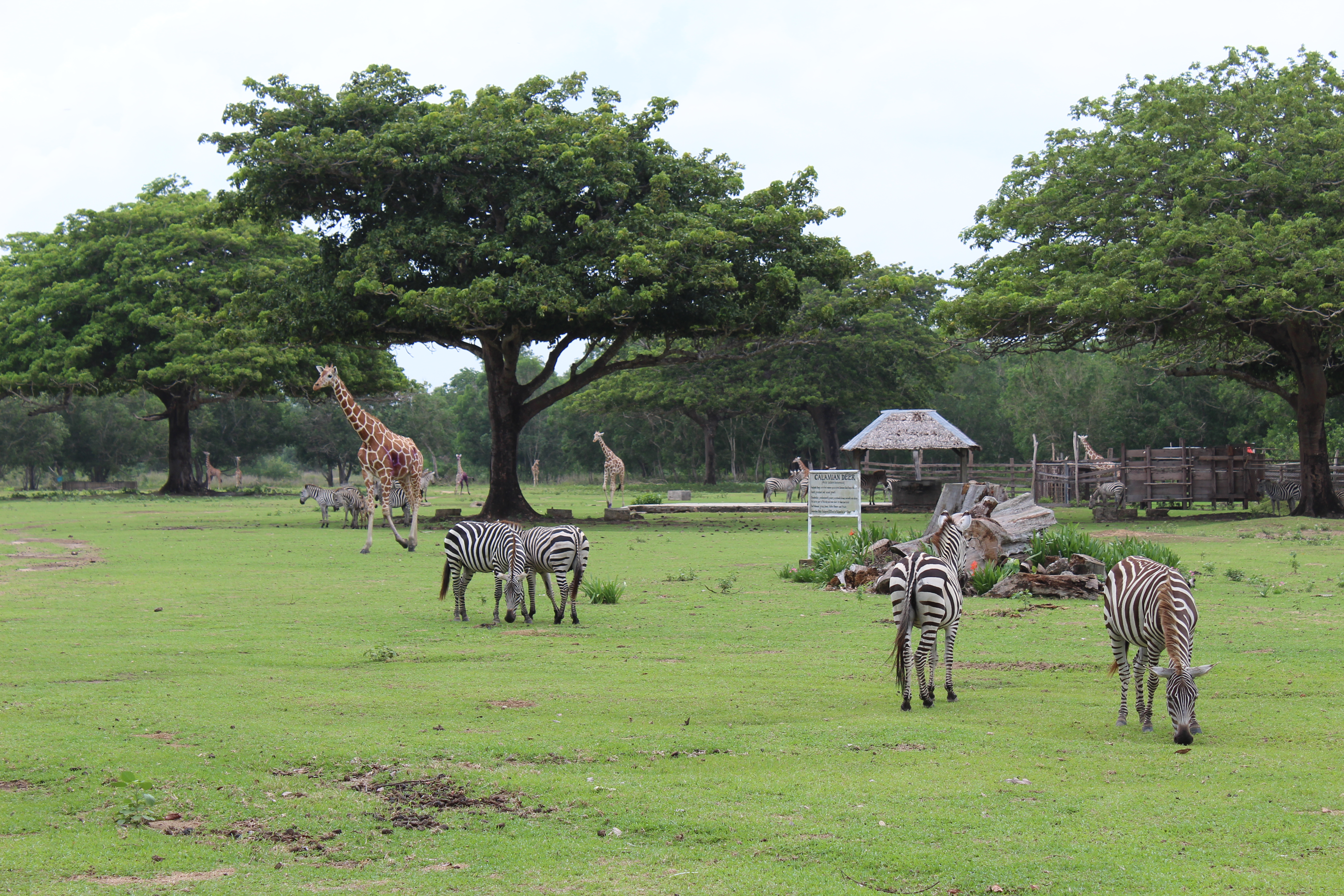
Calauit Safari Park
In May 1976, at a United Nations trade conference in Nairobi, Philippine President Ferdinand Marcos handed an Englishman named Tony Parkinson a briefcase full of money. The assignment: collect large African mammals and ship them to a remote island in the Philippines. Within a year, fifteen reticulated giraffes, fifteen Grevy's zebras, and dozens of antelope species were sailing across the Indian Ocean aboard the M/V Salvador, bound for Calauit Island -- a 3,700-hectare sliver of land in the Calamian Archipelago off Palawan. The park that resulted is one of the strangest wildlife stories in Southeast Asia, a place where the cruelty of authoritarian power and the resilience of both animals and people produced something no one planned.
The People Who Were Moved
Before the giraffes arrived, Calauit Island was home to an estimated 254 families, most of them members of the Tagbanwa, an indigenous people who had lived in the Calamian Islands for centuries. Under Marcos's martial law regime, these families were evicted and relocated to Halsey Island, a former leper colony 40 kilometers away. The island was stony, unsuitable for farming, and offered none of the resources the Tagbanwa had depended on. A United Nations report on indigenous rights later documented that the eviction was carried out under duress. The resettled families often went hungry but had no means to resist. It would take more than three decades for the Philippine government to formally acknowledge the wrong. In 2010, the National Commission on Indigenous Peoples turned over a property title for Calauit Island and 50,000 hectares of surrounding ancestral waters to the Tagbanwa community -- a legal recognition of what the Tagbanwa had never stopped asserting.
African Survivors on a Philippine Shore
The African animals arrived in 1977 and, against all expectations, many of them thrived. Without natural predators, the population grew to 201 within five years, with 143 animals born on Calauit itself. The giraffes and zebras adapted best, browsing the island's grasslands and scrub in conditions that bore at least a passing resemblance to the East African savanna. But other species struggled with the tropical climate, the unfamiliar vegetation, and the confined island geography. Impalas, topi, bushbuck, and Thomson's gazelles all died out by 1999. The waterbuck and common eland held on longer, their last sightings recorded in late 2016 before they too were presumed extinct on the island. As of 2024, 18 giraffes and 27 zebras remain -- descendants of the original Kenyan transplants, now threatened by inbreeding and the absence of a full-time veterinarian. The Grevy's zebra is itself one of the most endangered zebra species in the world, making Calauit's small herd an unexpected outpost for the species.
Bongbong's Safari and the Revolution
During the Marcos years, the park served as a private playground for the presidential family. It became colloquially known as "Bongbong's Safari Park" after the president's son, Ferdinand Marcos Jr., was known for flying to the island by helicopter to hunt native wild boar. When the Marcos family was deposed in the 1986 EDSA Revolution, the park became a symbol of the regime's extravagance -- a vanity project carved from stolen indigenous land, stocked with animals bought with public money, and maintained for the amusement of a ruling family. The post-Marcos years brought neglect and uncertainty. Squatters moved onto the island. Funding dried up. In 2008, President Gloria Macapagal Arroyo transferred administration of the sanctuary from the Palawan Council for Sustainable Development to the Provincial Government of Palawan and renamed it Calauit Safari Park. Slowly, it found a new identity as an eco-tourism destination.
The Native Species That Quietly Flourished
The park's most significant conservation story has nothing to do with Africa. In the 1980s, local officials expanded the program to include endangered Philippine species, and the results have been remarkable. The Calamian deer, declared critically endangered in 1981 with only 25 individuals remaining, rebounded under the park's protection. By 2016, the population had reached between 1,200 and 1,300, and the IUCN upgraded its status from critically endangered to endangered. The park also shelters Palawan bearded pigs, Philippine porcupines, binturong, and Philippine mouse-deer -- the tiny, nocturnal pilandok endemic to islands southwest of Palawan. Most dramatically, the park houses Philippine crocodiles, a critically endangered freshwater species. Starting with five crocodiles in 2005, one female laid eggs in late 2015 that hatched the following year. The hatchlings are nursed in a separated pond at the conservation center, a fragile but genuine step toward recovering one of the world's rarest reptiles.
An Unlikely Ark
Calauit Safari Park defies simple judgment. It was born from a dictator's impulse, built on the displacement of an indigenous people, and stocked with animals ripped from their native continent. Six of the original eight African species are gone. Yet the park endures, and the conservation work it now supports -- particularly for the Calamian deer and Philippine crocodile -- is real and measurable. The Tagbanwa have regained legal title to their ancestral land. The giraffes that remain are an oddity, browsing tropical vegetation under a Philippine sun, but they are also a living reminder of how power shapes landscapes in ways no one can fully predict. Poaching remains a threat: in 2016, authorities arrested two people inside the park with shotguns, dynamite, and the skins and bones of endangered Calamian deer. The tension between local needs and conservation goals persists. Calauit is neither a triumph nor a tragedy but something more complicated -- a place where history left a strange deposit, and people are still figuring out what to do with it.
From the Air
Calauit Island is located at 12.31N, 119.87E in the Calamian Archipelago, off the northwest coast of Palawan. From altitude, it appears as a moderately sized island with grassland and forest cover, distinguishable from neighboring islands by its relatively flat terrain. Francisco B. Reyes Airport (RPSD) in Busuanga is the nearest airfield. The island is accessible by boat from Coron. Best viewed at 3,000-8,000 feet to appreciate the island's shape within the Calamian chain. The South China Sea lies to the west.