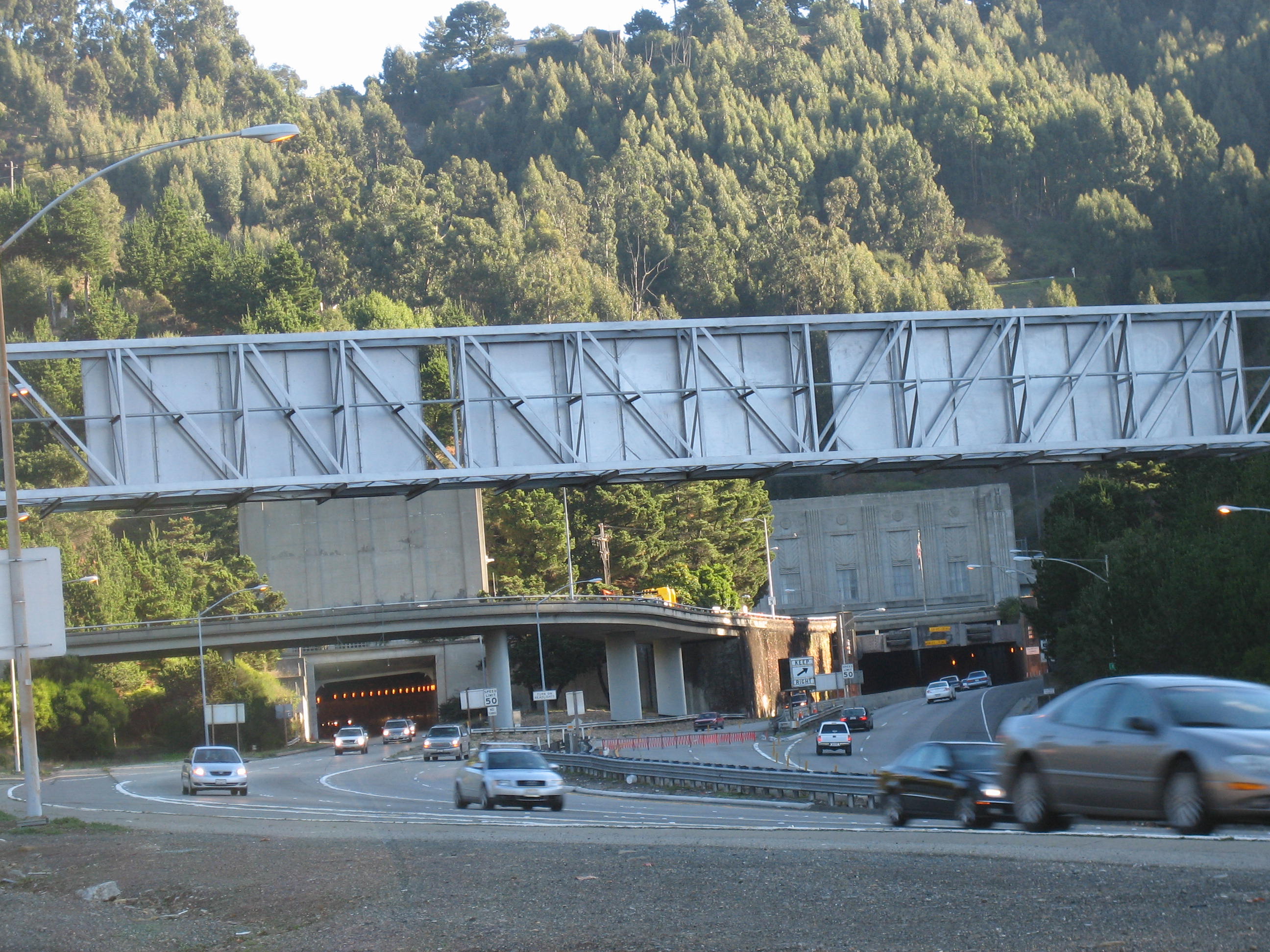
Caldecott Tunnel
In 1871, a man named L.W. Kennedy struck water 200 feet into the Berkeley Hills and watched his dream of a tunnel wash away in bankruptcy. That first failed bore sits somewhere above today's Caldecott Tunnel, a monument to ambition undone by geology. The hills themselves seem to resist passage: the active Hayward Fault runs just west of the tunnel's western portals, a reminder that the earth here is still restless. Yet four times since Kennedy's failure, engineers have punched through this stubborn ridge, each bore a response to California's insatiable appetite for connection.
The Newspaperman's Traffic Light
Before the automobile age, travelers crossed the Berkeley Hills on Fish Ranch Road, named for the Oakland Trout Company's frog farm in the vicinity. The Summit House inn marked the top, where stagecoaches rested before the descent. In 1903, a new Inter-County Tunnel opened with a traffic control system straight from the frontier: attendants lit small fires with newspaper to signal when vehicles could enter the one-way passage. The method worked until the automobile proved too numerous to manage with smoke signals. When the tunnel's ceiling was raised three feet in 1915 to accommodate larger vehicles, it was already clear that something grander was needed.
The Broadway Low Level
The Great Depression was an unlikely time to build California's most ambitious tunnel. Yet on June 17, 1934, crews broke ground on twin bores that would cost over $4 million and require filling part of Lake Temescal for the approach road. When the Broadway Low Level Tunnel opened on December 5, 1937, it transformed Contra Costa County from agricultural backwater to suburban frontier. The name changed to Caldecott in 1960, honoring Thomas E. Caldecott, the Berkeley mayor who had championed the project through Joint Highway District 13. But by then, 50,000 vehicles daily were straining the original two bores.
The Pop-Up Ballet
The third bore, opened in 1964, brought a technological marvel: plastic lane delineators set in pavement tubes that could be raised or lowered with water pressure. Every weekday, Caltrans workers reversed the middle bore's traffic direction twice, sometimes six times on weekends for Oakland A's games or concerts. The choreography required workers to clear drivers from closing lanes before the delineators popped up. It was elegant infrastructure theater that lasted nearly fifty years.
Fire in the Chimney
Shortly after midnight on April 7, 1982, a gasoline tanker truck crashed in the third bore. The tunnel became a natural chimney, venting flames and toxic smoke toward the eastern entrance. Seven people died, most overcome by smoke. Had it happened during rush hour, the death toll might have been hundreds. Today, tanker trucks carrying hazardous materials may only transit between 3:00 and 5:00 AM. Nine years later, the 1991 Oakland firestorm ignited on the ridge just north of the tunnel, eventually killing 25 people and destroying over 3,000 homes.
The Fourth Bore
The 2008 financial crisis stalled planning for a fourth bore, but federal stimulus money revived the project. When it opened in 2013, the daily pop-up reversal became obsolete: four permanent lanes now flow in each direction. The excavated rock found new purpose as fill for Treasure Island's redevelopment. The tunnel earned recognition as an Oakland Landmark and a Preservation Award from the Art Deco Society of California. Rick Riordan immortalized it differently: in his novels, the Caldecott serves as an entrance to Camp Jupiter, where demigods battle Roman emperors in its depths.
From the Air
The Caldecott Tunnel (37.8548N, -122.2166W) is visible as a gap in the Berkeley Hills ridgeline on the boundary between Oakland and Orinda. From 3,000-4,000 feet AGL, look for the four bore portals and State Route 24's path through the hills. Oakland Metro (KOAK) lies 6nm southwest. The western portal often sits in San Francisco Bay fog while the eastern portal basks in inland sunshine, a weather phenomenon that makes the tunnel a literal transition between climates.