Caldecott Tunnel Fire
The tape recording goes blank. Five minutes after a drunk driver struck the tunnel wall, June Rutledge stood at an emergency telephone inside the Caldecott Tunnel, calling for help while burning gasoline flowed through the drainage gutters behind her. A fireball erupted, and the line went silent. Seven people died in the early hours of April 7, 1982, in one of the few major tunnel fires involving a highly flammable cargo. The disaster would teach engineers a brutal lesson about how tunnels breathe, and how that breath can kill.
A Cascade of Collisions
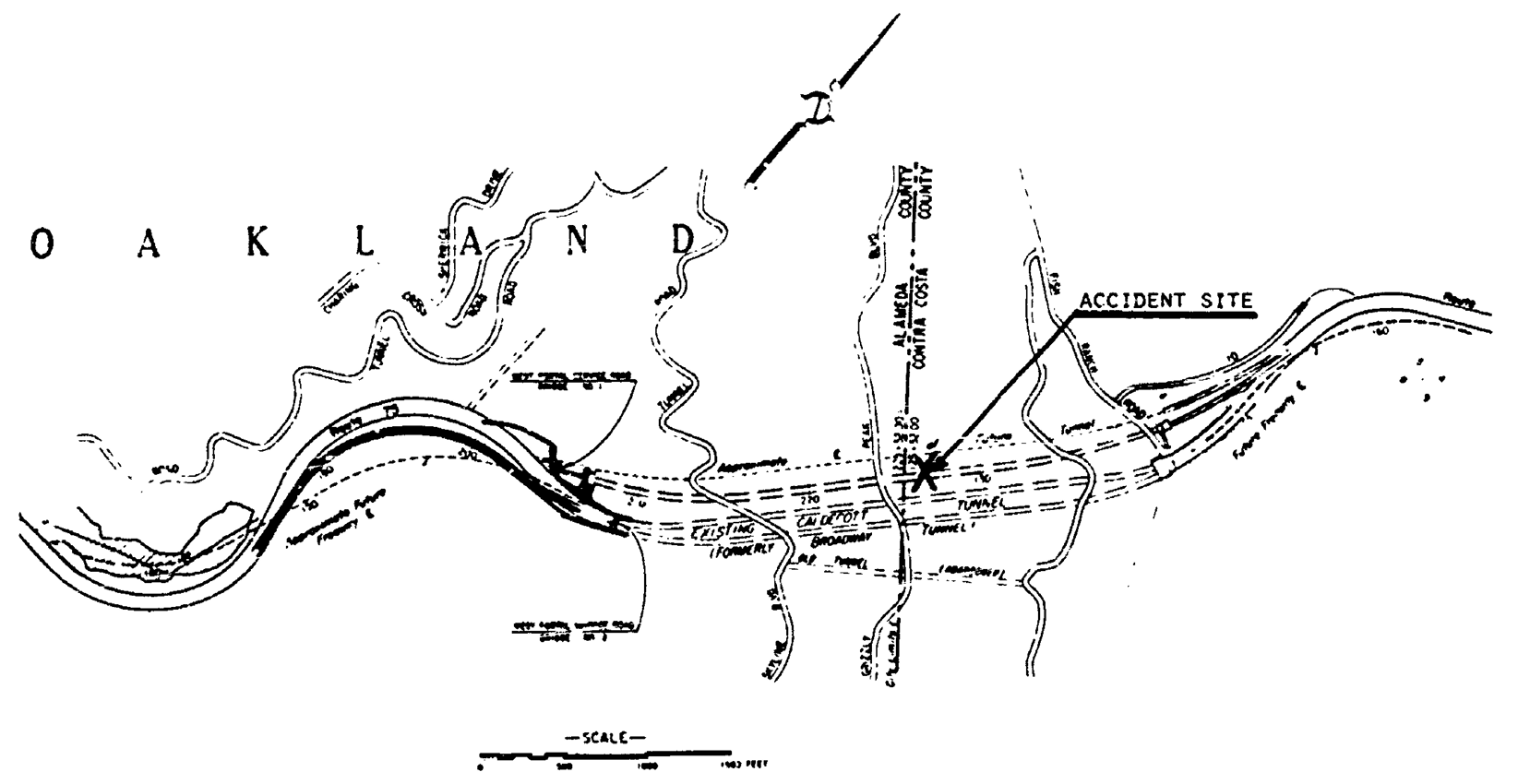
Shortly after midnight, a westbound driver drifted out of her lane and struck the tunnel wall almost halfway through the third bore. She got out to inspect the damage. Behind her, traffic stacked up. A double tanker carrying gasoline arrived at the bottleneck, followed by an empty bus. The tanker struck the stalled car, then braked to a halt. The bus hit the pileup. Its driver was thrown clear and killed instantly. The driverless bus continued through the tunnel and crashed into a bridge column outside the exit portal. The tanker driver found his rig immobile, gasoline leaking from the trailer, small fires igniting around the leaks. He ran downhill and escaped. Behind him, the burning fuel began to flow.
The Chimney That Killed
The Caldecott Tunnel slopes 4.7 percent downhill from Orinda to Oakland. That gradient, combined with natural draft, turned the bore into a chimney. Smoke and heat rushed uphill toward the eastern entrance, toward the vehicles still entering the tunnel. The ventilation system remained off. Approximately twenty vehicles entered during the next minutes. Most drivers reversed out when they saw smoke approaching. But four vehicles became trapped behind the burning tanker: a private car, a beer truck, and two pickups. The occupants of the closest pickup began reversing, then abandoned their vehicle to warn others. The elderly couple in the private car never left their seats. The two men in the beer truck collapsed and died as they stepped from the cab.
Systems That Failed
The Caldecott complex had a permanently staffed control room. Operators felt the vibrations from the initial crash and watched on closed-circuit television as the bus emerged and struck the column. Crews from Oakland and Orinda fire departments responded. But when firefighters tried to divert burning gasoline to a hazardous materials sump, they found the valves corroded and non-functional. The fuel went into a nearby lake instead. When firefighting finally began inside the tunnel at 1:30 in the morning, the fire had damaged the water main. Pressure was insufficient. Unable to fight the blaze effectively, crews let it burn out, extinguishing remnants with foam and dry powder. The fire lasted between twenty-eight and forty minutes.
Lessons Seared in Concrete
Temperatures at the tanker exceeded 1,800 degrees Fahrenheit, hot enough to melt brass vehicle components. Tiles and grout spalled from the walls all the way to the entrance portal. Over the first 1,000 feet east of the fire, concrete spalled to the steel reinforcement bars. The tunnel's wall tiles, water pipes, lighting, communications, and emergency panels required complete replacement throughout the eastern section. Repairs lasted months and cost over three million dollars. Unknown to those fleeing east, safe passages existed between the tunnel bores at regular intervals. Unlocked doors might have saved lives, but none of the trapped occupants found them. The disaster prompted investigations into tunnel ventilation, drainage systems, and escape route signage that would influence infrastructure design for decades to come.
From the Air
Located at 37.86N, 122.21W in the Oakland Hills where State Route 24 passes between Oakland and Orinda. The three tunnel bores (now four, with a fourth added in 2013) are visible as dark openings in the hillside. Best viewed at 2,500-4,000 feet AGL when transiting the East Bay hills. Oakland International (KOAK) lies 10nm south. Buchanan Field (KCCR) is 8nm north. The tunnel complex sits below the ridge line; the eastern and western portals are the primary visual landmarks.