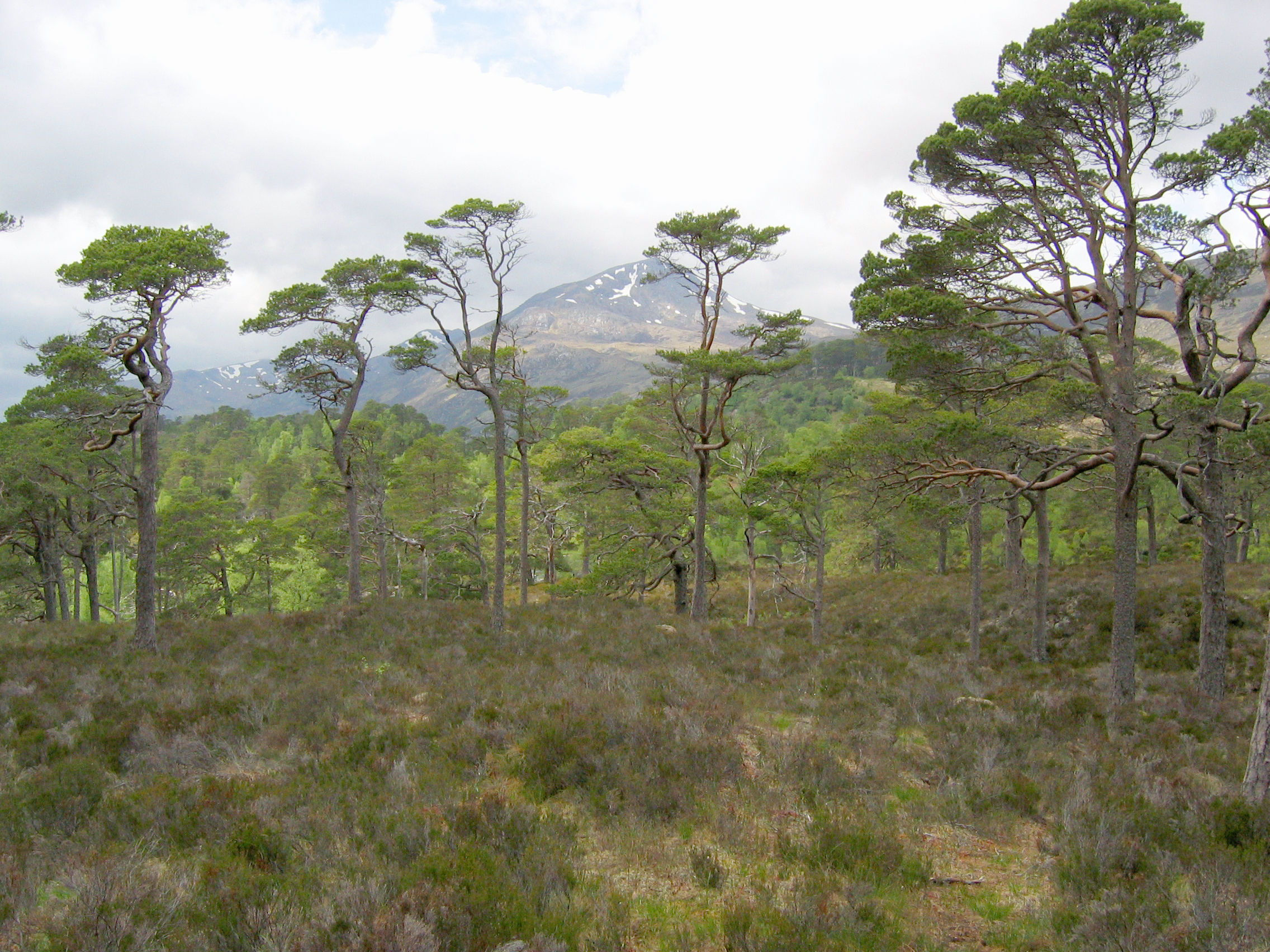
Caledonian Forest
Pliny the Elder named it silva Caledonia -- the wood of Caledonia. Two thousand years later, only fragments remain. The ancient Caledonian Forest, which once spread across an estimated 15,000 square kilometres of the Scottish Highlands, has been reduced to roughly 180 square kilometres in thirty-five scattered remnants. These fragments are not just old trees. They are the living descendants of the first Scots pines to colonize Scotland after the last ice age, part of an unbroken chain of natural regeneration stretching back approximately nine thousand years. Every pine in these remnants carries genetic material shaped by millennia of adaptation to Highland conditions -- a biological inheritance that cannot be replicated by planting.
A Forest Written in Legend
The Caledonian Forest occupies a place in the cultural imagination of Scotland and Britain that far exceeds its physical extent. Roman writers described it as a vast, impenetrable wilderness that sheltered the Pictish tribes who resisted imperial expansion. Arthurian legend placed the wizard Myrddin Wyllt -- the figure who became Merlin -- in its depths, driven mad after the Battle of Arfderydd in 573 and wandering among the trees as a wild man. The historical reality of the forest's decline is less romantic but equally dramatic. Centuries of clearing for agriculture, burning to deny cover to wolves and outlaws, grazing pressure from sheep and deer, and commercial timber extraction gradually consumed the wildwood. By the twentieth century, what remained was scattered in isolated pockets across the Highlands -- from Glen Affric to the Black Wood of Rannoch, from Rothiemurchus to the remoter glens of Wester Ross.
The Ecosystem That Survived
The Caledonian Forest remnants support an ecosystem found nowhere else in Britain. The Scottish crossbill, the only bird species endemic to the United Kingdom, depends on these native pinewoods for its survival, using its distinctive crossed bill to extract seeds from Scots pine cones. The capercaillie, the largest grouse in the world, nests in the forest undergrowth. Pine martens hunt through the canopy. Scottish wildcats -- among the most endangered mammals in Europe -- shelter in the forest margins. The forest floor is a complex community of blaeberry, juniper, wood anemone, and specialist fungi. Many of these species exist in a web of ecological relationships that evolved over millennia and cannot function outside the specific conditions of native pinewood. A plantation of Scots pine, however genetically similar, lacks the structural complexity -- the standing deadwood, the age diversity, the ground flora -- that makes these remnants irreplaceable.
Restoration Against the Clock
The conservation charity Trees for Life has pursued the restoration of the Caledonian Forest since the 1990s, planting native trees and working to reconnect isolated remnants. Their work at Glen Affric, Dundreggan, and other sites aims to create corridors between surviving fragments, allowing wildlife to move between populations that have been genetically isolated for centuries. But restoration faces formidable obstacles. Red deer, whose numbers have increased dramatically since the extirpation of their natural predators, browse young trees before they can establish. Sheep grazing prevents natural regeneration on many sites. Climate change is altering growing conditions in ways that may favor some native species while threatening others. The thirty-five remnants that survive represent less than two percent of the forest's estimated original extent. Whether they can serve as the seed stock for a larger recovery, or whether they will continue to shrink toward extinction, remains an open question -- one being answered tree by tree, glen by glen, across the Highlands.
From the Air
The Caledonian Forest remnants are scattered across the Scottish Highlands, with the article centered at approximately 57.12°N, 4.71°W near Glen Affric. From the air, remnants are identifiable as patches of native Scots pine -- darker and more irregular than commercial plantations. Major remnant locations include Glen Affric, Rothiemurchus, Abernethy, and the Black Wood of Rannoch. Nearest airport: Inverness (EGPE) approximately 20 nm to the northeast.