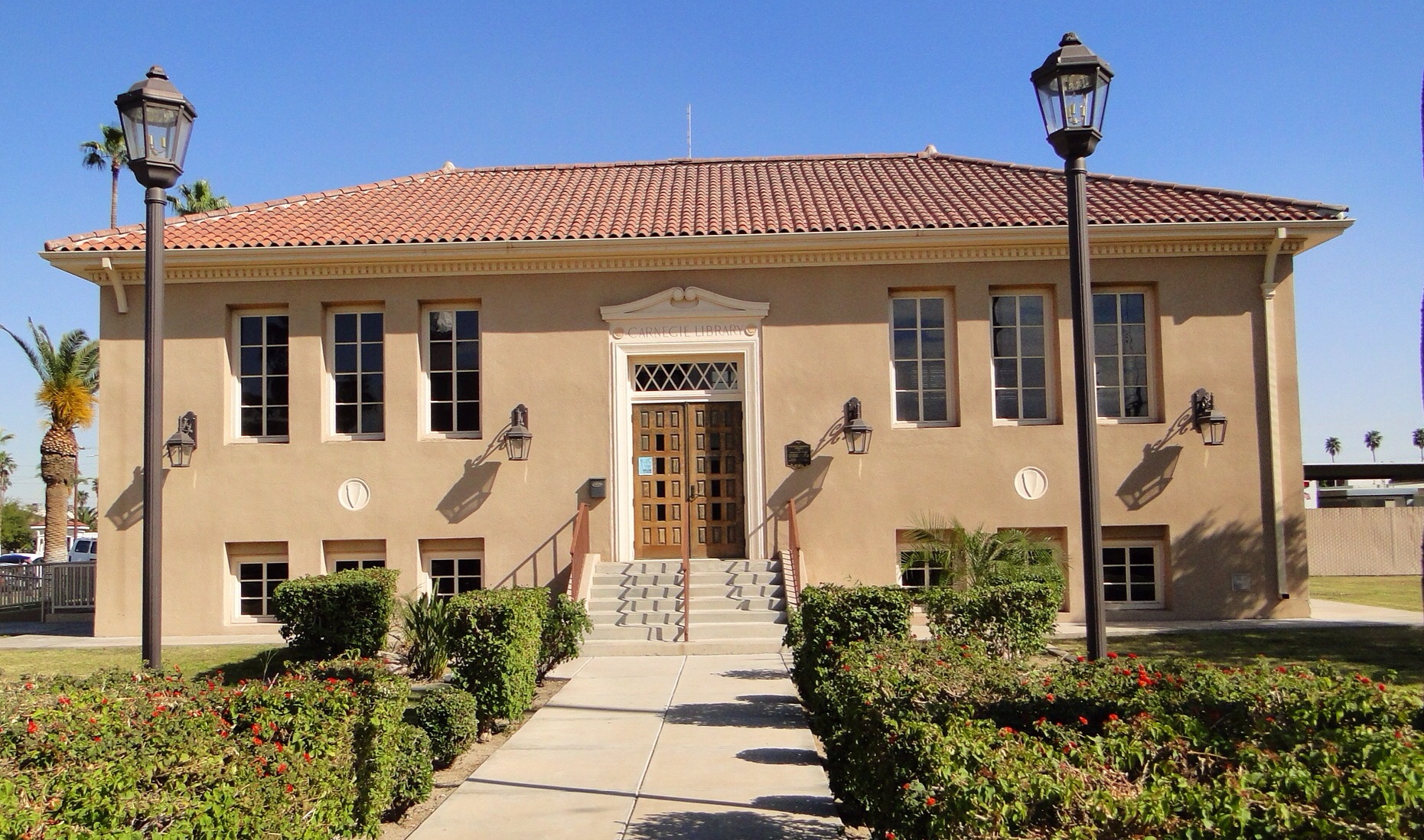
Calexico Carnegie Library
Andrew Carnegie's library philanthropy came with a negotiation. Cities applied for grants, Carnegie's foundation evaluated the requests and often reduced them, and the resulting building reflected both local ambition and the foundation's assessment of what was actually needed. Calexico wanted $25,000 in 1917. The Carnegie Corporation offered $10,000. The city took what was offered, hired the Los Angeles architectural firm Allison and Allison, and built a Spanish Colonial Revival library that opened in 1918 on a corner that would eventually become part of the National Register of Historic Places.
Carnegie's Reduced Offer
Andrew Carnegie's program of public library philanthropy, administered after his retirement by the Carnegie Corporation of New York, funded more than 2,500 libraries across the English-speaking world between 1883 and 1929. The formula was consistent: Carnegie would provide funds for the building if the local government committed to funding operations with a percentage of its tax revenue. Communities negotiated the grant amounts, and Carnegie's representatives regularly reduced requests they deemed excessive. Calexico's experience — requesting $25,000, receiving $10,000 — was not unusual. The resulting building was smaller than city leaders had imagined, but it was real, which is what mattered.
Allison and Allison's Spanish Revival
The Los Angeles firm Allison and Allison brought considerable California credentials to the Calexico commission. The brothers William and David Allison designed in the Spanish Colonial Revival style that was increasingly fashionable in Southern California during the 1910s and 1920s — a style that drew on the region's Spanish and Mexican heritage to produce a distinctive architectural vocabulary of red tile roofs, arched openings, stucco exteriors, and decorative ironwork. For Calexico, situated at the US-Mexico border with Mexicali directly across the line, the Spanish Colonial style carried particular resonance: it connected the American border town to the architectural traditions of the broader region.
Sixty-Eight Years as a Library
The Calexico Carnegie Library served its original function from 1918 until 1986 — sixty-eight years of books circulated, research conducted, and the particular quiet of library life maintained in a border city where Spanish and English always competed and coexisted. The building at the 400 block of East 5th Street anchored civic life in a community that was small but determinedly self-organizing. When the library outgrew the 1918 building and moved to larger quarters in 1986, the Carnegie library was left without its primary purpose, used for storage while the question of what to do with a beloved but functionally obsolete historic building remained unresolved.
The Long Restoration
The building sat in storage use for more than two decades before restoration began in 2007. The gap between obsolescence and restoration is long enough to accumulate both deterioration and sentiment, and historic preservation projects typically involve both. The 2005 listing on the National Register of Historic Places — September 28, 2005 — provided recognition that formalized what the community already knew: this building was worth keeping. The restoration that followed converted the original library into a public technology center, giving the Carnegie building a new function while preserving the architectural character that makes it worth preserving.
Border Landmark
Calexico sits directly on the US-Mexico border, with Mexicali immediately to the south. The city's character — bilingual, bicultural, shaped by the rhythms of border crossing and the particular economy of a border community — gives historic buildings like the Carnegie Library a specific context. This is not simply a Southern California town that happens to have a pretty old building; it is a border community with a distinct identity, and the library that Andrew Carnegie's reduced grant made possible is part of the physical record of how that community built its institutions in the early twentieth century. The Spanish Colonial Revival style was a choice that made sense here, on the border, in ways that it might not have anywhere else.
From the Air
The Calexico Carnegie Library stands at approximately 32.67°N, 115.49°W in Calexico, California, at the US-Mexico border directly across from Mexicali. Calexico International Airport (KCXL) is nearby. The historic building at the 400 block of East 5th Street is a modest structure within the urban grid of Calexico, visible from lower altitudes as part of the downtown historic district. The border crossing with Mexicali is immediately south.