Calico: The Ghost Town Walter Knott Saved
Walter Knott loved ghost towns. The founder of Knott's Berry Farm bought the abandoned silver mining camp of Calico in 1951, spending years restoring buildings, installing attractions, and creating an experience that presaged modern heritage tourism. Calico had boomed in the 1880s during a silver strike that extracted $86 million in ore; it died when silver prices collapsed in the 1890s. Knott saw potential in the ruins - a story to tell, an experience to sell. His restoration mixed genuine preservation with invented entertainment, creating a template that countless heritage sites would follow. He donated Calico to San Bernardino County in 1966. It remains California's official state silver rush ghost town.
The Boom
Prospectors discovered silver in the Calico Mountains in 1881. Within two years, the population reached 1,200. Over 500 mines operated in the district, producing $86 million in silver and $45 million in borax before the collapse. Calico was a real town - schools, churches, saloons, newspapers, the infrastructure of permanent settlement. The desert location was brutal, but the ore was worth the hardship. When silver prices crashed in 1896, following the end of the bimetallic monetary standard, Calico emptied. By 1907, the post office closed. The desert began reclaiming what miners had built.
The Rescue
Walter Knott found Calico in decline but not destroyed. Enough original structures remained to anchor restoration. He rebuilt collapsed buildings using period techniques, installed boardwalks and signage, and added attractions that blurred the line between history and entertainment. The Calico & Odessa Railroad, a narrow-gauge train, offered rides through the desert. Mystery Shack exploited optical illusions. A mine tour descended into actual workings. Knott's approach was entrepreneurial rather than academic - he wanted visitors to have fun while absorbing history. The result was theme park as preservation.
The Present
San Bernardino County has operated Calico since 1966, maintaining Knott's vision while adding modern amenities. The ghost town offers self-guided exploration, mine tours, train rides, and interpretive displays. Special events - Civil War reenactments, ghost tours, holiday celebrations - draw crowds beyond the baseline of heritage tourists. The mix of genuine artifact and deliberate entertainment continues: some buildings are original, some are reconstructed, some are pure invention. The experience doesn't distinguish clearly, and most visitors don't demand clarity. Calico delivers atmosphere; the details are secondary.
The Authenticity
How authentic is Calico? The question matters to historians more than tourists. Original structures include the Lane House, the schoolhouse, and portions of several commercial buildings. The reconstruction used period materials and techniques where possible. But the ghost town as tourist experience is fundamentally a 1950s creation - Knott's vision imposed on 1880s ruins. The result is neither pure preservation nor pure fiction, but something in between: a place where history provides framework and entertainment provides content. Calico is real enough to feel authentic, constructed enough to be comfortable.
Visiting Calico Ghost Town
Calico Ghost Town is located off Interstate 15 near Barstow, California, roughly 140 miles northeast of Los Angeles. Admission is charged; additional fees apply for attractions. The site includes restored and reconstructed buildings, mine tours, train rides, shops, and restaurants. Camping is available. Guided tours offer historical context. The ghost town is exposed to desert conditions - hot in summer, occasionally cold in winter. Allow 2-4 hours for full exploration. Barstow provides additional services. Route 66 attractions are nearby. The experience is family-friendly heritage entertainment, as Walter Knott intended.
From the Air
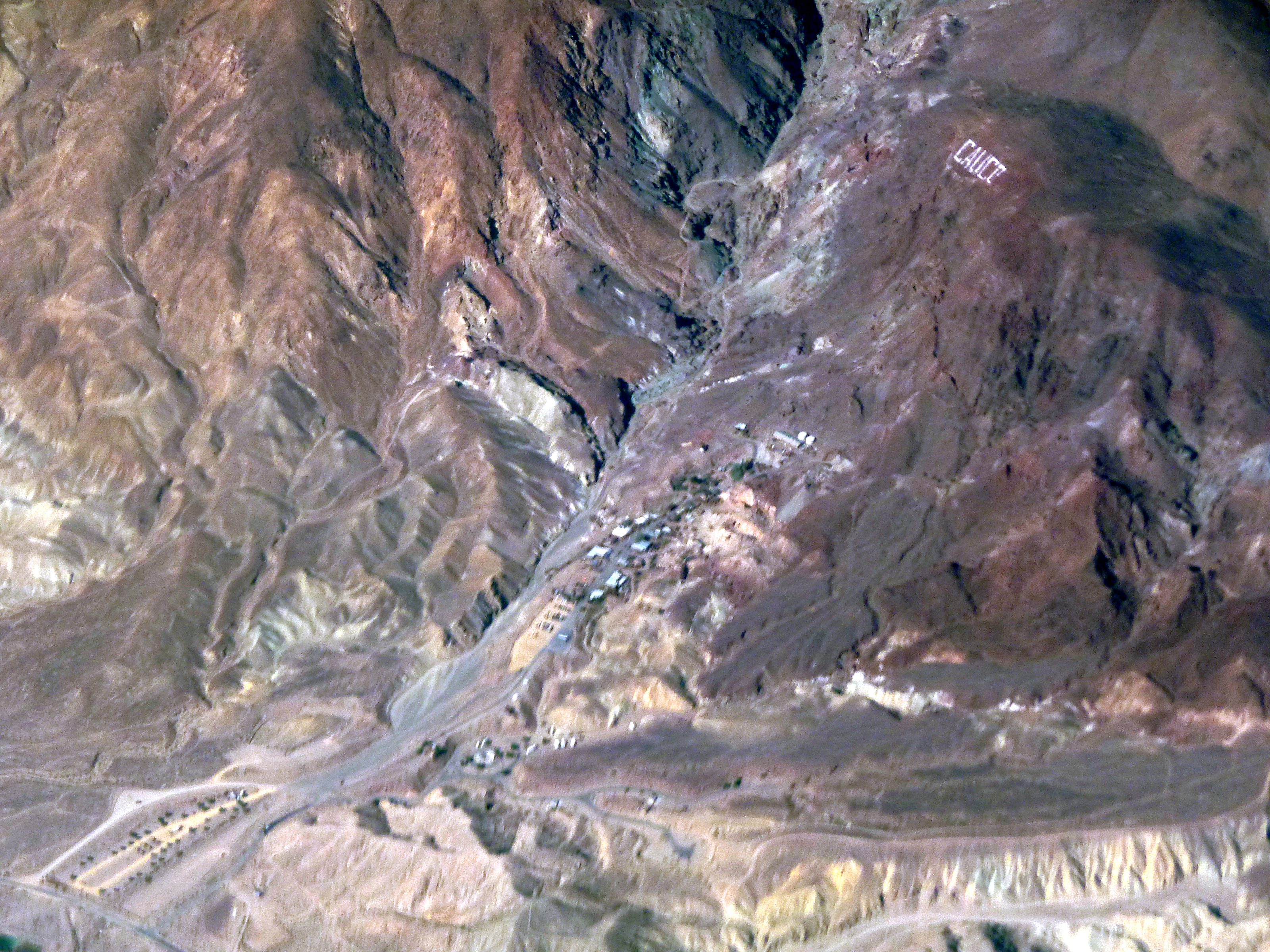
Located at 34.95°N, 116.87°W in the Calico Mountains north of Barstow, California. From altitude, Calico appears as a cluster of structures in barren desert mountains - the ghost town's restored buildings visible amid tailings piles and mine workings. Interstate 15 runs through the valley below. The Mojave Desert extends in all directions, brown and vacant. The Calico Mountains' stratigraphy shows the geology that made silver mining possible. The isolation that defined the town's boom era is visible as miles of empty terrain. What the altitude doesn't show is the boundary between original and reconstructed - from any distance, Calico looks like what it is: a place where something happened and something was made of it.