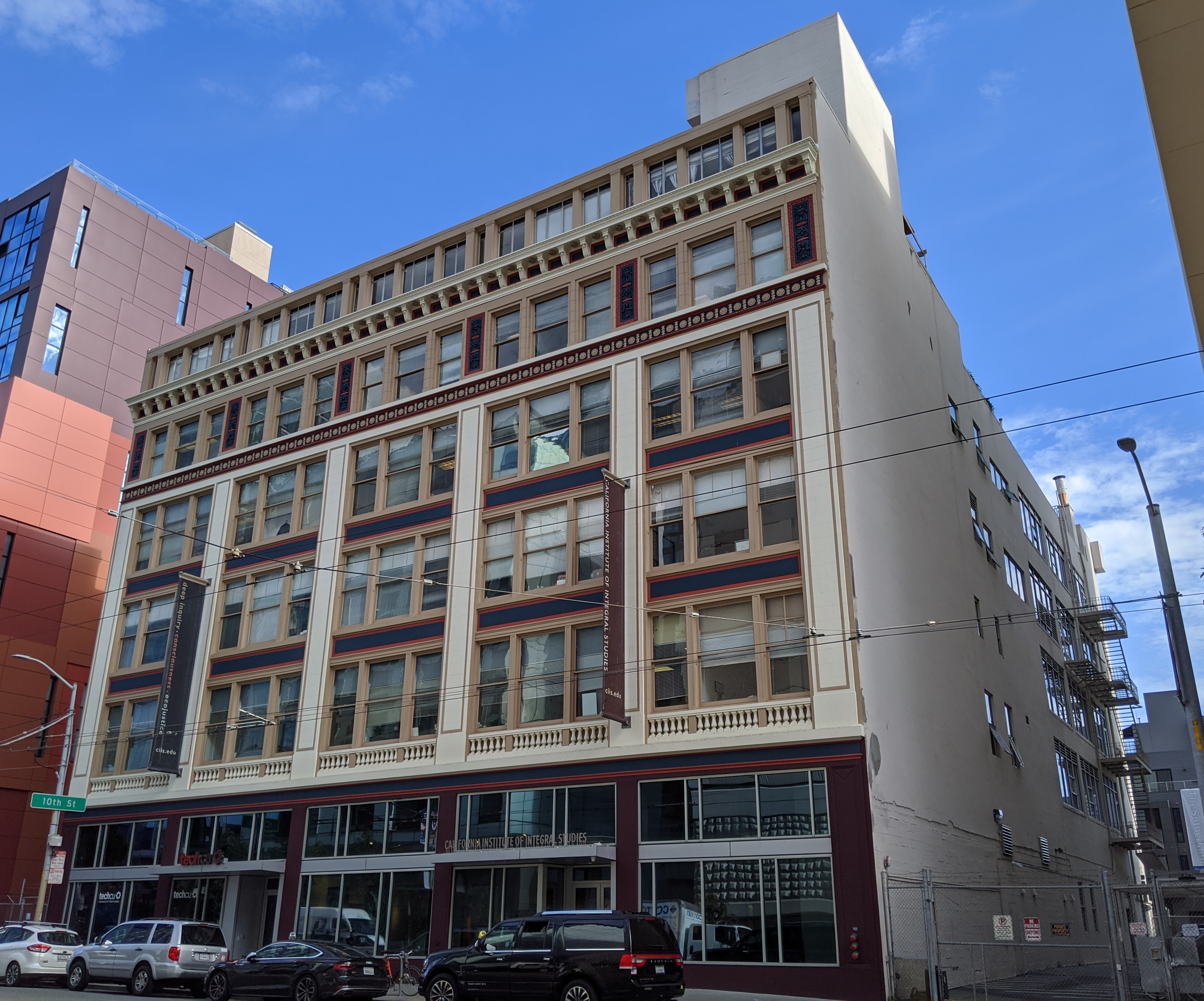
California Institute of Integral Studies
Jack Kerouac based characters in The Dharma Bums on people he met in this building. Gary Snyder studied here. The founders of Esalen -- Michael Murphy and Dick Price -- sat in these lecture halls before heading to Big Sur to launch the Human Potential Movement. And it all started because a Stanford professor who followed Sri Aurobindo invited an Indian philosophy scholar to San Francisco in the early 1950s, on the recommendation of Aurobindo himself. The California Institute of Integral Studies is a small graduate school in SoMa that has, improbably, served as an incubator for some of the most influential countercultural movements in American history.
The American Academy of Asian Studies
The story begins in 1951, when businessman Louis Gainsborough founded the American Academy of Asian Studies. Frederic Spiegelberg, a Stanford professor and Aurobindo devotee, served as director and recruited Haridas Chaudhuri, an Indian philosophy professor and disciple of Aurobindo, to join the faculty. Alan Watts arrived to teach Buddhist, Taoist, and Hindu philosophy, quickly establishing the Academy as a meeting place for the emerging San Francisco Renaissance. The student body was extraordinary: Murphy and Price would found Esalen, Eugene Rose would become the Orthodox hieromonk Seraphim Rose, and Gia-Fu Feng would go on to produce bestselling translations of the Tao Te Ching. Snyder, Feng, and Price lived at the school. Kerouac visited constantly.
Watts on a Shoestring
By 1952, the Academy was in financial trouble after Gainsborough suffered business losses. The school attached itself to the College of the Pacific for support and accreditation. Spiegelberg stepped down, leaving Watts to run the operation on a shoestring budget. He managed for four years before the college's conservative administration pushed him out in 1956. The Academy survived its crises and reinvented itself, eventually becoming the California Institute of Asian Studies in 1968. Chaudhuri's intellectual framework held: the integration of Indian philosophy with Western psychology, the pursuit of what he called integral counseling psychology. It was education as synthesis, East meeting West in a San Francisco classroom.
From Asian to Integral
In 1980, the Institute changed its name to the California Institute of Integral Studies, signaling a broader ambition. The word "Integral" came directly from Aurobindo's concept of Integral Yoga -- purnayoga -- interpreted as the integration of mind, body, and spirit. Regional accreditation followed in 1981. Programs expanded through the 1980s to include clinical psychology, counseling psychology, and East/West psychology, plus organizational development and what was called a "transformation certificate." The school acquired the Integral Counseling Center, a community-based service facility that became a training ground for clinical students. By the time CIIS moved to its current SoMa location in 1999, it had evolved from a countercultural salon into a regionally accredited graduate institution.
The Counterculture's Graduate School
CIIS today offers degrees ranging from Anthropology and Social Change to Transformative Leadership to Psychedelic Studies -- a curriculum that would have delighted Watts and Snyder. The direct line from the Academy's 1950s colloquia to Esalen to the Human Potential Movement to transpersonal psychology runs through this institution's history like a spine. In 2015, CIIS acquired the American College of Traditional Chinese Medicine, though it later closed the program following an external audit in 2021. The school remains small, occupying its SoMa campus on the border of the Civic Center and Mission districts. But its influence has always been disproportionate to its size -- a place where ideas incubated that would reshape American culture.
From the Air
Located at 37.7746°N, 122.4162°W in San Francisco's SoMa district, near the border of Civic Center and Mission neighborhoods. Best viewed at 2,000-3,000 feet AGL. Nearest airports: KSFO (11 nm south), KOAK (10 nm east). The campus is in the dense urban grid south of Market Street, near the intersection of Mission and 7th Streets.