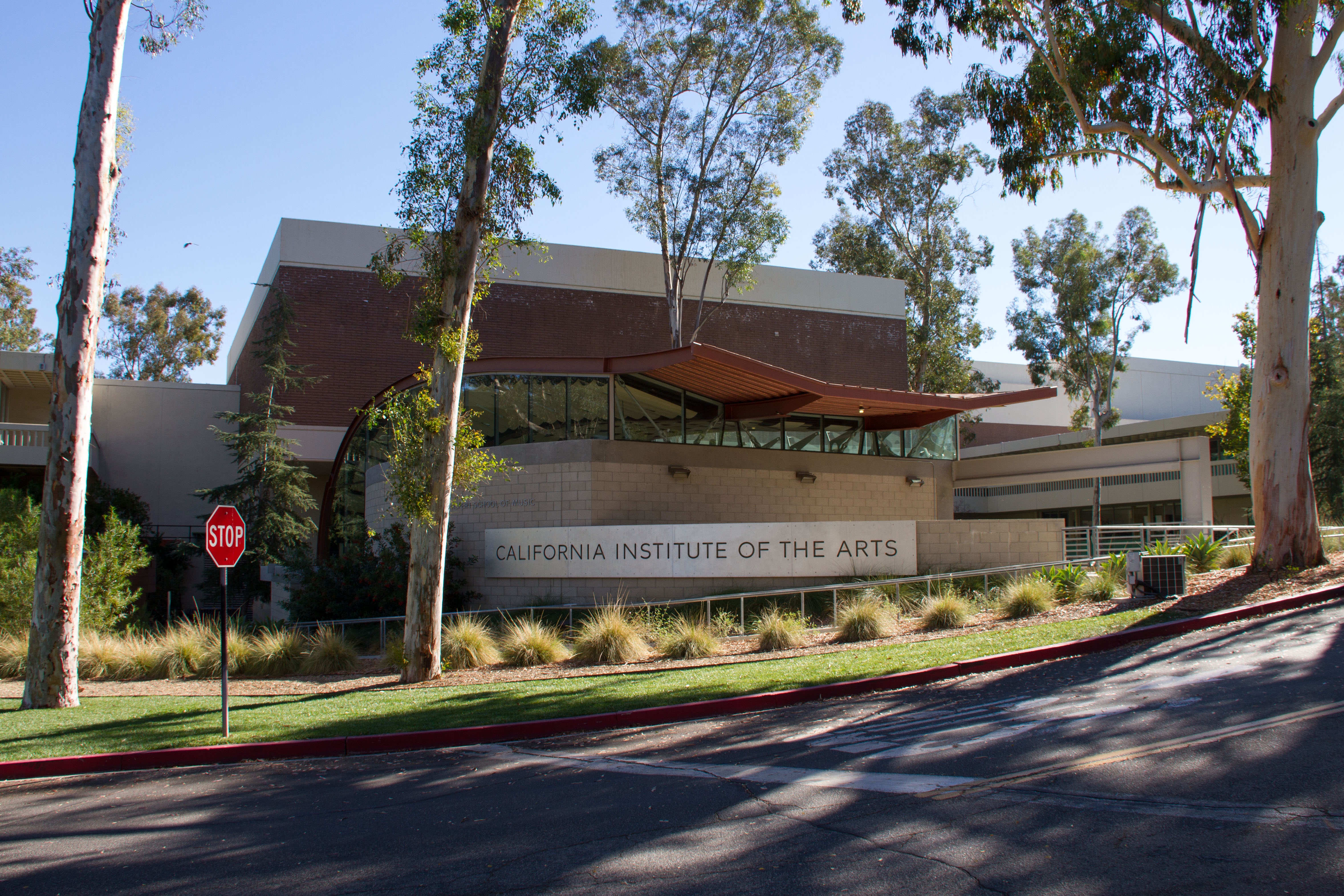
California Institute of the Arts
Inside CalArts, there is a classroom numbered A113. Generations of students have passed through it. And then those students went on to make films—Pixar's first features, Disney's renaissance of the 1990s, works that reached hundreds of millions of people worldwide. A113 appears as an Easter egg in so many animated films that fans have catalogued it obsessively. It's a small inside joke, but it points to something real: the California Institute of the Arts has an outsized, almost inexplicable hold on American visual culture.
A Dream Walt Disney Didn't Live to See
CalArts was incorporated in 1961 as the product of a merger between two institutions struggling financially: the Chouinard Art Institute, founded in 1921 by Nelbert Chouinard, and the Los Angeles Conservatory of Music, founded in 1883. Walt Disney was instrumental in making the merger happen. He had a long relationship with Chouinard—Disney had employed its teachers, sent his animators to study there, and eventually supported the school financially when Chouinard suffered a stroke and couldn't run it herself. Disney's vision was expansive: he wanted a school where every discipline of the arts—visual, musical, theatrical, cinematic—could cross-pollinate in one place. He called it a "City of the Arts." He died in 1966, before the school's Valencia campus opened in 1971, but the institution bears the imprint of his imagination.
The Experimental Years
CalArts was from the beginning a genuinely radical place. Its early faculty included avant-garde figures who pushed students to question every convention. The experimental film program produced work that played at festivals worldwide. The music composition program embraced electronic music when it was still considered fringe. The art program turned out painters, sculptors, and conceptual artists who would go on to show in major galleries and museums. Some alumni became famous; many more became the less-visible creative infrastructure of American culture—the cinematographers, composers, costume designers, and art directors whose names appear in credits that audiences scroll past.
The Disney Animation Pipeline
Perhaps the most consequential program CalArts developed was its character animation track, seeded with support from Disney. Graduates of the program didn't just join Disney—they reinvented it. Tim Burton, John Lasseter, Brad Bird, and many others who attended CalArts in the late 1970s and early 1980s became the architects of the Disney Renaissance of the late 1980s and '90s, and then founded Pixar's creative culture. The reference to classroom A113 that shows up in film after film is, among other things, a signal: the people who made this learned to see at the same place, at the same time, through the same windows.
A Campus in the Hills
The CalArts campus sits in Santa Clarita, in the hills above Valencia, about 30 miles northwest of downtown Los Angeles. The main building is a single large structure—unusual for a campus—designed so that the different arts programs share hallways, common spaces, and accidental proximity. It is the kind of place where a film student might wander through a music rehearsal on the way to class, or a dancer might critique a sculpture installation. That porousness, deliberately built into the architecture, reflects CalArts' founding belief: that the most interesting art emerges at borders, not in the middle of disciplines. The school remains one of the few institutions in the United States specifically designed from the ground up for both visual and performing arts.
From the Air
Located at 34.39°N, 118.57°W in Santa Clarita, northwest of the San Fernando Valley. The distinctive CalArts campus building is visible from the air at 3,000–5,000 feet MSL, set against the hills of the Santa Clara River valley. Nearest airports: KWHP (Whiteman Airport, ~20 miles southeast), KVNY (Van Nuys, ~22 miles east). The campus sits just off the Golden State Freeway (I-5) corridor.