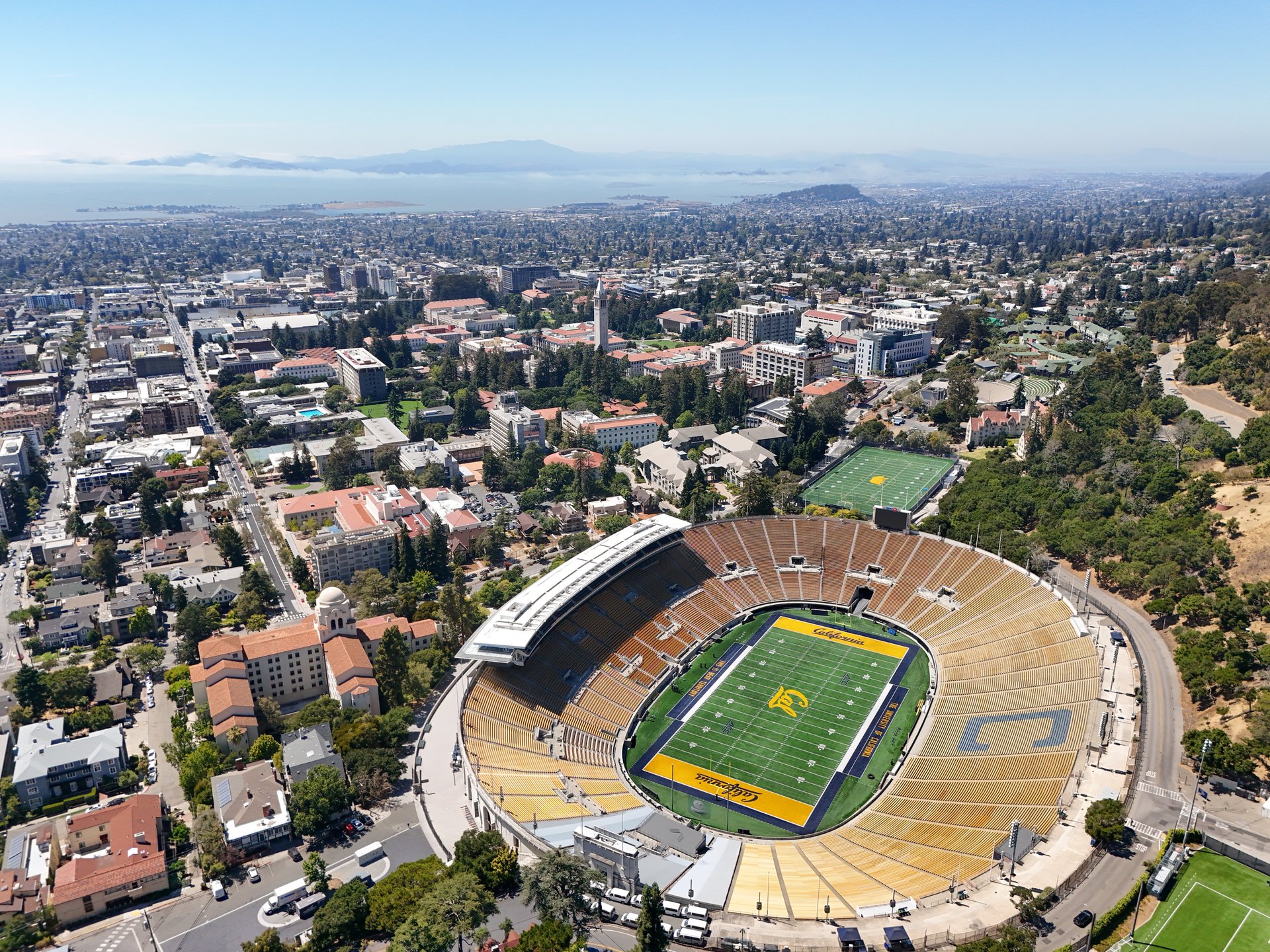
California Memorial Stadium
An earthquake fault runs directly beneath the end zones. Engineers know this. The university knows this. And every autumn Saturday, more than sixty thousand fans pack the stands anyway, because some places matter enough to rebuild on unstable ground. California Memorial Stadium, nestled into the base of the Berkeley Hills since 1923, was never just a place to watch football. It was built as an act of remembrance for Californians who died in World War I, funded entirely by public donations, and designed by John Galen Howard in a neoclassical style that made concrete feel solemn. A century later, it remains one of the most dramatic settings in college sports, where top-row spectators look out over San Francisco Bay while the Hayward Fault slowly pulls the building apart at a rate of 1.2 millimeters per year.
From Valentine's Day Kickoff to National Champions
The first football game on the UC Berkeley campus took place on February 14, 1885, drawing 450 spectators to a field where the Valley Life Sciences Building now stands. That modest beginning grew quickly. By 1904, the Bears had outgrown their 5,000-seat West Field and moved to California Field, a 20,000-seat venue closer to the heart of campus. It was there that Cal traditions crystallized: the first card stunt performed at the 1910 Big Game, the celebratory serpentine around the field after victories, the rise to national prominence under coach Andy Smith. Four consecutive undefeated seasons and three claimed national championships made California Field legendary, but the success also made it obvious that the Bears needed something larger. The push for a new stadium began, and by the early 1920s, the community rallied behind a memorial that would honor both the fallen and the living.
A Monument to Memory and Scenery
When Memorial Stadium opened on November 24, 1923, it seated over 70,000, its horseshoe shape cradled against the steep hillside of Strawberry Canyon. John Galen Howard's architectural committee gave the concrete structure neoclassical arches and pilasters that set it apart from the utilitarian bowls going up at other universities. But the setting itself was the real distinction. The Berkeley Hills rise directly behind the east stands, green with eucalyptus and oak. From the west side, the view stretches across the bay to San Francisco and the Golden Gate. It has been called one of the most scenic venues in college football, and that reputation draws people who have never cared about a down or a first-and-ten. Even those who cannot afford a ticket have options. The hill overlooking the east rim has attracted freeloaders for generations, earning the affectionate name Tightwad Hill.
Presidents, Raiders, and a Tax on Spectacle
The stadium has hosted more than football. On March 23, 1962, President John F. Kennedy addressed an above-capacity crowd of 88,000 for the university's Charter Day. In 1973, the Oakland Raiders played a regular-season NFL game here after a scheduling conflict at the Coliseum, and 46-year-old George Blanda kicked four field goals to end the Miami Dolphins' record 18-game winning streak, 12 to 7. But the Raiders' visit also revealed the tension between a college campus and professional sports. Traffic choked residential streets. Fans who normally tailgated at the Coliseum drove into a neighborhood built for pedestrians. Berkeley responded with a Professional Sports Events License Tax, levying 10 percent on gate receipts. The Raiders fought it in court and lost on appeal. Professional sports have not returned to the stadium since.
Building on a Fault Line
The Hayward Fault does not run near Memorial Stadium. It runs through it. Right-lateral strike-slip motion is shifting the east half of the structure southward, and expansion joints placed during the original construction were always part of the design. When the university approved a $321 million retrofit in 2010, seismic safety was the central justification. The west side was demolished down to its historic facade and rebuilt with modern amenities. Surface rupture blocks were placed in each end zone, resting on three feet of sand and plastic sheeting so they can move independently when the fault shifts. The field itself was lowered four feet to improve sight lines. Tree-sitters occupied an oak grove beside the stadium for nearly two years to protest the project, but construction eventually went forward. The Bears played the 2011 season at AT&T Park in San Francisco while the work was completed.
A Debt That Outlasts Its Builders
The grand reopening on September 1, 2012, did not go as planned. A sellout crowd of 63,186 watched the Nevada Wolf Pack win 31 to 24, Cal's first home loss to Nevada since before the original stadium opened. The financial picture proved equally sobering. The university had taken on $445 million in debt for the stadium renovation and a new athletic center, planning to repay it through an Endowment Seating Program. Professor Brian Barsky warned before construction began that the plan was unrealistic. The Wall Street Journal later confirmed that only $31 million had been received by the end of 2011, far short of projections. Annual interest payments consume roughly 20 percent of Cal's athletics budget. Principal repayment begins in 2032, and the debt is scheduled to run for a full century, with final payments due in 2113. The stadium that was built to honor sacrifice now asks a different kind of endurance from the institution that sustains it.
From the Air
California Memorial Stadium sits at 37.871N, 122.251W, elevation approximately 410 feet, tucked into the western slope of the Berkeley Hills. From the air, its distinctive horseshoe shape is clearly visible against the green hillside, with Sather Tower (the Campanile) rising nearby to the northwest. The nearest airport is Oakland International (KOAK), about 8 nautical miles south. San Francisco International (KSFO) lies 18 nm to the south-southwest. Best viewed at 2,000-3,000 feet AGL on approach from over San Francisco Bay, where the contrast between the urban campus and the hills behind makes the stadium easy to spot.