Fresno State: Where Students Make Wine and Horses Live on Campus
Not many universities let students bring their horses to school. At Fresno State, members of the nationally ranked equestrian team can stable theirs on campus, next to indoor and outdoor arenas, a perk that makes sense only in the context of a school that also maintains its own raisin and wine grape vineyards, operates a commercial winery, and sits at the heart of the most productive agricultural region on Earth. Student-made wines from Fresno State have won over 300 awards since 1997. The campus planetarium sits down the road from the vineyards. This is a university that refuses to choose between the cerebral and the agricultural, because in the Central Valley, that distinction has never made much sense.
From Normal School to Research University
Fresno State began in 1911 as the Fresno State Normal School, one of roughly 180 such institutions that state governments established across the country to train teachers for the growing public school system. Charles Lourie McLane served as its first president. The original campus occupied what is now Fresno City College, and the two institutions' histories are tangled accordingly: when Fresno State moved to its present location in the northeast part of the city in 1956, Fresno City College bought the old campus and moved back in. The name changed along the way. It became Fresno State College in 1949, when it gained the authority to grant bachelor's degrees. It joined the State College System of California in 1961 and was officially renamed California State University, Fresno in 1972. The trajectory mirrors dozens of American universities that started with a narrow mandate and grew into something far broader.
The Campus That Grows Its Own
The campus stretches from Valley Children's Stadium on the west to Highway 168 on the east, with the University Agricultural Laboratory marking the northern boundary and Shaw Avenue the southern edge. This is not a decorative campus that maintains a token garden. The Jordan College of Agricultural Sciences and Technology runs working vineyards and a commercial winery that competes seriously enough to accumulate hundreds of awards. The library, opened in 2009, houses a million books across nearly 328,000 square feet, making it the third-largest in the California State University system. Its shelves stretch over 20 miles in total length. Among its special collections is the Arne Nixon Center, a research center dedicated to children's and young adult literature, and the Central Valley Political Archive, which preserves the political history of a region too often overlooked.
Bulldogs and Underdogs
Fresno State competes in the NCAA Division I Mountain West Conference, fielding 22 varsity sports teams under the Bulldogs name in cardinal red and blue. The highlights are genuine: a national championship in softball in 1998, another in baseball in 2008. The baseball title was particularly improbable, won by a team that entered the NCAA tournament as the lowest seed. The rivalry with San Diego State in football is fierce enough to have its own trophy, the Old Oil Can, a name that captures the unpretentious spirit of both programs. The equestrian team competes in the Big 12 Conference, one of only a handful of schools that offer the sport. Alumni have gone on to major professional careers: Aaron Judge in baseball, Derek and David Carr in football, Trent Dilfer, Davante Adams, Paul George in basketball.
The Astronaut from Fresno
Among Fresno State's notable alumni is Rick Husband, the NASA astronaut and fighter pilot who commanded the Space Shuttle Columbia on its final mission. Husband was killed on February 1, 2003, when Columbia disintegrated during reentry over Texas. His connection to Fresno State is part of a broader alumni network that includes Joy Covey, the original CFO of Amazon; Kenny Guinn, a former governor of Nevada; and Gary Soto, the poet and novelist whose work draws heavily on his Central Valley upbringing. The Air Force ROTC Detachment 35 on campus, founded in 1948, is among the oldest in the nation and was named the best mid-sized detachment in the country in 2008. Fresno State has been quietly producing people who do consequential things, even if the school rarely gets the credit.
The Social Mobility Engine
Rankings tell a particular story about Fresno State. In overall national university rankings, it lands in the middle of the pack. But on social mobility, the picture changes dramatically. Washington Monthly ranked it 9th in the nation for social mobility in 2024 and 22nd overall. As a Hispanic-Serving Institution and an eligible Asian American Native American Pacific Islander-Serving Institution, Fresno State serves a student body that reflects the Central Valley's demographics, one of the most diverse regions in California. The university's largest graduating class came in May 2019, with over 6,200 graduates crossing the stage. For many of them, the degree represented a first in their families, the kind of transformation that doesn't show up in prestige rankings but matters more than most things that do.
From the Air
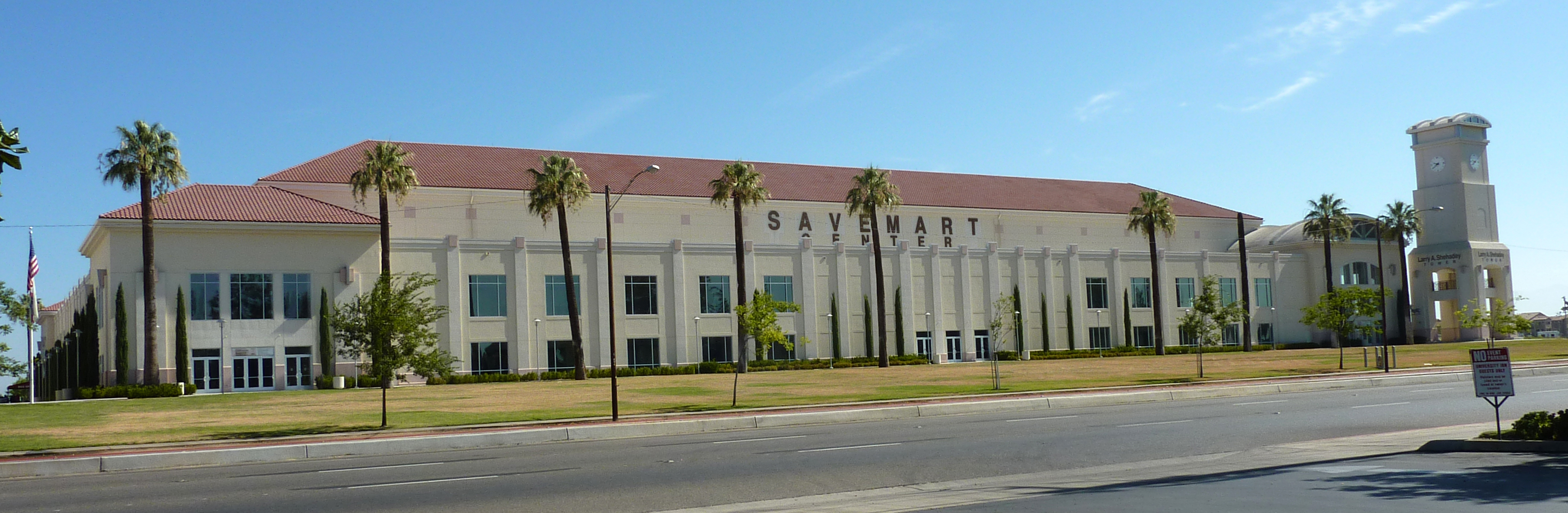
Located at 36.813°N, 119.75°W in the northeast part of Fresno. From the air, the campus is identifiable by the cluster of sports facilities including Bulldog Stadium and the Save Mart Center on the western edge, with agricultural fields and vineyards visible to the north. Nearest airport is Fresno Yosemite International (KFAT), approximately 4 nautical miles to the southeast. Highway 168 forms the eastern campus boundary and is visible as a major road corridor.