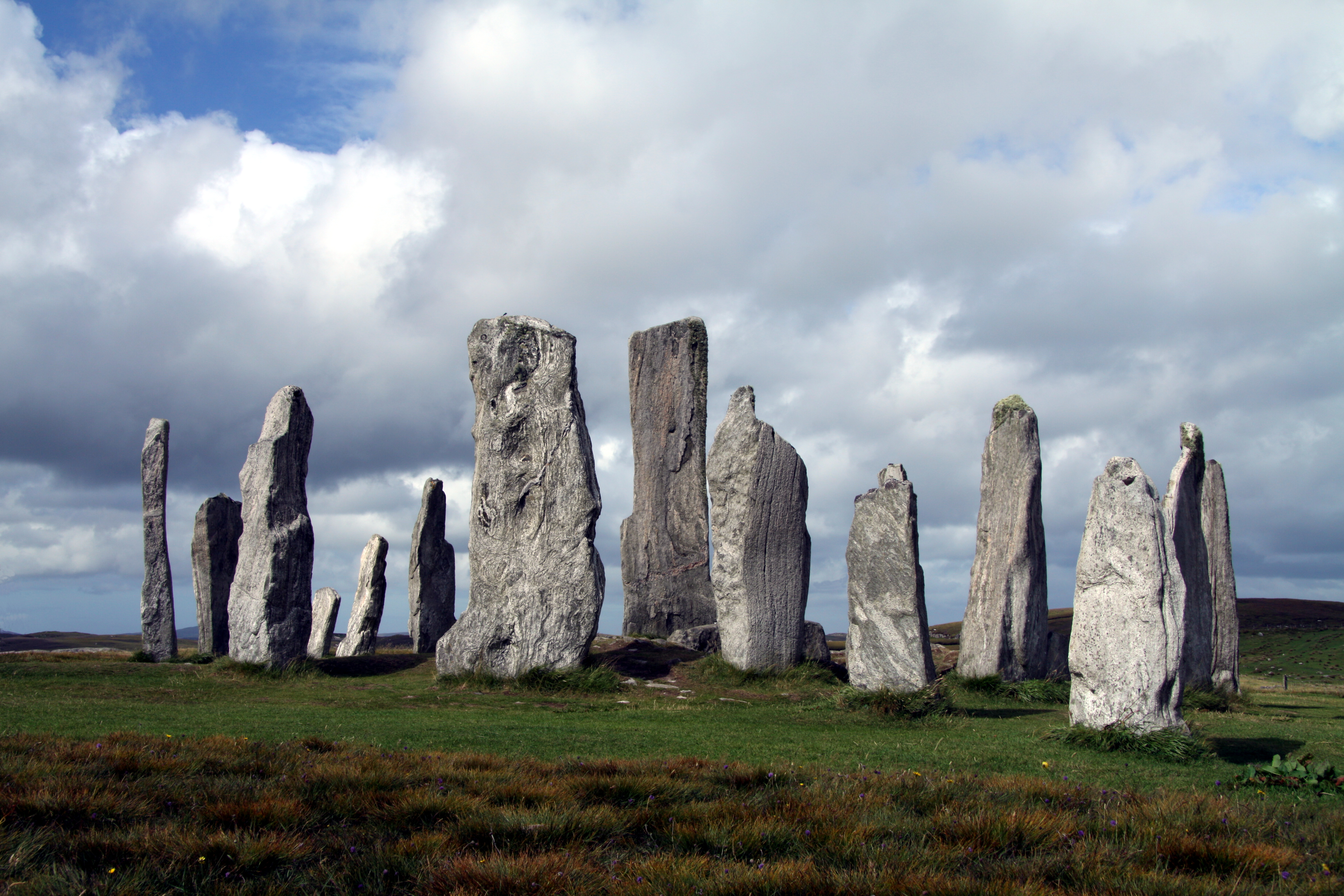
Callanish Stones
The stones are Lewisian gneiss, among the oldest rock on Earth -- nearly three billion years old, formed when nothing alive on this planet was more complex than a single cell. Around 2750 BC, people whose names and language are lost to us hauled these slabs of ancient stone into position on a low ridge above Loch Roag, on the west coast of the Isle of Lewis in Scotland's Outer Hebrides. They arranged thirteen stones in a circle, drove a tall monolith near the centre, and extended rows of standing stones outward like the arms of a cross. The result was a monument that predates Stonehenge by at least two centuries and has stood, through five millennia of Atlantic wind and rain, without the benefit of mortar, engineering, or explanation.
A Geometry Older Than Memory
The Callanish Stones -- known in Gaelic as Tursachan Chalanais -- form a pattern that is immediately legible from above but strange on the ground. Two roughly parallel rows of stones extend north-northeast from the circle, forming an avenue some six metres wide and over eighty metres long. Shorter single rows project to the south, east-northeast, and west-southwest, creating the cruciform shape that has invited comparison to a Celtic cross, though the stones predate Christianity by more than three thousand years. The central monolith stands nearly five metres tall, and within the circle lies a small chambered tomb, added after the stones were first erected and used for burials over several centuries. The stones themselves vary in height and shape, but all are cut from the same local gneiss -- grey, streaked with bands of darker mineral, and textured by the deep time that formed them. Standing among them on a grey Lewis afternoon, with low cloud moving fast overhead and the water of Loch Roag visible between the stones, you feel less like a visitor to a monument than an intruder at a ceremony whose meaning was sealed shut long ago.
Buried and Reborn
Sometime between 1000 and 500 BC, the stones were abandoned. Peat began to accumulate around their bases, and over the following centuries it buried them to a depth of five feet, leaving only their upper portions visible above a blanketed landscape. The people of Lewis knew the stones were there -- they had never been entirely hidden -- but their original purpose was forgotten. Local tradition held that they were giants turned to stone for refusing to convert to Christianity. The antiquarian Martin Martin visited around 1695 and was told by local people that the site had been a place of worship in heathen times, with the chief druid standing by the central stone to address the assembled crowd. In 1743, the English antiquary William Stukeley saw a druid circle and a serpentine avenue in the layout. None of these explanations was correct, but each preserved, in distorted form, the intuition that the stones had once served a purpose deeper than decoration. In 1857, James Matheson, proprietor of Lewis, ordered the peat cleared. Workers removed five feet of accumulated growth, revealing the chambered tomb and the full, startling height of the stones for the first time in over two thousand years.
Not Alone on the Moor
What makes Callanish extraordinary is not just the main monument but the density of ritual sites surrounding it. Archaeologists designate the primary circle as Calanais I, but within a few kilometres stand the remains of at least nineteen other megalithic sites -- stone circles, single standing stones, stone settings, and alignments -- collectively designated Calanais II through XIX. The landscape was not marked by a single monument but saturated with them, as though the ridge above Loch Roag was understood as sacred ground in its entirety. Calanais II and III, both stone circles, lie just over a kilometre to the southeast. Calanais VIII stands on a sheer cliff edge on the nearby island of Great Bernera, a semicircular arrangement that seems to gesture toward the sea. Some of these sites are well preserved; others survive only as stumps or as discolorations in the turf. A timber circle once stood half a kilometre south of the main stones, near Loch Roag, though nothing of it remains visible. Taken together, the Callanish complex suggests a landscape of sustained ceremonial activity spanning centuries -- a place to which people returned, generation after generation, to do things we can no longer reconstruct.
What the Stones Have Witnessed
The stones were taken into state care in 1885, and Historic Environment Scotland now manages the site. A visitor centre operated by Urras Nan Tursachan -- the Standing Stones Trust -- provides context, but the stones themselves remain freely accessible at all hours, standing in the open air without barriers or admission charges. You can walk among them at midnight in midsummer, when the Lewis sky never fully darkens and the stones throw long shadows across the moor. The site has entered modern culture in ways its builders could never have imagined: the standing stones in Pixar's Brave were inspired by Callanish, and the fictional Craigh na Dun in the television series Outlander is modeled on them. Bank of Scotland debit cards carry their image. But the stones themselves are indifferent to their fame. They stand where they were placed nearly five thousand years ago, on a windswept ridge above a sea loch, aligned to something -- the moon's extreme rising, perhaps, or the midwinter sunset, or a geometry whose logic died with its creators. The gneiss from which they are carved is older than multicellular life. The monument they form is older than recorded history. And yet they stand, patient and upright, offering no explanation for what they are or why they were made, only the stubborn fact that someone, long ago, thought this arrangement of stone mattered enough to build and maintain across generations.
From the Air
The Callanish Stones stand at 58.20°N, 6.75°W on a ridge above Loch Roag on the west coast of the Isle of Lewis in the Outer Hebrides. The cruciform arrangement of standing stones is visible from low altitude, with the avenue extending north-northeast. The hills of Great Bernera provide a backdrop to the west. Nearest airstrip: Stornoway (EGPO) approximately 13 nm to the east.