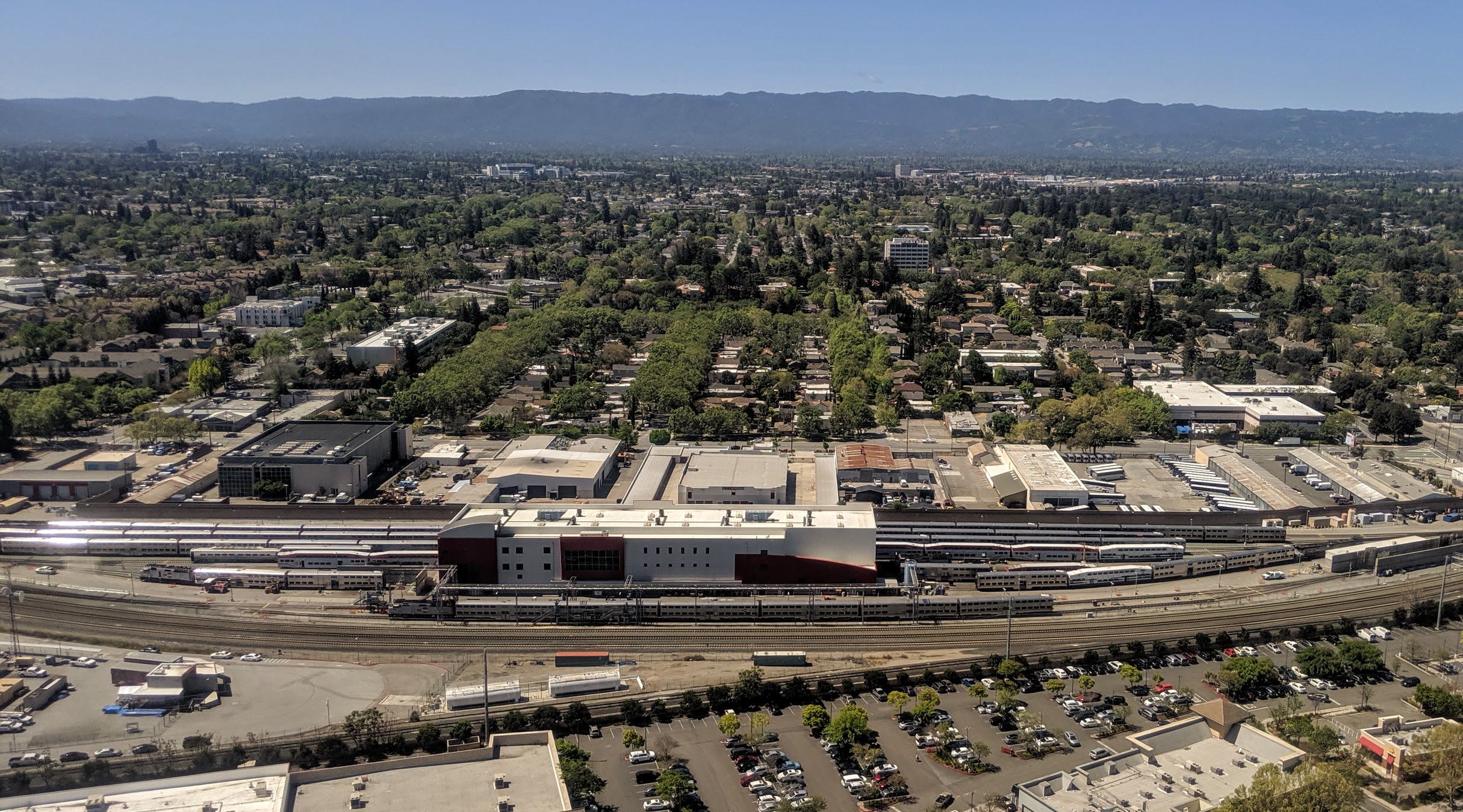
Caltrain
The tracks that Caltrain runs on today were first laid in 1863 by the San Francisco and San Jose Railroad, a line built in part because a steamboat named Jenny Lind had exploded in San Francisco Bay ten years earlier, killing 31 people and demonstrating that the Peninsula needed a safer way to travel. More than 160 years later, the same basic corridor carries tens of thousands of commuters daily between San Francisco and San Jose, threading through the most expensive real estate in North America.
The Peninsula's Backbone
Caltrain operates on a 77.4-mile corridor with 32 stations stretching from San Francisco's Fourth and King station to San Jose Diridon station, with an extension to Gilroy. The line passes through the heart of Silicon Valley, with stations serving communities from San Mateo and Redwood City to Palo Alto, Mountain View, and Sunnyvale. For decades, the diesel-powered trains served as the primary rail connection between the Peninsula's bedroom communities and its employment centers. The relationship between Caltrain and the communities it serves is symbiotic: the railroad created the commuter corridor in the nineteenth century, and the technology industry that filled that corridor in the twentieth century now depends on the railroad to move its workforce.
Electrification
After years of planning and construction, Caltrain completed its transition from diesel to electric power in 2024 — one of the most significant infrastructure upgrades in Bay Area history. Electric service launched on August 11, 2024, with the full fleet of Stadler electric multiple units replacing diesel trains by September 21. The new trains accelerate faster, run more quietly, and produce no direct emissions; a local trip from San Jose to San Francisco shrank from 115 minutes to 83 minutes. The overhead catenary wires that power the new trains have transformed the visual landscape along the corridor, adding a web of infrastructure to stations and grade crossings that had looked essentially unchanged for decades. Ridership surged 76 percent in the year following electrification, suggesting the corridor's working assumption — that faster service would attract more riders — was correct.
A Railroad's Second Century
The challenges facing Caltrain are as old as its tracks. Grade crossings, where the railroad intersects with city streets, create traffic delays and safety hazards along the entire corridor. The system's governance structure, a joint powers authority managed by the Peninsula Corridor Joint Powers Board, reflects the political complexity of operating a railroad through three counties and dozens of cities. Yet the fundamental proposition of Caltrain remains as sound as it was in 1863: moving large numbers of people along a fixed corridor is more efficient by rail than by any other means. That the corridor happens to connect the densest concentration of technology companies in the world only makes the argument more compelling.
From the Air
Caltrain operates along a 77.4-mile corridor from San Francisco to San Jose/Gilroy. The rail line is visible from altitude as a linear transportation corridor paralleling Highway 101 along the San Francisco Peninsula. Major stations include San Francisco (37.78°N, 122.39°W), Palo Alto (37.44°N, 122.16°W), and San Jose Diridon (37.33°N, 121.90°W). The line passes near multiple airports including SFO, SQL, and SJC.