Cambodian Genocide
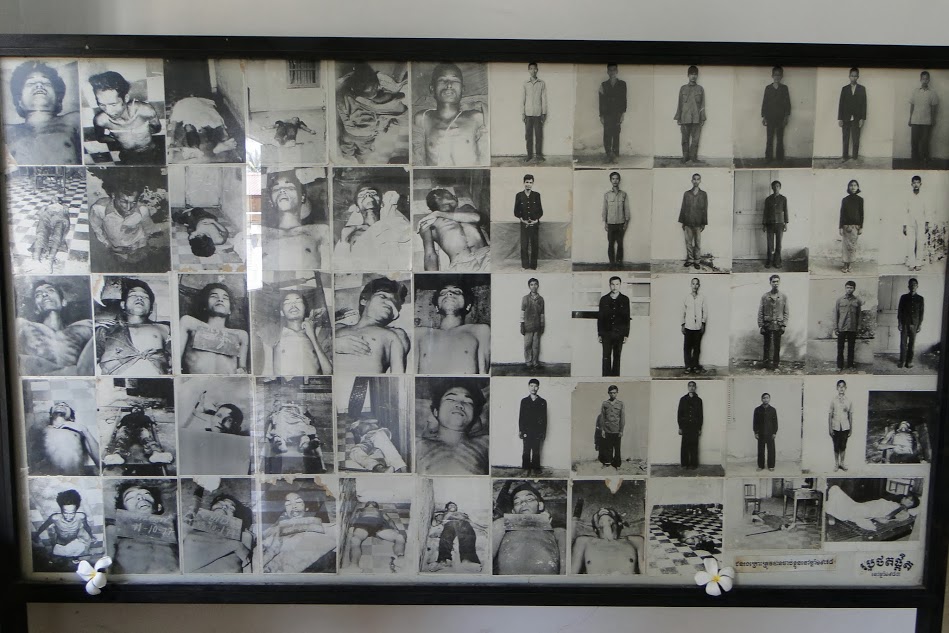
Of the roughly 20,000 people who entered Security Prison 21 in Phnom Penh, seven adults walked out alive. The rest were blindfolded, loaded onto trucks, and driven to the Killing Fields at Choeung Ek, where they were executed at night with metal tools, their screams masked by propaganda music blaring from loudspeakers. This was not an aberration or a breakdown of order. It was policy. Between April 1975 and January 1979, the Khmer Rouge regime systematically dismantled Cambodian society and rebuilt it as a forced-labor state, murdering anyone who resisted, anyone who was suspected of resisting, and entire ethnic communities whose existence contradicted the regime's vision of a pure agrarian utopia.
Year Zero
When the Khmer Rouge captured Phnom Penh on April 17, 1975, they did not celebrate. They emptied the city. Within days, the entire urban population was marched into the countryside at gunpoint, beginning a forced migration that would eventually encompass virtually every Cambodian. Pol Pot's vision, shaped by Marxist-Leninist ideology filtered through Mao Zedong's agrarian theories and his own romanticized memories of Cambodia's rural northeast, demanded the eradication of everything he considered corrupting: foreign influence, Western education, Buddhism, Islam, professional expertise, even the wearing of eyeglasses, which suggested intellectual inclinations. The country was renamed Democratic Kampuchea, though democracy had nothing to do with what followed. Cambodians were organized into mobile work teams and sent to labor in rice paddies, dig irrigation canals, and build dams. The workdays were punishing, the food rations starvation-level, and the penalties for failure or complaint were imprisonment, torture, and death.
The Machinery of Killing
The genocide was bureaucratic in its thoroughness. The Documentation Center of Cambodia has mapped 23,745 mass graves containing approximately 1.3 million suspected victims of execution. Across Cambodia, the Khmer Rouge operated 196 prisons, the most notorious being S-21, a former high school in Phnom Penh converted into an interrogation and extermination center. Prisoners were tortured into confessing crimes they had not committed and naming accomplices who did not exist, generating an ever-expanding circle of arrests. Whole families were taken, including children, because the regime feared that survivors would seek revenge. Pol Pot articulated the logic himself: to kill the grass, you must also kill the roots. Former soldiers, government officials, teachers, doctors, lawyers, monks, and anyone who spoke a foreign language were marked for elimination. Direct execution accounted for up to 60 percent of the death toll. The rest died of starvation, exhaustion, and disease in the labor camps, where untrained teenage medics performed medical experiments without anesthesia and child soldiers were indoctrinated to kill without hesitation.
Communities Erased
The Khmer Rouge targeted Cambodia's ethnic and religious minorities with particular ferocity. Between 200,000 and 300,000 Chinese Cambodians perished, victims of the regime's hostility toward urban populations and commerce. The ethnic Cham, Cambodia's Muslim minority, faced what scholar Ben Kiernan has called the fiercest extermination campaign of the genocide. The regime banned Islam, destroyed 132 mosques, dispersed Cham communities across the country, forced Muslims to eat pork, and murdered those who refused. Cham leaders, imams, and religious teachers were systematically killed. When Cham villages resisted, as they did in the Eastern Zone in 1975, the regime's military reinforcements annihilated entire communities. An estimated 90,000 to 500,000 Cham died. The Vietnamese minority fared no better: 20,000 Vietnamese Cambodians were killed, and the regime conducted cross-border raids that slaughtered an estimated 30,000 Vietnamese civilians, including 3,157 people in the Ba Chuc massacre of April 1978. It was these raids, ultimately, that provoked the Vietnamese invasion which ended the genocide.
The Long Road to Accountability
Vietnam's military invaded Cambodia in late 1978 and toppled the Khmer Rouge regime by January 1979. But justice moved at a crawl. Geopolitics conspired to delay accountability: China, which had provided at least one billion dollars in aid to the Khmer Rouge in 1975 alone, condemned Vietnam's invasion. The United States avoided using the word genocide until 1989, calling such language counterproductive to finding peace. The Khmer Rouge retained Cambodia's United Nations seat for years after its overthrow. It was not until 2003 that the Extraordinary Chambers in the Courts of Cambodia were established, and trials did not begin until 2009. The tribunal convicted three senior leaders: Kang Kek Iew, commander of S-21, sentenced to life; Nuon Chea, the regime's chief ideologist, sentenced to life; and Khieu Samphan, head of state, also sentenced to life. Pol Pot himself died in 1998 without facing trial. Over 350,000 Cambodians attended the proceedings in person.
What the Land Holds
Cambodia's landscape still bears the scars. The mass graves at Choeung Ek are now a memorial, the former S-21 prison is the Tuol Sleng Genocide Museum, and May 20 is observed annually as the National Day of Remembrance. But the weight of what happened between 1975 and 1979 extends far beyond monuments. A third of Cambodia's population perished. The killing of 50 to 70 percent of the country's working-age men reshaped the society in ways that persist decades later, including a measurable shift in gender norms around labor and political participation. In 2013, Cambodia passed legislation criminalizing denial of the genocide, mirroring laws enacted in Europe after the Holocaust. The Cham have rebuilt mosques and communities. Buddhism has returned. Yet across the countryside, in the rice paddies and forests where the labor camps once stood, the earth still gives up bones.
From the Air
Centered on 12.25N, 105.60E in central Cambodia. Phnom Penh, the capital and site of the Tuol Sleng Genocide Museum (former S-21 prison), lies to the southwest. The Killing Fields memorial at Choeung Ek is approximately 15 km south of Phnom Penh. Phnom Penh International Airport (VDPP) is the nearest major airfield. The Tonle Sap lake is visible to the northwest, and the Mekong River winds through the eastern landscape. Best viewed at 5,000-10,000 ft AGL. The flat terrain of the central Cambodian plain, once the site of countless forced labor camps, stretches in every direction.