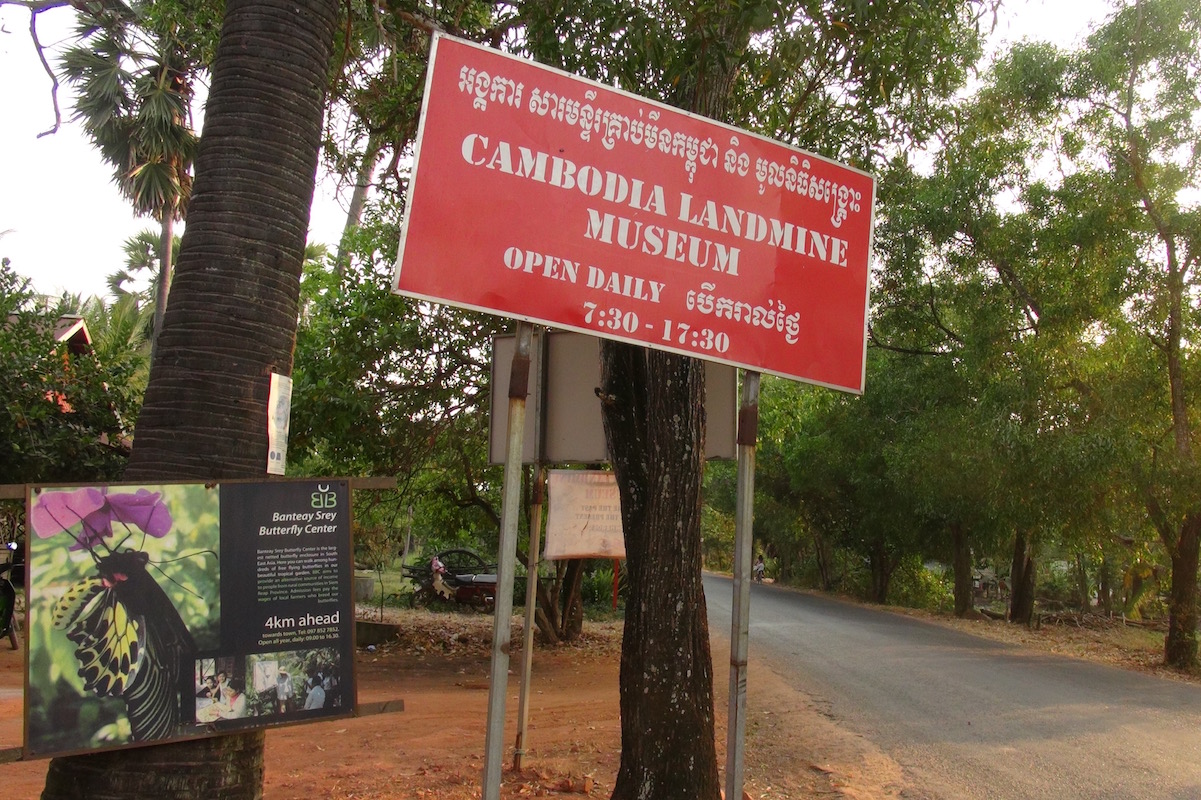
Cambodian Landmine Museum
He was roughly five years old when the Khmer Rouge put him to work laying landmines. His parents had already been killed. The boy who would become known as Aki Ra did not choose this life, but decades later he chose what to do with it. Since 1992, working first with a stick, a knife, and a hoe, he has personally defused an estimated 50,000 landmines and pieces of unexploded ordnance across Cambodia. The museum he built to display those defused weapons sits 25 kilometers north of Siem Reap, inside the Angkor National Park near the Banteay Srey temple complex, and it exists for a reason that is simple and devastating: the war ended, but the mines did not.
A Child Soldier's Reckoning
Aki Ra believes he was born around 1970 or 1973; he is not certain. Orphaned in a Khmer Rouge camp, he was raised by a woman named Yourn alongside other parentless children. As soon as he was strong enough to be useful, local commanders pressed him into service. He laid mines, cooked for soldiers, carried supplies. When the Vietnamese invaded Cambodia in 1979, Aki Ra was conscripted again, this time by the Vietnamese-backed forces. War was the only life he knew. It was not until 1991, when the United Nations arrived to oversee Cambodia's transition to peace, that Aki Ra found a different purpose. He took a job as a deminer with the UN. When he left in 1992, he kept going on his own, returning to the villages where he had once planted mines and pulling them from the earth one by one. He had no proper equipment, no body armor, no metal detector. What he had was an intimate knowledge of how mines were laid, because he had been the one laying them.
A Dollar to See the Collection
Word spread among travelers in the late 1990s: a young Khmer man near Siem Reap was clearing landmines with hand tools and storing the defused ordnance in his house. Tourists began showing up to see the collection. In 1999, Aki Ra started charging one dollar for admission, funneling the money back into his demining work. It was makeshift and improbable, but it worked. The museum grew. By the mid-2000s, however, the Cambodian government ordered it closed at its original location. With the help of a Canadian NGO, the Cambodia Landmine Museum Relief Fund, founded by documentary producer Richard Fitoussi, and major funding from California film director Tom Shadyac, Aki Ra secured a new site 25 kilometers from Siem Reap. The new museum opened in May 2007, situated near Banteay Srey temple inside the Angkor National Park. It now houses four galleries of exhibits documenting the landmine crisis.
The Mines That Remain
The scale of Cambodia's contamination defies easy comprehension. Estimates suggest four to six million landmines and pieces of unexploded ordnance remain buried across the country, with some calculations reaching as high as ten million. Since 1979, mines and explosive remnants of war have killed or injured more than 65,000 Cambodians. The country has over 40,000 amputees, one of the highest rates in the world. Annual casualties have dropped dramatically, from 4,320 in 1996 to 49 in 2024, a testament to decades of demining work. But approximately one million people still live and work in contaminated areas, and a 2002 survey found that 20 percent of all Cambodian villages remained affected by minefields or cluster munitions. The museum does not let visitors look away from these numbers. Its galleries trace the journey from buried weapon to human cost, connecting the abstract statistics to specific lives shattered by devices that were designed to maim rather than kill.
The Children of the Museum
In the villages where Aki Ra cleared mines, he kept finding children. Some had been wounded by the same ordnance he was removing. Others had been orphaned or abandoned by families too poor or too broken to care for them. He brought them home. The museum is not only a museum; it is a relief facility and a home. Twenty-seven children lived there as of the most recent count, cared for by Aki Ra and his wife Hourt alongside their own children. The institution runs on ticket sales, donations, and proceeds from a small shop. In 2008, with help from the Landmine Relief Fund and the Vietnam Veterans Mine Clearing Team from Australia, Aki Ra obtained full certification as a professional deminer and established Cambodian Self Help Demining, a separate NGO that continues clearance work across the country. In 2010, CNN named him a Top 10 Hero from among 10,000 nominees. The recognition was welcome, but the work continued regardless. There are still mines in the ground.
Among the Temples
The museum's location within the Angkor National Park places it in a landscape where ancient grandeur and modern trauma coexist. The Banteay Srey temple, a 10th-century jewel of pink sandstone carved with extraordinary delicacy, lies just to the north. The great temples of Angkor stretch to the south and west. Visitors often arrive at the landmine museum on the same day they explore those ruins, and the juxtaposition sharpens both experiences. The Khmer Empire that built Angkor was one of the most powerful civilizations in Southeast Asian history. The landmines in the museum's galleries are the residue of the conflicts that followed centuries of decline. From the air, the museum appears as a modest compound surrounded by forest, easy to miss among the vast archaeological zone. But what it contains is as essential to understanding Cambodia as any temple. The stone carvings tell you what this civilization built. The defused mines tell you what it survived.
From the Air
Located at 13.540°N, 103.946°E, approximately 25 km north of Siem Reap within the Angkor National Park, near the Banteay Srey temple complex. Nearest airport is Siem Reap-Angkor International Airport (ICAO: VDSR), roughly 30 km to the south. Best viewed at 1,500-2,500 feet, though the facility is modest in footprint. The surrounding landscape is dense forest interspersed with the archaeological sites of the Angkor complex. Tonle Sap lake visible to the southwest. Tropical monsoon climate; dry season (November-April) offers clearest viewing conditions.