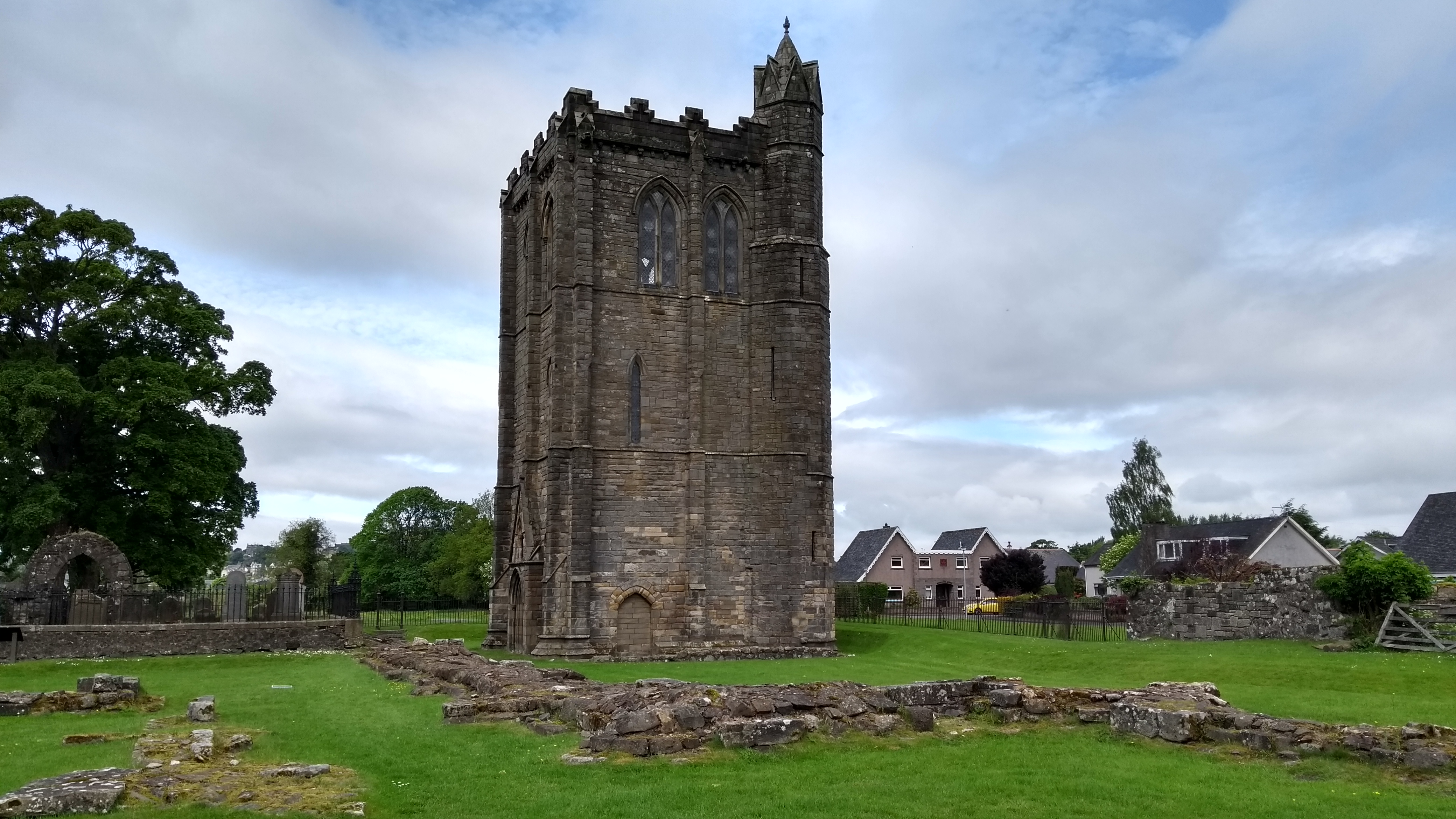
Cambuskenneth Abbey
The building they called Parliament Hall is gone. So are the cloisters, the chapter house, and most of the abbey church. But the thirteenth-century bell tower of Cambuskenneth Abbey still stands on a peninsula of land created by a tight meander of the River Forth, a mile downstream from Stirling Castle. For four centuries, this small Augustinian house punched well above its weight in Scottish history, hosting parliaments, witnessing coronation oaths, and burying a king. Then the Reformation came, and the very castle it had served for generations consumed it stone by stone.
David's French Monks
King David I founded Cambuskenneth around 1140, part of his ambitious programme to modernise Scotland by importing European monastic orders. The canons he installed were from the Arrouaise congregation in northern France, followers of the Augustinian rule who distinguished themselves by their unusually strict, Cistercian-inspired discipline. Cambuskenneth was their only Scottish house. The choice of site was deliberate: the loop of the Forth created a natural enclosure, almost an island, while the proximity to Stirling placed the abbey within easy reach of what was, intermittently, Scotland's capital. David understood that abbeys were not merely houses of prayer. They were engines of literacy and administration, producing the educated clerks his expanding royal government required. Cambuskenneth fulfilled this role for centuries, its canons serving the crown as scribes, diplomats, and counsellors.
Where Scotland Made Its Laws
The abbey's closeness to Stirling's royal court made it a natural venue for the business of state. Scottish parliaments met at Cambuskenneth repeatedly during the thirteenth and fourteenth centuries, so frequently that one of the abbey's ancillary buildings acquired the name Parliament Hall. In 1326, a parliament gathered here to swear allegiance to Robert the Bruce and confirm the succession of his son, David II. The abbey witnessed the machinery of medieval Scottish governance at work: nobles and clergy assembling in the chapter house or refectory, debating taxation, land disputes, and the ever-present question of the English threat. It was a role that few religious houses in Scotland could match, and it bound Cambuskenneth inextricably to the fate of the nation.
A King's Grave and a Castle's Appetite
James III of Scotland was killed at the Battle of Sauchieburn in 1488, and his body was brought to Cambuskenneth for burial alongside his wife, Margaret of Denmark. Their tomb became one of the abbey's most significant features. But the Reformation of 1560 proved fatal. Monastic life was outlawed, and the abbey was placed under the jurisdiction of John Erskine, the military governor of Stirling Castle. Erskine treated the abbey as a quarry, stripping its dressed stone and architectural features for construction projects in the castle above. The building that had hosted Scotland's parliaments was dismantled by the very fortress it had served. The royal tomb survived but was damaged, and it was not restored until 1865, when Queen Victoria funded its repair. It stands today within a railed enclosure at the east end of the ruins.
The Tower That Refused to Fall
Of the entire abbey complex, only the bell tower remains intact, a slender thirteenth-century campanile that was extensively renovated in 1859. It rises above the flat river meadow like a finger pointing at what used to be, a solitary vertical amid the horizontal lines of foundation walls that trace the footprint of the vanished church and cloisters. The site was acquired by the crown in 1908 and is managed by Historic Environment Scotland. Visitors who walk the foundation outlines can still read the plan of the original cruciform church and identify the locations of the chapter house, the refectory, and the domestic ranges. The historic graveyard holds not only James III and Margaret of Denmark but many of the abbots who governed this house through its centuries of influence. Standing beside the tower, looking uphill toward Stirling Castle, the relationship between the two sites becomes clear: the abbey existed because the castle needed it, and when it no longer did, the castle consumed it.
From the Air
Located at 56.12N, 3.92W on a meander of the River Forth, approximately 1 nm east of Stirling Castle. The surviving bell tower is clearly visible from the air, standing alone amid foundation ruins on the river peninsula. Stirling Castle dominates the skyline to the west on its volcanic crag. Nearest airports: Glasgow (EGPF) approximately 30 nm west; Edinburgh (EGPH) approximately 28 nm east. Best viewed at 1,500-2,500 ft AGL to appreciate the river meander that defines the site.