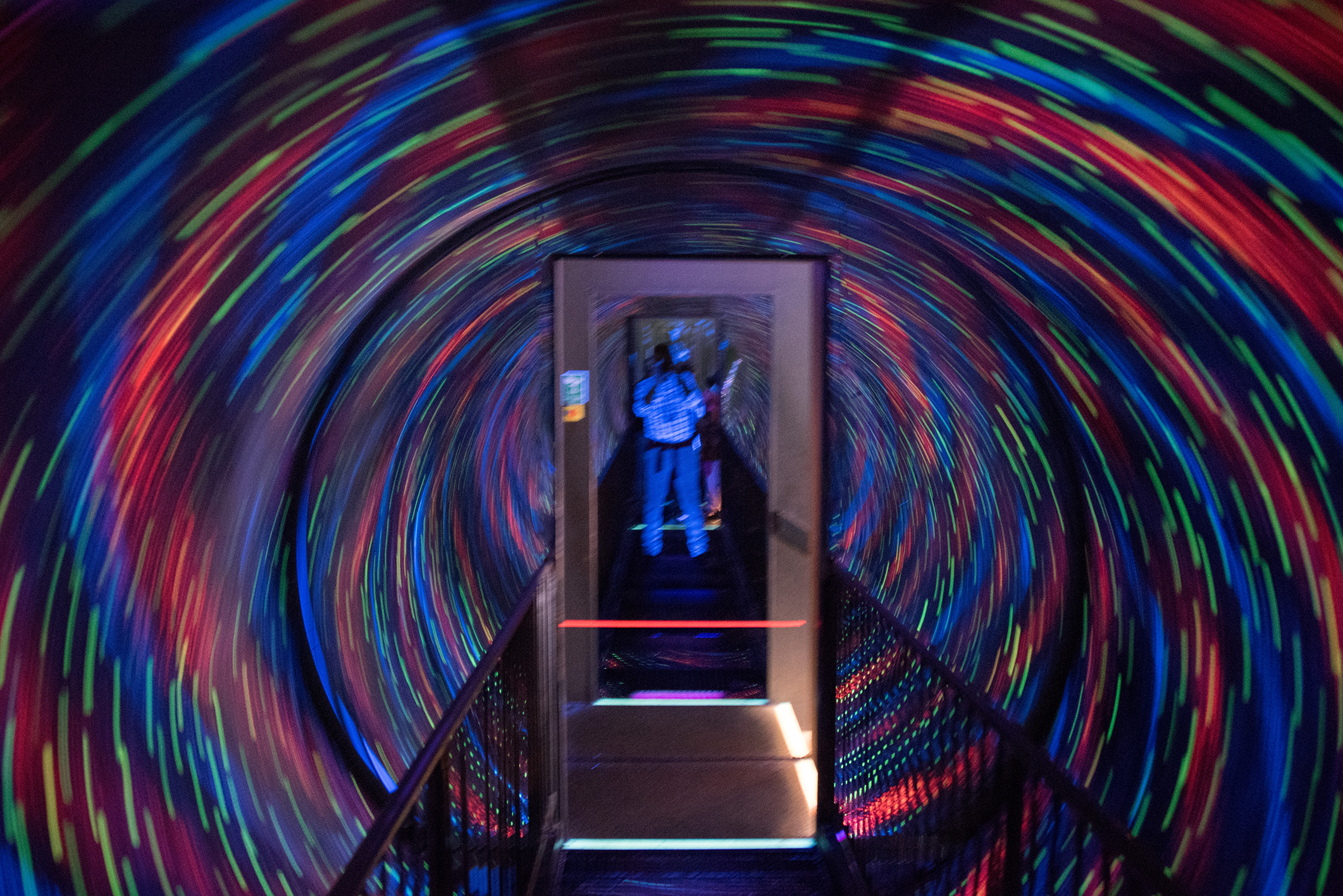
Camera Obscura, Edinburgh
In 1827, a woman named Maria Theresa Short arrived in Edinburgh from the West Indies claiming to be the daughter of Thomas Short, a deceased instrument maker. She wanted his "Great Telescope." Despite competing claims, she won it -- and with it, she built something that has outlasted nearly every other attraction in Britain. The Camera Obscura on Castlehill, perched just below Edinburgh Castle on the Royal Mile, has been operating in one form or another since 1835, making it the oldest purpose-built visitor attraction in the city.
A Woman and Her Observatory
Maria Theresa Short did not simply inherit a telescope and rest on the achievement. She established Short's Popular Observatory in 1835, housed in a building next to the National Monument on Calton Hill, and kept it open until nine o'clock each evening -- unusually late hours for the era. She exhibited scientific instruments and made science accessible to anyone willing to climb the hill. When authorities demolished her Calton Hill building against her protests in 1851, she refused to disappear. She moved to Castlehill, bought the Laird of Cockpen's townhouse, added two storeys, and reopened as Short's Observatory, Museum of Science and Art. The camera obscura occupied the topmost room, projecting a live panorama of Edinburgh onto a white concave table. After Maria died in 1869, her husband Robert Henderson carried on the attraction.
Patrick Geddes and the Thinking Tower
In 1892, the building passed to Patrick Geddes, a figure who defies easy classification. He was an urban planner, sociologist, and ecologist -- before any of those fields had established themselves as proper disciplines. Geddes renamed the building the Outlook Tower and reimagined it as something revolutionary: a museum organized by geography, ascending from the global to the local. The ground floor presented the world. As visitors climbed, they passed through Europe, the English-speaking countries, Scotland, and finally Edinburgh, with the camera obscura at the very top projecting the living city in real time. Geddes invited people from all walks of life to study their own city through his tower. The concept was ahead of its time, and after his death in 1932 the museum closed.
Reinvention on the Royal Mile
The University of Edinburgh purchased the building in 1966 with plans for a Patrick Geddes Centre, but the project fizzled when the university closed its regional planning department. In 1982, the tower was sold to a private owner, who revived its public role. Today, six floors of interactive exhibitions fill the building beneath the camera obscura itself, which still projects Edinburgh onto the same kind of concave table that Maria Short used. Mirror mazes, vortex tunnels, holograms, and optical illusions occupy the floors below, but the core experience remains what it has always been: a darkened room where the city appears in miniature, moving and breathing, carriages replaced by buses, gaslight by LED, but the projection fundamentally unchanged.
The View from the Top
The rooftop terrace offers one of the finest vantage points in Edinburgh -- the castle looming just above, Princes Street Gardens sweeping below, the Firth of Forth glinting to the north. Telescopes line the parapet for visitors who want to study the landscape the old-fashioned way. But the camera obscura remains the draw, a device so simple it borders on magical: a mirror and a lens capturing light, bending it through a dark room, and painting a living picture without electricity or screens. In an age of digital everything, there is something quietly astonishing about watching the real world projected by nothing more than optics and daylight. Maria Theresa Short would recognize it instantly.
From the Air
The Camera Obscura sits at 55.949N, 3.196W on Castlehill, immediately below Edinburgh Castle at the top of the Royal Mile. From the air, look for the distinctive tower adjacent to the Castle esplanade. Nearest airport: Edinburgh (EGPH), approximately 6 nm west. Best viewed at 1,500-2,500 ft.