Caminito del Rey
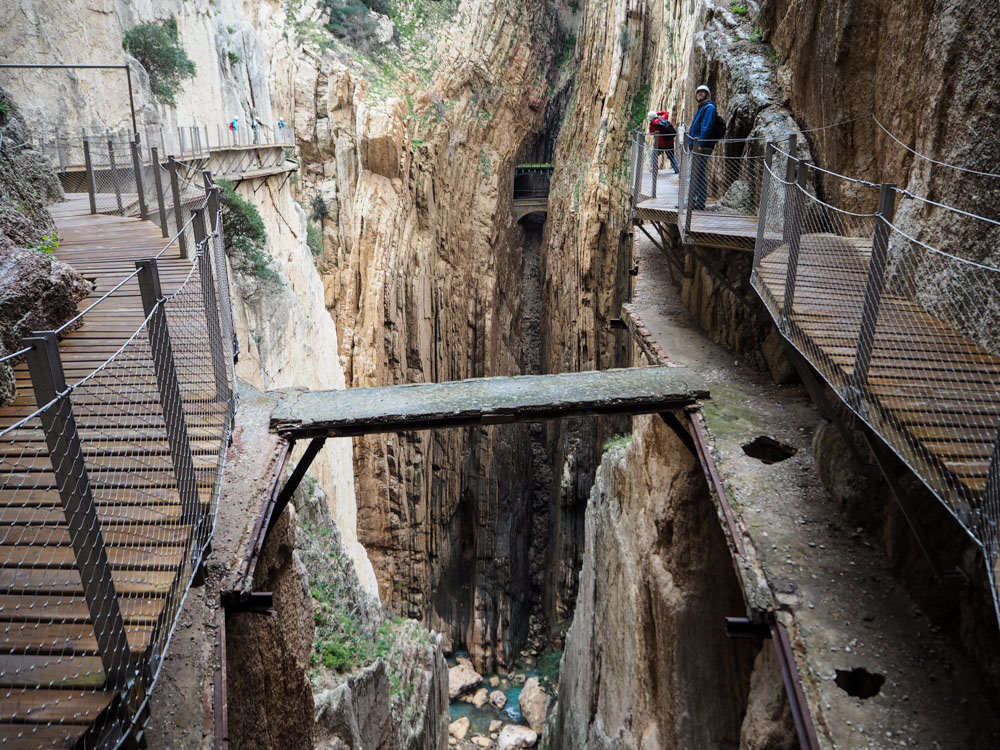
For years, the concrete was crumbling. Whole sections had fallen away, leaving nothing but narrow steel beams spanning gaps where the walkway used to be, with the Guadalhorce River churning 100 meters below. The handrails were gone. A single safety wire ran the length of the path. Between 1999 and 2000, five people died trying to cross it. The local government closed both entrances. But people kept coming, scaling the gorge walls to reach what the internet had crowned the world's most dangerous walkway. Four more died in the four years before 2013. Then Spain spent nine million euros to rebuild it, and El Caminito del Rey reopened in 2015 as a legitimate hiking trail. Lonely Planet named it one of the best new attractions that year.
The King's Little Path
The walkway was never meant for tourists. It was built between 1901 and 1905 to give workers at the hydroelectric power plants at Chorro Falls and Gaitanejo Falls a way to cross between them, carry materials, and inspect the water channel linking the two stations. The path was one meter wide, constructed of concrete resting on steel rails supported by stanchions driven into the rock face at roughly 45-degree angles. It served its utilitarian purpose for decades until King Alfonso XIII crossed it in 1921 for the inauguration of the Conde del Guadalhorce dam. After that royal walk, what had been the Camino del Rey, the King's Pathway, became affectionately known as El Caminito, the Little Path, and it stuck.
The Dangerous Years
Neglect transformed the walkway from an industrial access path into a death trap. The concrete deteriorated year by year, leaving sections where nothing but steel crossbeams bridged the void. The most dramatic accident involved three men from El Chorro who attempted to cross the gorge using a zip line to reach a train line on the far side. The cable could not support their combined weight, and it snapped. After the government sealed the entrances, the path's reputation as forbidden fruit only intensified its appeal. Thrill-seekers from across Europe found ways around the barriers. The gorge itself claimed additional victims, people who attempted to navigate the cliffs rather than the ruined path, proving that the danger was in the landscape, not merely the infrastructure.
Carved by Deep Time
The gorge through which the path runs, the Desfiladero de los Gaitanes, began forming during the Mesozoic Era roughly 250 million years ago, when the entire region lay beneath the sea. Millennia of accumulated marine sediment from coral and ancient species compressed into the limestone and dolomite that now form the gorge walls. Karst weathering dissolved the limestone into a network of caves, grottos, and jagged formations. The Guadalhorce River completed the work, carving the gorge itself and grinding massive potholes into the rock where water swirled around boulders over geological time. The result is a chasm whose walls rise sheer on both sides, barely wide enough for the river at its narrowest points, with the walkway clinging to the cliff face like a thread on a cathedral wall.
The New Path
The regional government of Andalusia and the local government of Malaga agreed in June 2011 to share the nine-million-euro cost of restoration. Specialized alpinists laid the cornerstone in March 2014, and the renovated path reopened on 29 March 2015, offering a 2.9-kilometer walk along the side of the gorge. The new walkway is modern and secure, with glass-floored sections that let hikers look straight down to the river, but the original path remains visible below in many places, its collapsed concrete and rusted stanchions a reminder of what the walk used to cost. The gorge has also appeared on screen: a chase scene in the 1960 film Scent of Mystery played out on the old walkway, and final scenes of the 1965 film Von Ryan's Express were shot where the path meets the railway. Today the path draws hundreds of thousands of visitors annually, all of them walking safely where others once risked their lives.
From the Air
Located at 36.92N, 4.77W near El Chorro in the province of Malaga. The Desfiladero de los Gaitanes gorge is visible from the air as a dramatic narrow cleft in the limestone terrain, with the Guadalhorce reservoir system nearby. Best viewed at 3,000-5,000 feet. Nearest airport: Malaga-Costa del Sol (LEMG), approximately 50 km southeast.