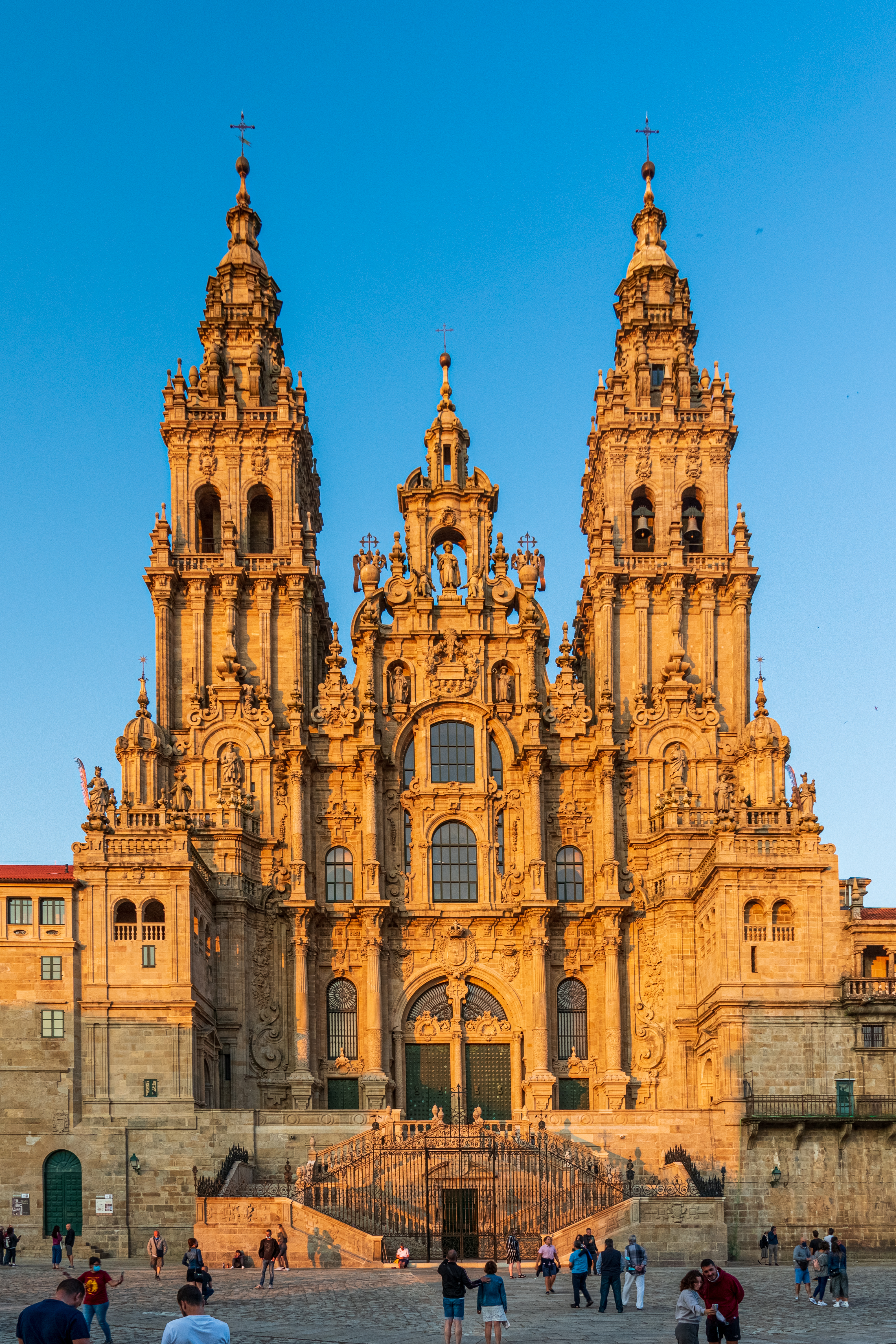
Camino de Santiago
Every pilgrim who completes the Camino de Santiago receives a Compostela, a certificate of pilgrimage written in Latin, but only if they have walked at least the final 100 kilometers or cycled the final 200. The rule exists because this is not a symbolic journey. It is a physical one, measured in blisters and sunburn and the particular exhaustion that comes from walking day after day through landscapes that change as slowly as your thinking does. The Camino de Santiago, the Way of Saint James, is a network of pilgrimage routes leading to the Cathedral of Santiago de Compostela in Galicia, northwestern Spain, where tradition holds that the remains of the apostle James are buried. In 1987, the route network became the first Cultural Route designated by the Council of Europe. Since 2013, more than 200,000 pilgrims have arrived each year, with annual growth exceeding ten percent.
Bones in a Field of Stars
The story begins around the year 830, when a hermit named Pelayo reported seeing strange lights in a field in Galicia. The local bishop, Theodomir, investigated and declared that the remains found there were those of the apostle James the Great, who tradition said had preached in Iberia before his martyrdom in Jerusalem around 44 AD. King Alfonso II of Asturias walked from Oviedo to venerate the relics, becoming what some consider the first pilgrim on the Camino Primitivo, the oldest route. A church was built over the burial site and the settlement that grew around it took the name Santiago de Compostela, derived from campus stellae, the field of stars. By the 10th century, the pilgrimage had become a major phenomenon of medieval Christianity, and in 1492, Pope Alexander VI declared it one of the three great pilgrimages of Christendom, alongside Jerusalem and the Via Francigena to Rome.
Many Roads to One Cathedral
The Camino is not a single path but a network. The most popular route, the Camino Frances or French Way, accounts for roughly two-thirds of all pilgrims. It enters Spain at Saint-Jean-Pied-de-Port in the French Pyrenees and crosses 780 kilometers of northern Spain through Pamplona, Burgos, Leon, and into Galicia. But dozens of other routes converge on Santiago from across Europe. The Camino Primitivo follows Alfonso II's original path from Oviedo. The Camino del Norte hugs the Bay of Biscay coast. The Via de la Plata climbs north from Seville along the old Roman road. The Camino Portugues arrives from Lisbon and Porto. Routes extend into France, Germany, Scandinavia, and beyond. In 1993, the Camino Frances was inscribed as a UNESCO World Heritage Site, and in 1998, the routes through France received the same designation.
The Infrastructure of Faith
Walking the Camino is both ancient ritual and modern logistics. A network of albergues, pilgrims' hostels, lines the routes, some operated by municipalities, others by churches or private owners. Pilgrims carry a credencial, a pilgrim's passport, which is stamped at each stop along the way and serves as proof of the journey when presented in Santiago. The tradition of hospitality toward pilgrims shaped the infrastructure of northern Spain for centuries, producing hospitals, bridges, and entire towns along the routes. The scallop shell, the symbol of the Camino, marks waypoints along thousands of kilometers of trail. Yellow arrows, painted on walls and trees and rocks, guide walkers through cities and countryside alike. For those who continue 90 kilometers beyond Santiago to the coast at Finisterre, the ancient Roman end of the known world, the tradition is to burn a piece of clothing or your walking shoes on the beach.
A Thousand Years of Footsteps
The Camino declined after the Reformation and the European wars of religion, and by the mid-20th century it had nearly vanished. In 1985, fewer than 700 pilgrims completed the journey. The 1987 Council of Europe designation and the 1993 UNESCO inscription helped spark a revival, but the real catalyst was simpler: word of mouth. People who walked it told others, and those others walked it and told more. By 2023, the Camino was attracting hundreds of thousands of pilgrims annually from every continent. Some walk for religious devotion. Others walk for physical challenge, personal reflection, or the social experience of a shared journey with strangers. The medieval pilgrims walked to earn spiritual merit; many modern pilgrims walk to earn something harder to define. The route remains what it has always been: a long walk through beautiful country, ending at a place where someone once saw lights in a field.
From the Air
The Camino de Santiago is a network of routes across Spain, France, and Portugal, all converging on Santiago de Compostela at 42.88N, 8.54W in Galicia, northwest Spain. The most prominent route, the Camino Frances, crosses northern Spain from the Pyrenees. From altitude, the Cathedral of Santiago de Compostela is visible in the city center. Nearest airport is LEST (Santiago de Compostela) approximately 12 km east of the city. The routes themselves are not visible from cruising altitude but the towns along them are identifiable. Best viewed at low altitude following the route corridors.