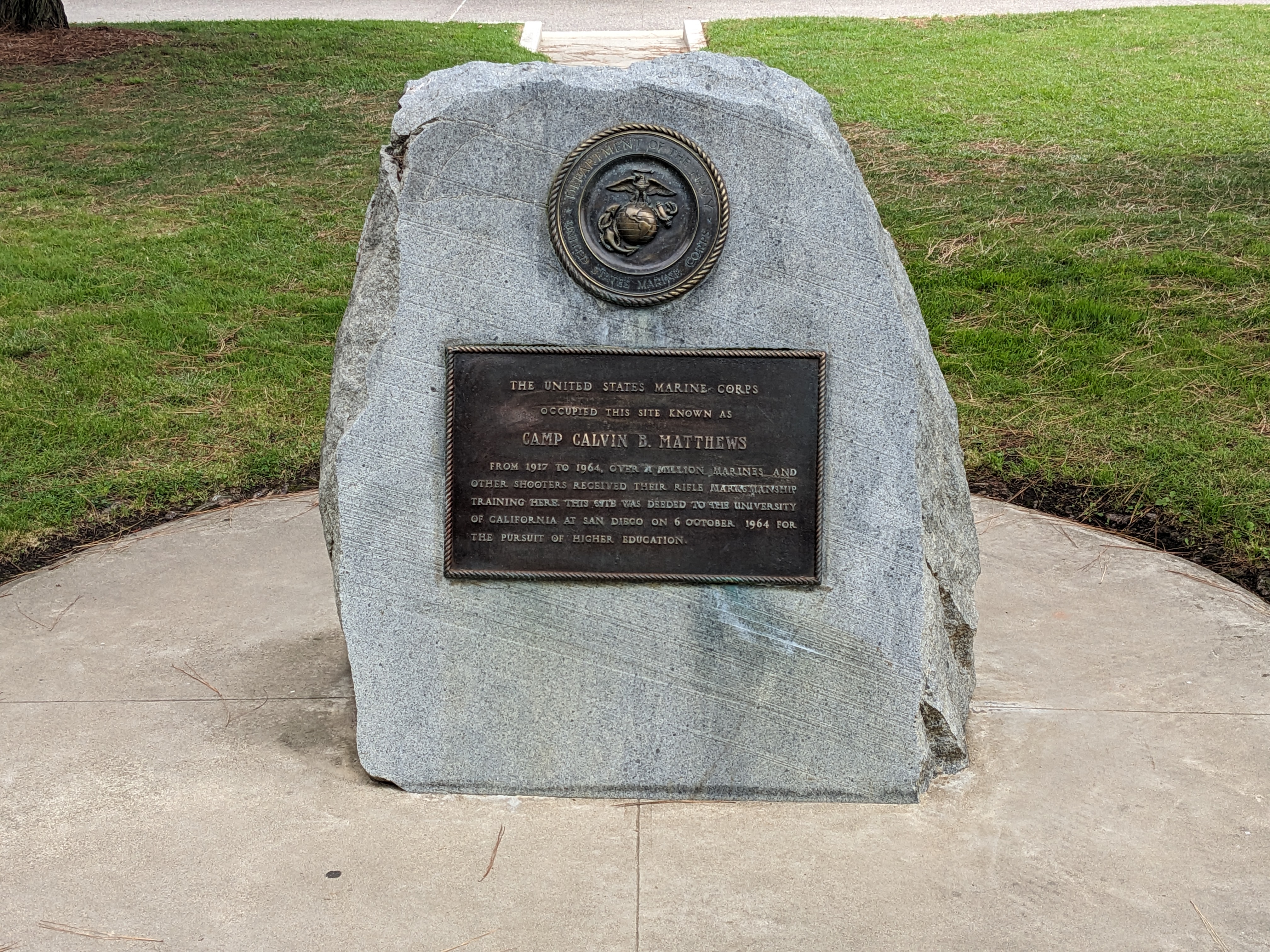
Camp Calvin B. Matthews
The Ché Café at UC San Diego is a small, weathered building that has hosted punk shows and radical political meetings since 1980. It is also one of the last surviving structures from Camp Calvin B. Matthews, the Marine Corps rifle range that operated on the same ground from 1917 to 1964. More than a million Marines fired weapons on the ranges here. The café that replaced the mess hall now serves vegan food and books DIY bands. The ordinance from the rifle ranges keeps turning up in the soil during campus construction projects.
A Million Marines
Camp Calvin B. Matthews was established in 1917, just as the United States entered World War I, as a rifle marksmanship training facility for the Marine Corps. The location — a broad mesa north of La Jolla, above the coastal canyons that drain toward the Pacific — offered the long sight lines that rifle training required. Over the next 47 years, through World War I, World War II, Korea, and into the early Cold War era, the camp trained Marines in the fundamentals of rifle shooting. By the time it closed in 1964, an estimated one million or more Marines had qualified on its ranges. The camp was named for Calvin B. Matthews, a Marine Corps officer who had served in the early twentieth century. The rifle ranges covered hundreds of acres of the mesa.
The Transition to UCSD
When the Marine Corps decommissioned Camp Matthews in 1964, the University of California San Diego — established just four years earlier in 1960 — was in the process of building a campus on the adjacent Torrey Pines mesa. The former rifle range land was transferred for university use, and UCSD expanded onto it. The conversion was not complete in the physical sense: the rifles ranges had deposited decades of lead bullets and other ordnance into the soil, and this legacy has complicated every major construction project on the affected portions of the campus. Environmental remediation efforts have been ongoing. Unexploded shells and bullets continue to be found. The mesa holds what it was given.
What the Ché Café Became
The Ché Café opened in 1980 in a former camp building — a structure that had served the Marines and was now being repurposed as a student cooperative. The name is a reference to Ernesto 'Che' Guevara, though students also adopted 'Cheap Healthy Eats' as a backronym. The cafe became a venue for punk, hardcore, and DIY music — a space where bands could play without the commercial pressures of larger venues. Zack de la Rocha of Rage Against the Machine performed there in his early years and has cited it as an important place. The Ché Café has survived multiple eviction attempts by the university, including significant battles in 2014 and 2017. It operates as a worker cooperative and remains one of the oldest continuously operating student-run cooperatives in the University of California system.
The Mesa Today
UC San Diego has grown into one of the leading research universities in the United States, particularly in oceanography, biology, and the physical sciences. Its campus spreads across the Torrey Pines mesa in a mix of mid-century modernist buildings, later additions, and outdoor sculpture — the Stuart Collection of site-specific artworks is distributed across the grounds. The Torrey pines at the edges of the mesa, the same rare species for which the area is named, grow on the coastal slopes in relative isolation from the campus activity above. Below the western bluffs, the Pacific runs cold and kelp-rich. Somewhere under the playing fields and parking structures and pathways, the lead of a million rifle rounds remains in the ground, slowly oxidizing, evidence of the purpose this mesa served before it became a place of learning.
From the Air
Located at 32.876°N, 117.228°W on the Torrey Pines mesa, within what is now the UC San Diego campus. The campus is clearly identifiable from the air by its dense mix of structures on the broad coastal plateau. Directly to the west, the mesa drops sharply to Black's Beach and the Pacific. The Torrey Pines Golf Course and Gliderport are visible to the northwest. San Diego International Airport (KSAN) lies approximately 11 miles to the south.