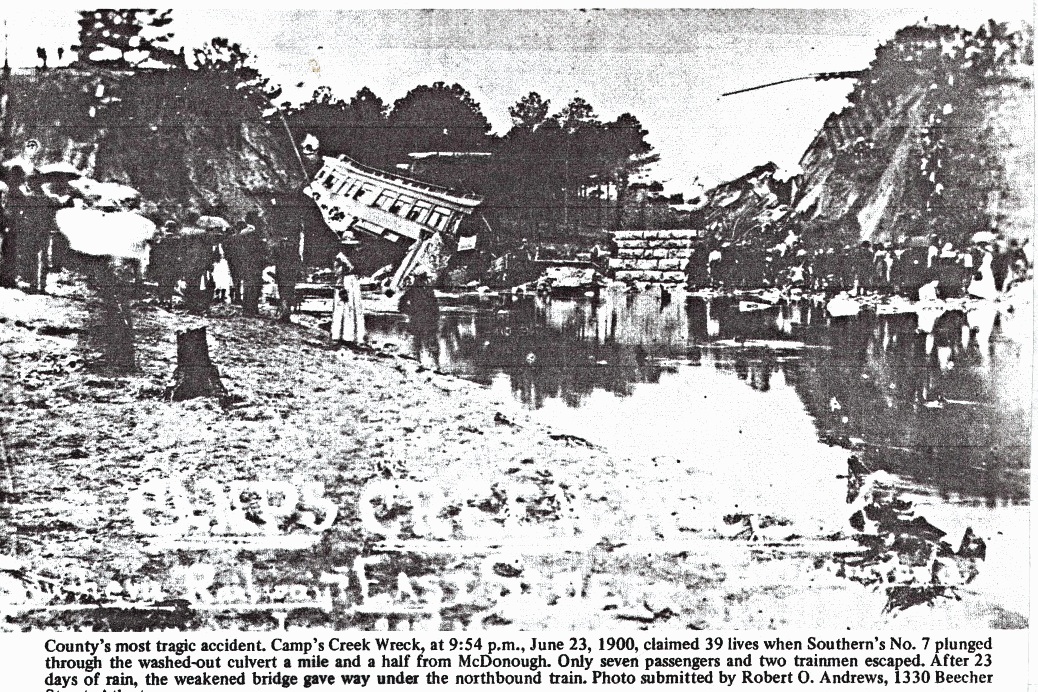
Camp Creek Train Wreck
"We'll either be having breakfast in Atlanta or Hell." Engineer J.T. Sullivan wasn't supposed to be at the throttle of Southern Railway No. 7 on the night of June 23, 1900. The regular engineer had stayed home because his daughter had come down with pneumonia, and Sullivan had agreed to fill in. By the time his train departed McDonough, Georgia, bound for Atlanta on a rain-lashed Saturday night, two weeks of continuous downpour had turned every creek in Henry County into a torrent. Sullivan never made it to breakfast anywhere. Just north of town, the brick supports of the Camp Creek trestle gave way beneath his locomotive, plunging the train 60 feet into the raging flood below. Thirty-five of the 45 people aboard died in what remains one of the deadliest rail disasters in Georgia history.
A Twist of Fate at McDonough
Southern engine No. 7 had departed Macon at 7:10 that evening hauling two coaches and a Pullman sleeper car. The plan was routine: arrive in McDonough, couple with a connecting train from Columbus, and haul the combined load north to Atlanta. But the Columbus train was late -- delayed, perhaps, by the same punishing weather that would soon destroy No. 7. This small miracle of scheduling meant the train left McDonough with far fewer passengers than it would have carried on a normal night. Had the Columbus connection arrived on time, the death toll would have been significantly higher. Sullivan received his orders to head north at around 9:45 p.m. Some of the passengers had already expressed nervousness about traveling in such severe conditions, but the train pulled out of the station and into the darkness.
Sixty Feet Into the Flood
The Camp Creek trestle appeared in No. 7's headlamp as a void. Two weeks of relentless rain had swollen the creek into a torrent that scoured away the bridge's brick supports. Sullivan saw the gap and threw the brakes, but momentum and wet rail conspired against him. The locomotive and its two coaches crashed through the collapsing trestle and dropped 60 feet into the rushing water. Almost immediately, the engine burst into flames, and fire consumed both coaches. The wooden cars splintered on impact, trapping their occupants in a nightmare of rising water and spreading fire. Only the Pullman sleeper car at the rear survived intact. Every one of the ten survivors was riding in that car. Not a single person in the locomotive or the forward coaches lived through the crash.
The Flagman's Run
Among the survivors in the Pullman car was flagman J.J. Quinlan. Battered and soaked, Quinlan was the first to claw his way up the muddy embankment from the wreckage. He found a length of rope and used it to haul two women from Boston -- Mary B. Merritt and Clara Alden -- out of the debris and up the slippery slope. Then he ran. Through the downpour and darkness, Quinlan made it back to McDonough to reach the telegraph office, where he gasped out the news of the wreck before collapsing on the floor. The entire male population of the town mobilized within the hour, but they could do nothing. The burning coaches kept rescuers at bay, and anyone still alive in those forward cars was beyond help. A relief train carrying doctors and ministers did not arrive from Atlanta until the following morning.
The Dead on the Square
Dawn revealed the full horror. The flames had burned through the night, and the bodies recovered were so badly crushed and charred that identification depended on whatever documents remained in pockets and luggage. The dead included three conductors, a cotton buyer, a Pullman conductor, section hands, firemen, and a 13-year-old boy traveling with his father -- both killed. Among the dead were also eight Black section hands, listed in the records of the era only as a group, without individual names. Four other bodies were never identified at all. Those without identification were carried to the McDonough town square and laid out for families to come and claim. Local lore holds that the square has been haunted ever since, a persistent ghost story rooted in the very real grief of that summer morning when the unclaimed dead waited in the Georgia heat for someone to speak their names.
What the Rain Left Behind
The Camp Creek train wreck killed 35 people and left only 10 survivors, making it one of the worst rail disasters in the American South at the turn of the twentieth century. It was a catastrophe born of infrastructure and weather: a bridge built for fair conditions, two weeks of rain that no one had planned for, and a schedule that sent a train into the night with no way to know the road ahead had vanished. Sullivan's dark joke at the station -- breakfast in Atlanta or Hell -- became the epitaph for a night when the ordinary machinery of travel met the indifference of a swollen creek. The site lies just north of modern-day McDonough, in the rolling piedmont country between Atlanta and Macon, where Camp Creek still runs through a landscape that has long since forgotten the trestle that once spanned it.
From the Air
Located at 33.46N, 84.16W, approximately 1.5 miles north of McDonough, Georgia, in the piedmont region between Atlanta and Macon. The site sits in the rolling terrain along Camp Creek. Nearest airports: Atlanta Hartsfield-Jackson International (KATL) approximately 20nm northwest, Henry County Airport (4A7) approximately 5nm south. The area is heavily developed suburban sprawl today, but the creek drainage is still visible from moderate altitudes. Best viewed at 2,000-3,000 feet AGL. The terrain is relatively flat with gentle hills typical of the Georgia piedmont.