Camp David: Where Presidents Escape and History Gets Made
You will not find it on any map of Catoctin Mountain Park. The National Park Service omits its location entirely, for reasons of privacy and security. Yet this wooded compound in Frederick County, Maryland, about 100 kilometers north-northwest of Washington, D.C., has shaped the course of modern diplomacy more than most embassies. Roosevelt called it Shangri-La. Eisenhower renamed it Camp David after his grandson. Every president since has retreated to its cabins, and the deals struck among its trees - from the Camp David Accords to post-September 11 war planning - have altered the trajectory of nations. Technically classified as Naval Support Facility Thurmont, Camp David is a military installation staffed by Seabees, the Navy, and the Marine Corps. But its real function has always been something harder to define: a place where the weight of the presidency lifts just enough for consequential thinking.
From Hi-Catoctin to Shangri-La
The compound began as something far more modest. Originally known as Hi-Catoctin, it was built by the Works Progress Administration between 1935 and 1938 as a retreat for federal government agents and their families. In 1942, President Franklin D. Roosevelt converted it to a presidential retreat, rechristening it Shangri-La after the fictional Himalayan paradise from James Hilton's novel. The name captured Roosevelt's intent - a place impossibly removed from the pressures of wartime Washington. When Dwight Eisenhower took office, he renamed the retreat Camp David in honor of his grandson, David Eisenhower. The name stuck, and with it a tradition: every president since has made the mountain retreat their own, imprinting personal habits and preferences onto the rustic cabins nestled among the hardwood forest.
The Diplomacy of Informality
Camp David's power as a diplomatic venue lies in what it lacks. There are no marble halls, no press galleries, no ceremonial staircases. The informality of the setting has a way of stripping protocol and encouraging candor. Eisenhower hosted Nikita Khrushchev for two days of discussion in September 1959, at the height of Cold War tension. Jimmy Carter brokered the Camp David Accords there in September 1978, bringing Egyptian president Anwar al-Sadat and Israeli prime minister Menachem Begin together for negotiations that produced a framework for Middle East peace. Bill Clinton attempted a similar feat at the 2000 Camp David Summit, hosting Israeli prime minister Ehud Barak and Palestinian Authority chairman Yasser Arafat. In February 2001, George W. Bush chose Camp David for his first meeting with a European leader, British prime minister Tony Blair, to discuss missile defense, Iraq, and NATO.
The War Room in the Woods
After the September 11 attacks, George W. Bush convened a Cabinet meeting at Camp David to prepare the United States invasion of Afghanistan. During his two terms, Bush visited Camp David 149 times, spending a total of 487 days there - more than any other president of his era. The compound served as both personal sanctuary and operational command center. Barack Obama hosted the 38th G8 summit there in 2012 and later the GCC Summit in 2015. Donald Trump planned to bring Taliban leaders to Camp David in 2019 to negotiate a peace agreement for Afghanistan, but canceled after a suicide bombing in Kabul killed American troops. Joe Biden hosted the U.S.-Japan-Korea Summit in August 2023, producing the Camp David Principles on trilateral cooperation. The pattern repeats: when the stakes are highest, presidents leave the White House for the mountain.
Par 3 and F-15s
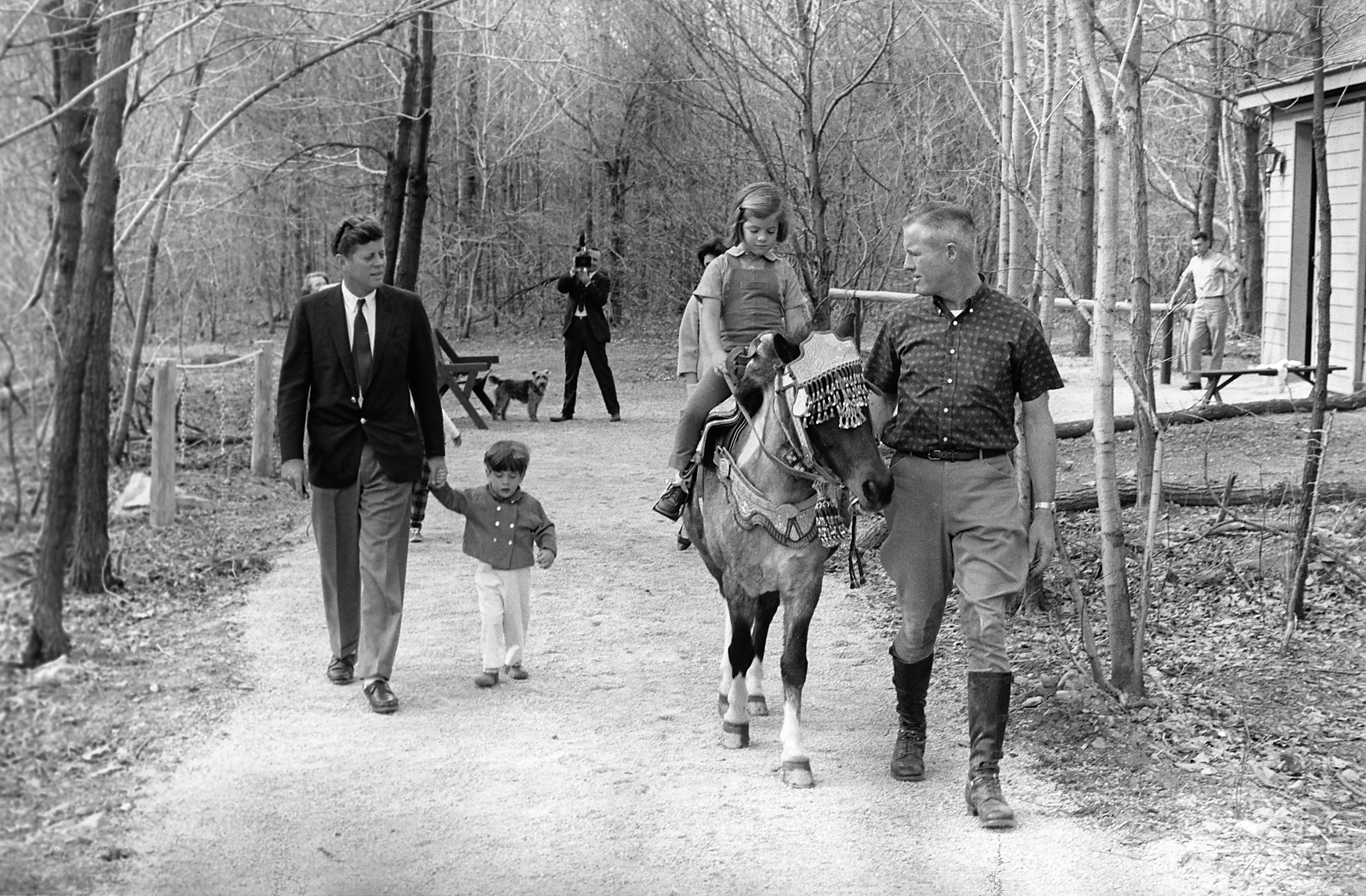
For all its gravity, Camp David has its lighter side. President Eisenhower, devoted to golf, commissioned architect Robert Trent Jones to design a practice facility on the grounds around 1954. Jones built a single par-3 hole with four different tees, and Eisenhower added a driving range near the helicopter landing zone. John F. Kennedy and his family enjoyed horseback riding. Richard Nixon personally directed the construction of a swimming pool and improvements to Aspen Lodge. Reagan restored nature trails that Nixon had paved over. George H. W. Bush's daughter, Dorothy Bush Koch, was married there in 1992 - the first wedding ever held at Camp David. Clinton made it a family tradition, spending every Thanksgiving at the retreat. The compound's restricted airspace, meanwhile, is defended with less subtlety: on a single weekend in July 2011, F-15 fighters intercepted three civilian aircraft that strayed too close while President Obama was in residence.
The Mountain That Does Not Appear
Camp David occupies a peculiar space in American life - universally known, perpetually invisible. Its location in the Catoctin Mountains is an open secret, yet the National Park Service respects the fiction of concealment by leaving it off official maps. The compound sits near the towns of Thurmont and Emmitsburg, surrounded by the same forests and ridgelines that stretch across the Blue Ridge. From the air, restricted airspace marks its presence more clearly than any physical feature. Underground, a Navy-operated facility called Orange One provides hardened communications capability, while nearby Site R at Raven Rock Mountain serves as a bunker and communications center. The retreat has no public tours, no visitor center, no gift shop. It exists entirely for its occupant, whoever that may be - a patch of wooded Maryland where the most powerful person on Earth can walk among the trees and decide what comes next.
From the Air
Located at 39.65N, 77.47W in the Catoctin Mountains of Frederick County, Maryland. Camp David sits within restricted airspace - pilots should be aware of the prohibited area (P-40) surrounding the facility. The compound is not visible from altitude due to dense tree canopy; there are no distinctive structures or clearings that would identify it from the air. The surrounding Catoctin Mountain Park terrain features rolling, forested ridgelines typical of the Blue Ridge. The nearest airports are Hagerstown Regional Airport (KHGR) approximately 35 km to the west and Frederick Municipal Airport (KFDK) about 30 km to the south. Washington Dulles International (KIAD) is approximately 90 km to the southeast. Be aware of temporary flight restrictions (TFRs) that are frequently active when the president is in residence.