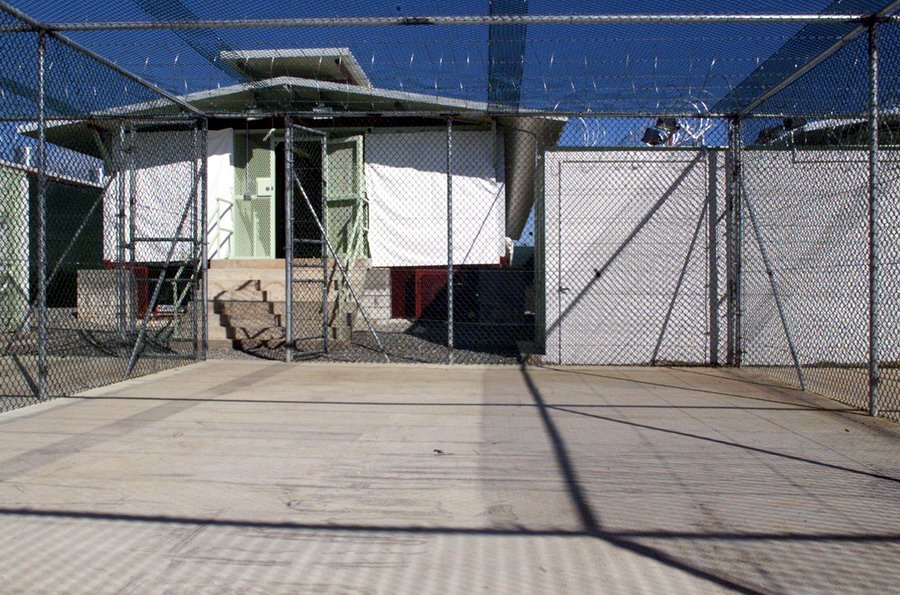
Camp Delta, Guantanamo Bay
The jumpsuits tell you everything. Orange means you are non-compliant - a detainee who has not cooperated with guards or interrogators. White means you have earned privileges: communal meals, longer showers, a bed with a locker. The color system at Camp Delta, the permanent detention facility at Guantanamo Bay, reduces the complexities of law, war, and human rights to a wardrobe choice made by someone else. Built in early 2002 by Navy Seabees, Marine Engineers, and workers from the Halliburton subsidiary Kellogg, Brown and Root, Camp Delta replaced the temporary open-air cages of Camp X-Ray with something more permanent - and more troubling. Here, on 116 square kilometers of Cuban soil that the United States controls but does not own, hundreds of people classified as "enemy combatants" were held in a legal framework that existed nowhere else on Earth. Not prisoners of war. Not criminal defendants. Detainees, a word chosen precisely because it carried no established rights.
A Hierarchy of Cages
Camp Delta is not one facility but many, each calibrated to a different level of control. Newly arrived detainees go directly to Camp 3, maximum security. Cooperation earns a transfer to Camp 2, then Camp 1. The reward for sustained compliance is Camp 4, where detainees sleep in communal rooms of ten, eat meals together, and wear the white jumpsuits that signal their status. Camp 5, modeled on a maximum-security federal prison in Terre Haute, Indiana, cost $17.5 million and was built to hold the most resistant prisoners. Its disciplinary annex, Camp 5 Echo, drew particular criticism - cells half the size of those in Camp 5, squat toilets set into the floor, lighting that never dimmed. Lawyer David Remes described it in 2011 as "a throwback to the bad old days at Guantanamo."
Then there was Camp 7, also called Camp Platinum. Strictly off-limits to journalists, it held the fourteen "high-value detainees" transferred from CIA custody in September 2006. Military lawyers who visited concluded in February 2012 that conditions fell short of minimum Geneva Convention guarantees.
The Legal Nowhere
Camp Delta's location was not incidental - it was the point. Guantanamo Bay sits on Cuban soil leased to the United States under a 1903 treaty. The detainees held there occupied a legal gray zone that the U.S. government argued placed them beyond the reach of American courts and outside the protections of the Geneva Conventions. They were not on American soil, so constitutional rights did not automatically apply. They were not prisoners of war, so the conventions governing wartime captivity did not either. What remained was a framework created specifically for this place and these people - Combatant Status Review Tribunals, Administrative Review Boards, and military commissions operating under rules that shifted as legal challenges mounted.
The Supreme Court weighed in repeatedly. In 2004, Rasul v. Bush established that federal courts had jurisdiction to hear habeas corpus petitions from Guantanamo detainees. In 2006, Hamdan v. Rumsfeld struck down the military commission system. Each ruling chipped away at the legal architecture, but the facility persisted. President Obama ordered it closed by January 2010. Congress refused to fund the closure. The camps remained.
Behind the Wire
What happened inside Camp Delta became a matter of fierce dispute. In 2005, Arabic translator Erik Saar described detainees subjected to sexual interrogation techniques and physical assaults by "snatch squads" - in one incident, a prisoner's arm was broken. During a training exercise, a U.S. soldier playing the role of a prisoner was beaten so severely he suffered brain damage. In November 2007, WikiLeaks published the 238-page Camp Delta Standard Operating Procedures manual, which included protocols for managing hunger strikes, instructions for psychological manipulation, and guidelines for using military dogs to intimidate prisoners.
The ACLU raised alarms that some detainees had been hidden from International Committee of the Red Cross representatives - a violation of international law. Human Rights Watch documented conditions camp by camp in a June 2008 report, finding that facilities officially closed were still in use, holding non-compliant prisoners in isolation. Camp 6, built by Halliburton and designed as a medium-security facility with communal areas, had been converted before completion into a high-security lockdown. The communal mess halls sat empty. When The Guardian documented the facility in 2010, detainees in Camp 6 were shackled to the floor during their television time.
The Weight of the Question
Camp Delta forced a question that American democracy had avoided: what rights belong to people captured in a war with no battlefield, no uniforms, and no foreseeable end? The answer changed depending on who was asking. For the government, the facility represented a necessary adaptation - a secure location for people deemed too dangerous to release but too difficult to prosecute in conventional courts. For critics, it represented the abandonment of principles the nation claimed to fight for. For the detainees themselves - some held for more than a decade without charge - it was simply the place where years disappeared.
The numbers tell part of the story. At its peak, Camp Delta held roughly 680 detainees. Hundreds were eventually released without charge. Some returned to violence. Others returned to lives destroyed by years of detention. The facility shrank but did not close, each administration inheriting a problem none could solve - because the question Camp Delta posed was never really about security. It was about whether rights are universal or conditional, and whether a nation built on law can indefinitely maintain a place designed to exist outside it.
From the Air
Located at 19.90N, 75.10W on the southeastern coast of Cuba within the Guantanamo Bay Naval Base (ICAO: MUGM). Camp Delta sits on the eastern side of the bay, visible from altitude as a cluster of low buildings surrounded by fencing near the coast. The naval base's Leeward Point Field airstrip (2,400m runway) is on the western shore. The facility is approximately 8 km from the bay entrance and can be distinguished from other base structures by its security perimeter. From 5,000 ft, the overall base layout is clearly visible - look for the runway, the bay's horseshoe shape, and the detention compound on the eastern shore. Caimanera, the nearest Cuban town, is visible on the inner bay's western shore. Santiago de Cuba (ICAO: MUCU) is roughly 65 km west. Semi-arid climate with clear skies common.