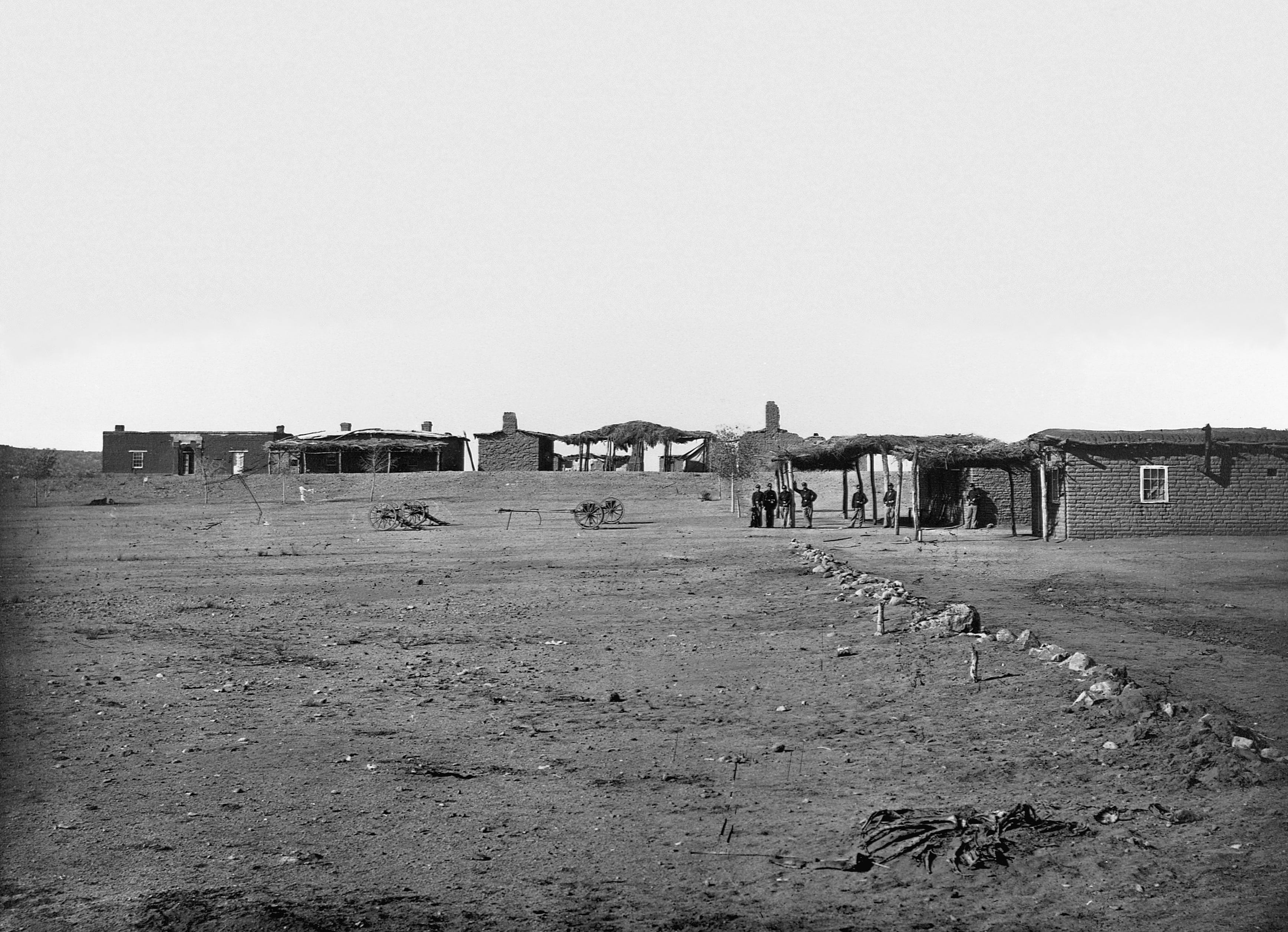
Camp Grant Massacre
The jury took nineteen minutes. That was all the time required to acquit 100 defendants charged with 108 counts of murder. Outside the Tucson courthouse in December 1871, the men who had killed 144 Apaches walked free, their deed endorsed by their neighbors. President Ulysses S. Grant had threatened to place Arizona under martial law if the perpetrators were not tried. They were tried. They were not convicted. And for over a century, Arizona would work to forget what happened at Camp Grant on the morning of April 30, 1871.
A Refuge Along the Creek
In February 1871, five elderly Apache women arrived at Camp Grant, a sun-scorched collection of adobe buildings about fifty miles northeast of Tucson. They were looking for a son who had been taken prisoner. Lieutenant Royal Emerson Whitman, the 37-year-old commanding officer, fed them and treated them with kindness. Word spread. Within weeks, nearly 500 Aravaipa and Pinal Apaches had gathered at a refuge Whitman established along Aravaipa Creek, about five miles east of the post. Chief Eskiminzin led them. They began cutting hay for the fort's horses and harvesting barley in nearby fields. For a moment, it seemed peace might take root in the Arizona desert.
The Economics of War
Peace was bad for business. Tucson merchants had built their livelihoods on what historians call the 'blankets for peace' economy, selling goods to the federal government for distribution to hostile tribes. With the Apaches settling peacefully at Camp Grant, that revenue stream was drying up. Some Arizonans allegedly staged mock raids on isolated settlements to bolster public support for renewed hostilities. Lieutenant Whitman sensed the danger. He urged Eskiminzin to move his people to the White Mountains near Fort Apache. The chief refused. The Aravaipa homeland was along this creek, in the shadow of these mountains. He would not leave.
Before Dawn
On the morning of April 30, 1871, a vigilante force descended on the sleeping camp. William S. Oury and Jesus Maria Elias had assembled a coalition as diverse as it was deadly: Anglo Americans, Mexican Americans, and Tohono O'odham warriors who had been enemies of the Apache for generations. The attack came before dawn. The Apache men were away from camp, hunting. What followed was not a battle but a slaughter. When it ended, 144 Aravaipas and Pinals lay dead, nearly all of them women, children, and elderly. Almost all had been scalped. Twenty-seven children were taken captive, most of them eventually sold off, their fates unrecorded.
A President's Ultimatum
Lieutenant Whitman returned to find the bodies. He searched for survivors, finding only one wounded woman. He buried the dead and sent interpreters into the mountains to assure the Apache men that his soldiers had not participated in what he called the 'vile transaction.' The Eastern press called it a massacre, and the story reached Washington. President Grant informed Arizona Governor A.P.K. Safford that if the perpetrators were not prosecuted, the territory would face martial law. A grand jury indicted 100 assailants. The trial focused almost exclusively on Apache depredations. Nineteen minutes of deliberation. Not guilty.
The Architecture of Forgetting
The Camp Grant Massacre posed a problem for Arizona's narrative of itself. The attackers were not rugged Anglo pioneers subduing the wilderness, but a multi-ethnic coalition that included Mexican Americans and indigenous O'odham. This complicated the story white Americans wanted to tell about the West. So the massacre faded from memory, displaced by tales of military campaigns against Geronimo. The perpetrators preserved their version through the Society of Arizona Pioneers, which later became the Arizona Historical Society. Today, no marker stands at the massacre site. Its exact location is only generally known, somewhere south of Aravaipa Creek, about five miles upstream from where Camp Grant once stood. In 2021, descendants of those killed spoke out against a proposed copper mine at nearby Oak Flat. The silence, it seems, is finally breaking.
From the Air
Located at 32.85N, 110.70W in the San Pedro River Valley northeast of Tucson. The massacre site lies south of Aravaipa Creek near its confluence with the San Pedro River. Best viewed at 3,000-5,000 feet AGL. The terrain is rugged desert canyon country with the Galiuro Mountains to the east and the Santa Catalina Mountains to the west. Tucson International Airport (KTUS) lies 45nm southwest. Safford Regional Airport (KSAD) is 35nm northeast. The site has no marker and the exact location remains uncertain, but Aravaipa Canyon is visible as a dramatic gash in the landscape running east toward the Galiuros.