Camp Las Casas
In January 1905, hundreds of Puerto Rican civilians applied for officer appointments in the Porto Rico Regiment. Seven made it through the examination. One of them was Teofilo Marxuach, a civil engineer who had been building aqueducts in the mountain town of Cayey. These men were training to serve in the United States Army, but they were not United States citizens. They were citizens of Puerto Rico -- a territory the U.S. had acquired from Spain seven years earlier, renamed "Porto Rico" by military decree, and governed under laws its residents had no vote in shaping. The camp where they trained, in the Santurce neighborhood of San Juan, would spend the next four decades sending Puerto Rican soldiers into American wars under precisely this contradiction.
A Regiment Built on Paradox
Camp Las Casas was established in 1904 as the home of the Porto Rico Regiment of Infantry, a segregated unit created by Act of Congress the same year. The segregation policy imported from the mainland sat uneasily in Puerto Rico, where racial categories had never tracked neatly along the binary lines the U.S. military demanded. Antonio Guzman's case was typical: assigned to a white regiment, then reassigned to a Black one, he requested a hearing and argued against the classification. He lost. Puerto Ricans were expected to sort themselves into American racial categories that bore little resemblance to the island's social reality, and then to serve in a military that used those categories to determine where they ate, slept, and fought. Captain Luis R. Esteves, the first Hispanic graduate of West Point, arrived at Camp Las Casas to train Puerto Rican officers for the regiment. An Act of Congress in 1908 folded the unit into the Regular Army, but because the officers were Puerto Rican citizens rather than American ones, they were required to take a new oath of U.S. citizenship alongside their commissions -- citizenship conferred by individual military necessity, not by law.
Citizenship, Then the Draft
On March 2, 1917, Congress passed the Jones-Shafroth Act, granting United States citizenship to Puerto Ricans -- a change the Puerto Rican House of Delegates had actually voted to reject. The timing was not coincidental. Five weeks later, on April 6, Congress declared war on Germany. Puerto Ricans were now citizens and immediately eligible for the draft. Within a month the regiment at Camp Las Casas had recruited 1,969 men to war strength. Among those who reported to the camp was Dr. Dolores Pinero, who applied to serve as a contract surgeon after being told the Army had enough male physicians. She wrote directly to the Surgeon General in Washington, received a telegram ordering her to Camp Las Casas, and became one of the first female doctors to work under contract for the U.S. Army -- though contract physicians had little status, no uniform, and minimal authority. In May 1917, the Porto Rico Regiment shipped to Panama to defend the Canal Zone. While stationed there, an estimated 335 Puerto Rican soldiers were wounded by chemical gas experimentation conducted by the United States as part of its active weapons testing program.
From Santurce to Corsica
The regiment returned from Panama in 1919 and was renamed the 65th Infantry Regiment. That same year, Felix Rigau Carrera -- known as El Aguila de Sabana Grande, the Eagle from Sabana Grande -- flew the first air mail route from Camp Las Casas, and the base began doubling as an airfield. Through the Depression years, when Puerto Rico's unemployment ran deep, the military offered one of the few steady paychecks on the island, and Camp Las Casas filled with recruits. By 1941, the 65th Infantry was training intensively under Colonel John R. Mendenhall, running maneuvers at Punta Salinas near the southern town of Salinas. In November 1943, Colonel Antulio Segarra took command -- the first Puerto Rican Regular Army officer to lead a Regular Army regiment. Under Segarra, the 65th embarked from Camp Las Casas to Jackson Barracks in New Orleans, then to Fort Eustis in Virginia, and finally across the Atlantic to Casablanca. By April 1944 they had landed in Italy and moved on to Corsica, carrying with them the training ground of Santurce into a war half a world away.
What Remains of the Camp
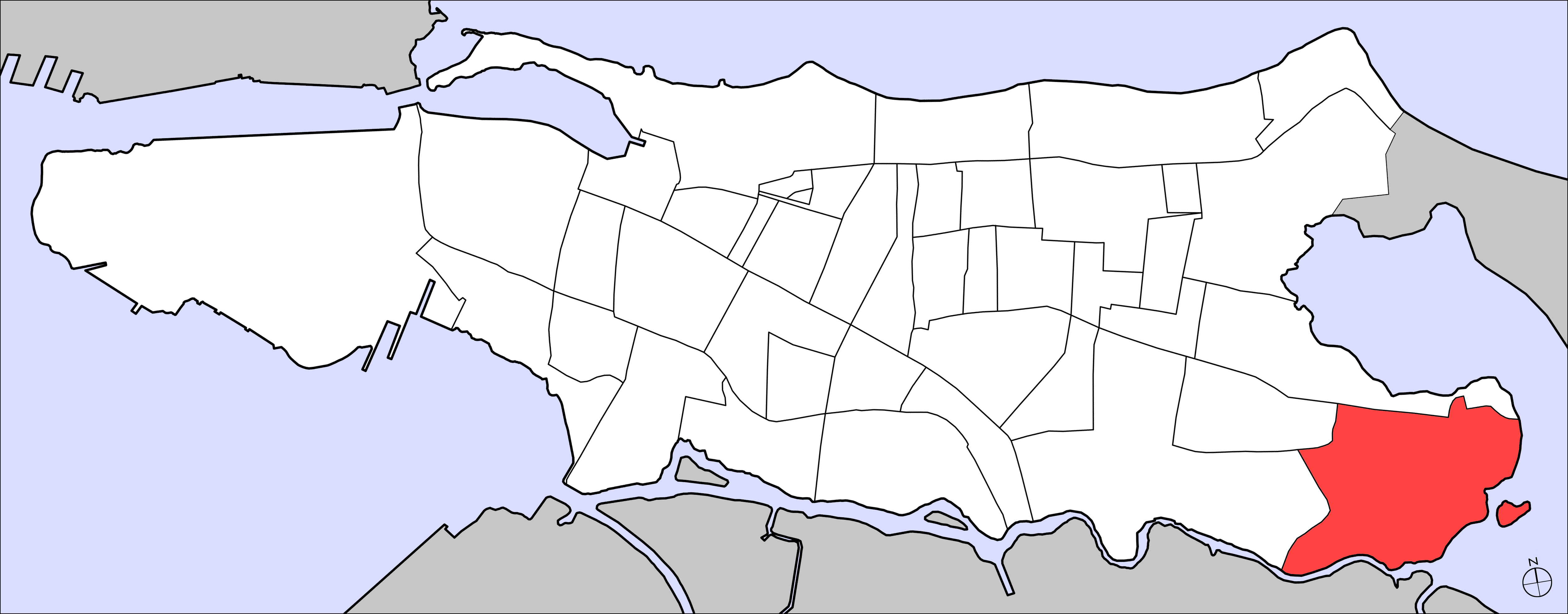
Camp Las Casas closed in 1946. The Santurce neighborhood absorbed it, the way cities absorb all the spaces that wars leave behind. In 2019, a lake at Fort Buchanan -- the Army base that succeeded Camp Las Casas as the main military installation in the San Juan metro area -- was named Las Casas Lake, a small monument to a place most Puerto Ricans no longer remember as anything but a street name or a housing project. The camp's real legacy is the regiment it produced. The 65th Infantry went on to fight in Korea, where its soldiers earned the nickname Borinqueneers and, decades later, the Congressional Gold Medal. But the story that began at Camp Las Casas was always shadowed by the terms under which these soldiers served -- trained to fight for a nation that granted them citizenship when it needed their bodies, subjected to racial segregation policies alien to their culture, and exposed to chemical weapons testing by the country whose flag they carried. The camp is gone, but the questions it raised about citizenship, obligation, and whose wars these were have never fully been answered.
From the Air
Located at 18.433N, 66.040W in the Santurce district of San Juan, Puerto Rico. The camp no longer exists as a military installation -- the area is now part of the dense urban fabric of Santurce. Fort Buchanan (18.411N, 66.108W), the nearest active military installation, is approximately 4 nm west. Nearest airports: Fernando Luis Ribas Dominicci (TJIG) approximately 2 nm west, Luis Munoz Marin International (TJSJ) approximately 5 nm east. The Santurce neighborhood is identifiable from the air as a densely built urban area between Old San Juan to the west and the Marin airport to the east, bordered by the Atlantic to the north and San Juan Bay to the south.