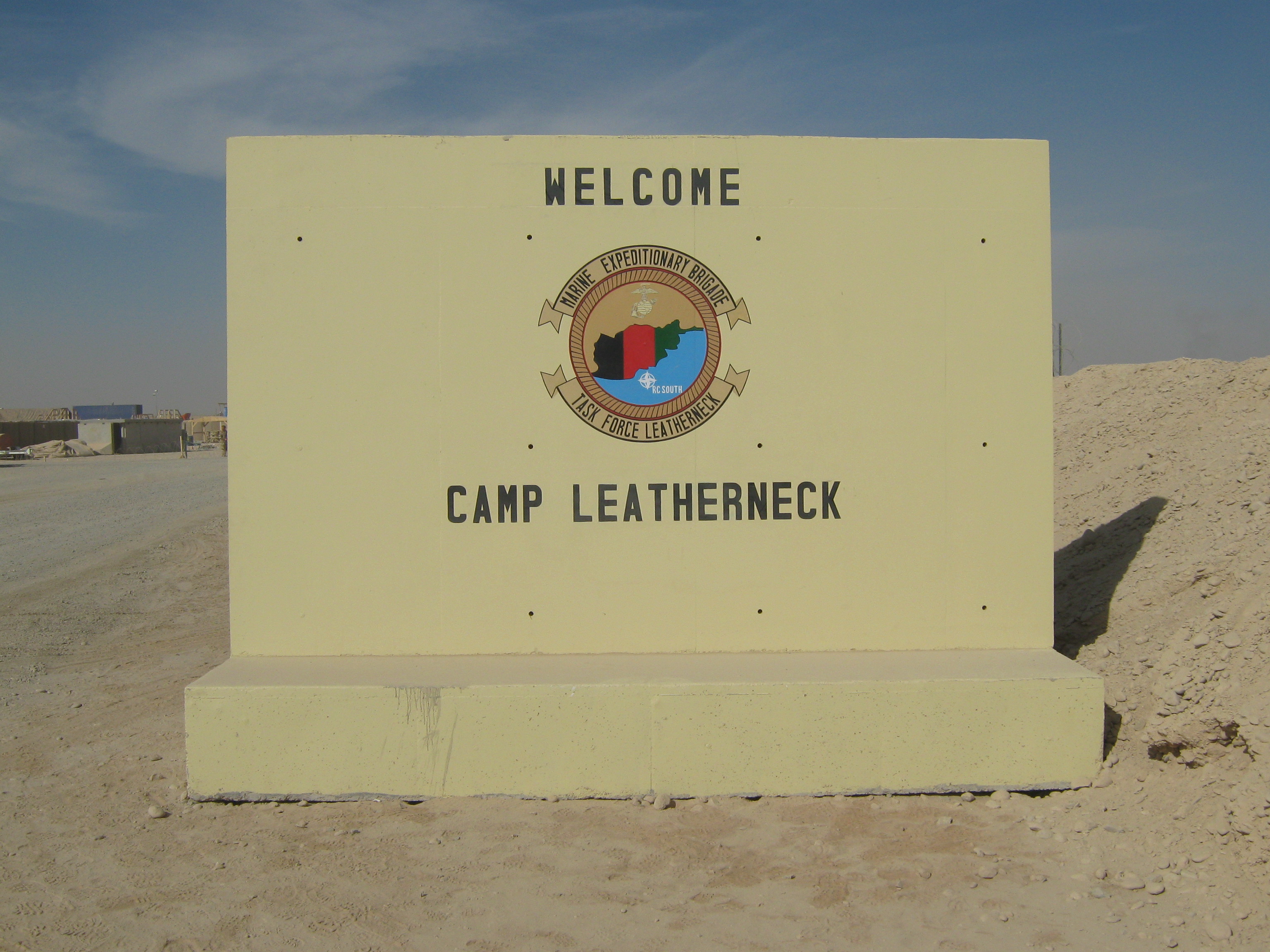
Camp Leatherneck
They called it Tombstone II at first, which turned out to be an ominous name for a place built to house the largest surge of American forces into southern Afghanistan. In late November 2008, a team from the U.S. Army Corps of Engineers broke ground on 1,600 acres of flat Helmand Province desert, and within four months they had raised a functioning military city from nothing but sand and ambition. By the time it was renamed Camp Leatherneck and the I Marine Expeditionary Force claimed it as their own, the base could shelter over 12,000 troops and an equal number of civilian contractors. It was a feat of engineering that rivaled any in the modern military, and it would be abandoned in just six years.
A City Built on Speed
The engineering challenge was staggering. Every base in southern Afghanistan had reached capacity, and an estimated 26,000 additional U.S. troops were heading into the country under President Obama's surge authorization. The Corps of Engineers FEST-A team, flown in from Wiesbaden, Germany, chose this patch of Helmand desert for two reasons: its adjacency to Camp Bastion's British airfield, and its position along Highway 1, the critical east-west corridor. The base was designed in modular blocks so that troops could occupy finished sections while construction continued next door. Naval Mobile Construction Battalions Seven, Five, and Seventy-Four -- the Seabees -- drove the work. The result was a small city with the grid logic of a circuit board, every element calculated for speed rather than permanence.
The Weight of War
Camp Leatherneck saw its share of violence without ever being the front line. In May 2010, a fire in the Supply Management Unit burned for eight hours while one of the worst sandstorms in the base's history tore through simultaneously -- firefighters from three nations battled both at once. In September 2012, Taliban fighters breached the perimeter of the adjacent Camp Bastion, killing two Americans and destroying or damaging multiple aircraft, including six AV-8B Harrier jump jets. The attack exposed vulnerabilities that no amount of planning had anticipated. Meanwhile, the base grew into a small aviation empire: Harriers, SuperCobras, Ospreys, and Sea Stallions rotated through in a dizzying succession of Marine Aircraft Wing deployments, their rotor wash a constant presence over the desert.
Thirty-Four Million Dollars and a Ghost
Not everything built at Leatherneck served its purpose. In 2013, the Special Inspector General for Afghanistan Reconstruction reported that $34 million had been spent on a 64,000-square-foot facility that would presumably never be used. The revelation became a symbol of the broader questions haunting the Afghan campaign: how much was enough, how much was too much, and who would benefit from what was left behind. The answer, when it came, was sobering. When the base transferred to Afghan control in October 2014, 420,000 bottles of water -- enough to stretch more than 50 miles if lined up end to end -- sat in storage. Ten thousand MREs were incinerated rather than passed along to Afghan troops because they were nearing expiration. More than 7,500 computers were destroyed or removed. The television sets, at least, remained.
Flags Furled, Anthems Played
The ceremony on October 26, 2014, was brief and solemn. Service members from three nations -- American, British, and Afghan -- stood at attention while their anthems played in sequence. U.S. Marine flags were furled and cased, the formal military gesture that signifies the end of a mission. Camp Bastion became Camp Shorabak, absorbing Leatherneck into a single Afghan-controlled installation. For the thousands of Marines, soldiers, sailors, and airmen who had rotated through its dusty blocks, the moment carried a particular weight. They had built something enormous in the desert, lived and fought and lost friends within its perimeter, and now they were folding it up and handing over the keys.
What the Desert Keeps
Today the site sits in Washir District, a place few Americans could locate on a map but many remember vividly. The modular blocks that once hummed with generators and mess hall chatter are under Afghan jurisdiction, their future uncertain. From the air, the geometric footprint remains visible against the surrounding emptiness -- straight lines and right angles imposed on a landscape that has never favored order. Camp Leatherneck lasted six years as an American installation. The desert it was built on has been there for millennia, and it will outlast whatever comes next.
From the Air
Located at 31.89°N, 64.20°E in Helmand Province, Afghanistan. The base's geometric footprint is visible from altitude against the surrounding desert. Adjacent to Camp Bastion (now Camp Shorabak). Nearest major airport: Kandahar International Airport (OAKN), approximately 150 km east. Terrain is flat desert with minimal obstructions. Best viewed at 5,000-10,000 feet AGL for full layout perspective.