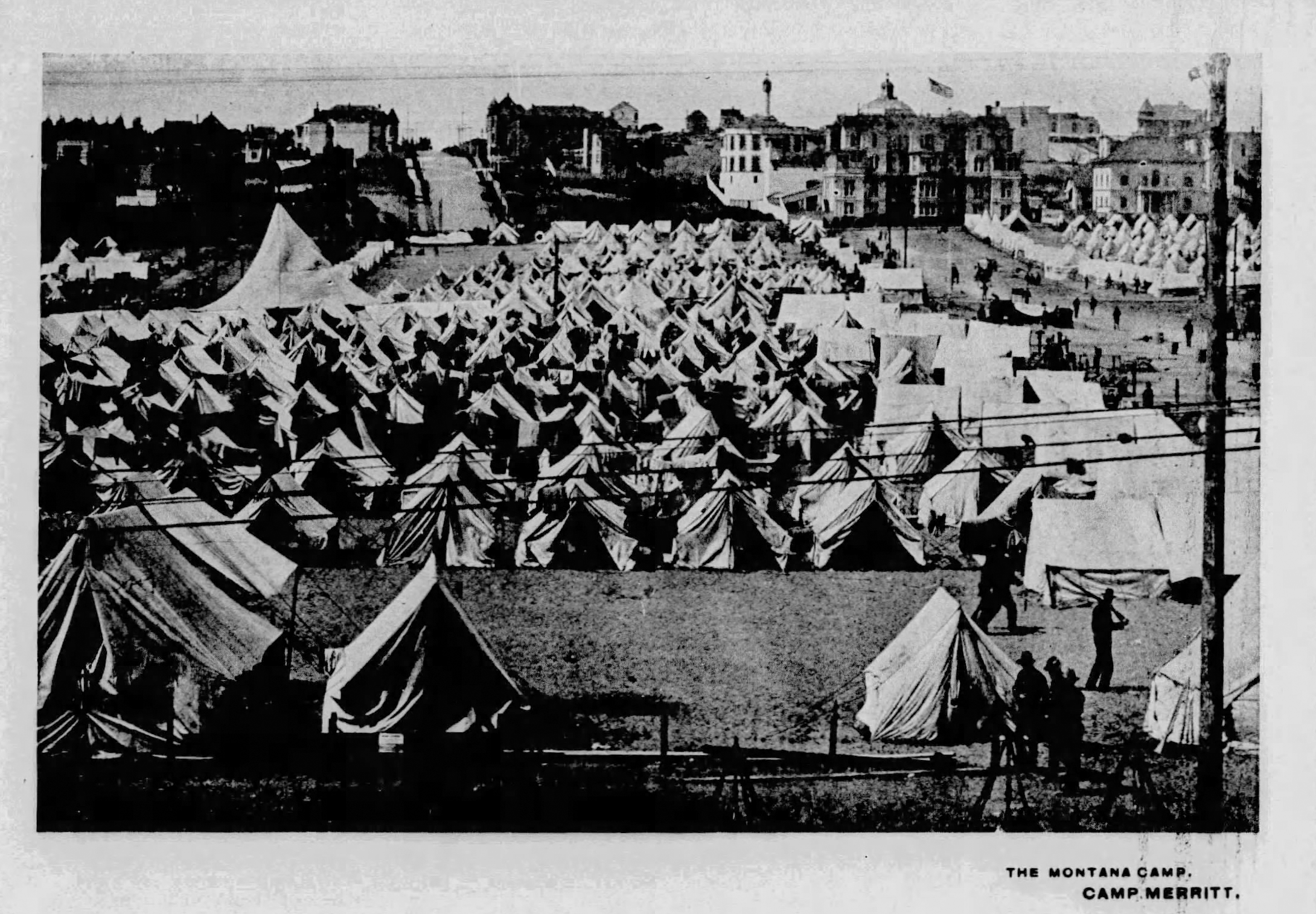
Camp Merritt, California
For ninety days in the summer of 1898, a racetrack in San Francisco's Richmond District became a staging ground for America's first overseas war. Camp Merritt -- named for General Wesley Merritt, commanding general of the Eighth Army Corps -- processed 18,000 troops bound for the Philippines during the Spanish-American War. The camp was established on May 29, ravaged by measles and typhoid, and abandoned by August 27. Three months of organized chaos on what had been a horse track, and then the soldiers were gone, the tents struck, and San Francisco absorbed the land back into its expanding grid.
The Racetrack Goes to War
Camp Merritt occupied a tract bounded roughly by what are now Point Lobos Avenue (Geary Boulevard), Fulton Street, Arguello Boulevard (then called First Avenue), and Sixth Avenue -- deep in the residential Richmond District, in an area that would later be swallowed by the city's western expansion. Before the war, the site had been a racetrack, its oval scraped into the sandy soil of the Outer Richmond. In May 1898, pursuant to General Order 7 of the U.S. Expeditionary Forces, General Elwell Stephen Otis transformed it into headquarters for the Philippine Islands Expeditionary Forces, placing his command post on slightly elevated ground at the southwest corner, at Fulton Street and 4th Avenue.
Disease and Departure
The camp's problems were immediate and severe. Measles and typhoid swept through the crowded tent rows, accelerating the timeline for getting troops aboard ships and out to sea. The infrastructure of a racetrack was not designed for the sanitary needs of thousands of soldiers living in close quarters, and the medical challenges compounded the logistical ones. The entire purpose of Camp Merritt was speed: assemble the fleet, load the troops, and ship them to Manila Bay before the Spanish could reinforce their Pacific colonies. The camp existed only long enough to accomplish that task, a military installation measured in weeks rather than years.
Vanished Without a Trace
When the remaining troops transferred to Camps Merriam and Miller at the Presidio of San Francisco around August 27, Camp Merritt ceased to exist. No monuments mark its boundaries today. The racetrack-turned-military camp was absorbed into the residential blocks of the Richmond District, its tent sites now occupied by row houses and corner stores. The site sits just south of Golden Gate Park, in a neighborhood that gives no visible indication that 18,000 soldiers once bivouacked here, falling sick, drilling, and waiting for orders to ship out to a war that would make the United States a Pacific power for the first time.
From the Air
Located at 37.7765°N, 122.462°W in San Francisco's Richmond District, just south of Golden Gate Park. The former camp area is bounded roughly by Geary Boulevard, Fulton Street, Arguello Boulevard, and 6th Avenue. Best viewed at 1,500-3,000 feet AGL. Nearest airports: KSFO (13 nm south), KOAK (12 nm east). The site is now entirely residential, indistinguishable from the surrounding grid.