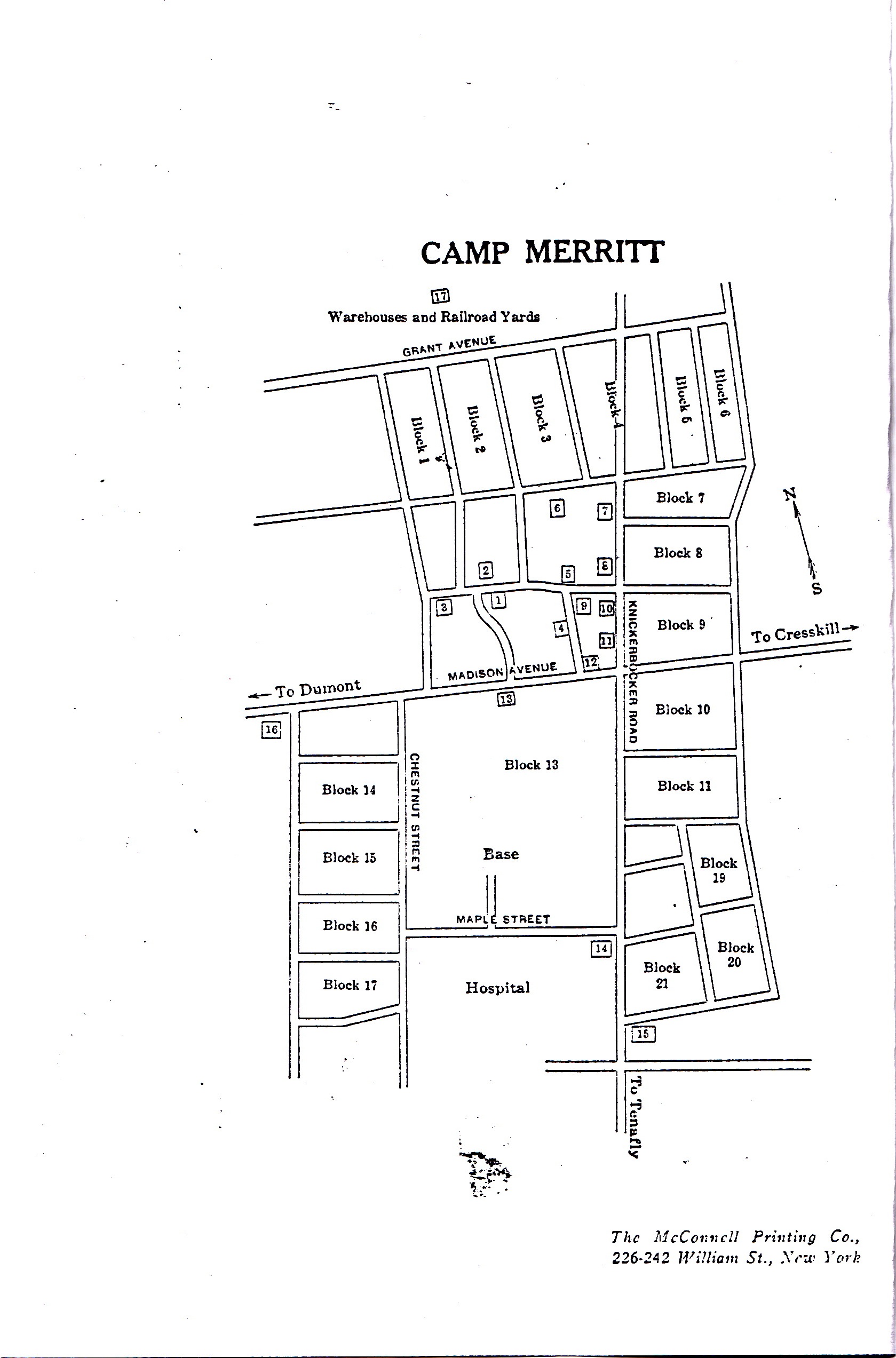
Camp Merritt, New Jersey
One million men walked this ground and left almost nothing behind. Camp Merritt, sprawling across the Bergen County towns of Dumont and Cresskill, processed roughly a quarter of all American troops sent to fight in World War I -- yet today, only a stone monument at the corner of Madison Avenue and Knickerbocker Road marks the place where so many soldiers took their last steps on American soil. The camp existed for barely two years, from 1917 to 1920, a temporary city of 38,000 that appeared, served its purpose, and was dismantled as if it had never been.
From Tenafly to the Western Front
The camp was originally called Camp Tenafly, after the New Jersey town where negotiations for its construction took place. It was soon renamed for Major General Wesley Merritt, a career soldier who had fought from Gettysburg through the Spanish-American War and served as Governor General of the Philippines before retiring in 1900. In 1917, Brigadier General William Wright selected the Bergen County site for its practical advantages: reliable water and sewage systems, electric power, and good railroad connections. Construction began on August 20, 1917, with MacArthur Brothers Company of New York handling the build. Local carpenters, electricians, and tradesmen filled out the workforce. By the time the plans were formally authorized in December, the camp was already taking shape -- seven infantry regiment areas, six warehouses, and a hospital with five hundred beds.
The March to Alpine Landing
What made Camp Merritt distinctive was not its barracks but its route to the sea. As one of three camps under the New York Port of Embarkation, it funneled soldiers toward the troopships docked at Hoboken. Some rode local railroads south. But the more dramatic path sent contingents of two to three thousand men marching northeast to the edge of the Palisades, then descending the cliffs to Alpine Landing at Old Closter Dock. The march took about an hour. At the landing, ferryboats waited to carry them on a two-hour voyage down the Hudson to Hoboken's embarkation piers, where they joined soldiers arriving by train from Camp Mills and Camp Upton on Long Island. Contingents departed Camp Merritt at half-hour intervals, a conveyor belt of young men feeding the transports that would carry them across the Atlantic.
The Plague Before the Crossing
In September 1918, the influenza pandemic arrived at Camp Merritt. The first soldier in New Jersey to be diagnosed had been at Fort Dix, and the disease spread fast across the state. On September 19, fifty-eight soldiers were admitted to the camp's hospital. Three weeks later, roughly a thousand cases filled the wards, and 265 men were already dead -- soldiers who had survived training and the journey to Bergen County but would never board a transport. Many fell ill in the days between leaving camp and reaching Europe. Across the country, approximately 675,000 Americans died from the influenza pandemic. At Camp Merritt, the virus turned a staging ground for war into something closer to a hospital -- and, for too many, a final resting place before the fight even began.
Dismantled and Remembered
Camp Merritt closed officially in January 1920. The last overseas troops to arrive while it was still active came on January 26. After that, the military ordered it dismantled, and the remaining soldiers transferred to Fort Dix. The wooden barracks, the hospital, the warehouses -- all of it came down, and suburban Bergen County reclaimed the land. But on Memorial Day 1924, General John J. Pershing himself stood at the corner of Madison Avenue and Knickerbocker Road, at the border of Cresskill and Dumont, and dedicated a monument to the million men who had passed through. An estimated 20,000 people attended the ceremony. The monument still stands, a quiet sentinel on a suburban intersection, commemorating a place that existed just long enough to send a generation to war.
From the Air
Located at 40.94N, 73.98W in Bergen County, New Jersey, between Dumont and Cresskill. The camp site is now suburban residential development. The Camp Merritt Memorial Monument stands at the intersection of Madison Avenue and Knickerbocker Road. Nearby airports include Teterboro (KTEB) approximately 8 nm south. Best viewed at 2,000-3,000 ft AGL. The Palisades escarpment is visible to the east, marking the route soldiers took to Alpine Landing.