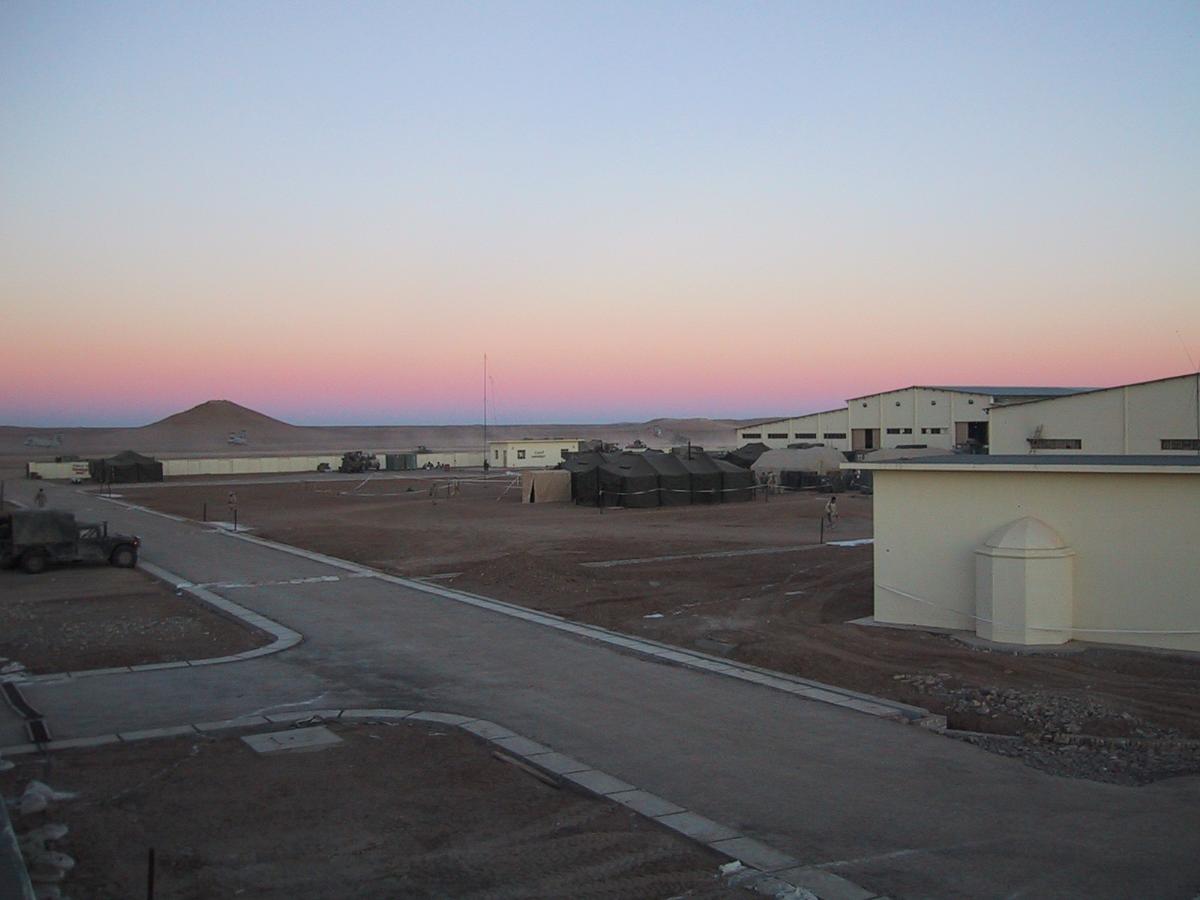
Camp Rhino
Before the Americans came, it was a falcon-hunting camp. Wealthy Arabs had built it up over the years in the Registan Desert, 100 nautical miles southwest of Kandahar -- a few buildings, some walls, a hard-surface runway, and nothing else for miles in any direction. There was no water. On November 25, 2001, less than seven weeks after the first bombs fell on Afghanistan, Task Force 58 turned this isolated compound into the first U.S. forward operating base of Operation Enduring Freedom. Camp Rhino, as it came to be known, existed for barely five weeks. In that time, it changed the trajectory of the ground war.
Four Days of Watching
Navy SEALs had the compound under surveillance for four days before the assault. They watched and reported, confirming the layout that reconnaissance imagery had suggested: a 10-foot wall surrounding the compound, four hardened guard towers at the corners, sealed roads running through the interior, and a 3-foot cement moat bisecting the grounds. Inside were new warehouses, offices, and a small mosque -- some with paint barely dry. The facility was far more developed than a seasonal hunting camp had any reason to be. When the 3rd Ranger Battalion of the 75th Ranger Regiment launched Operation Rhino, the raid combined airborne and air assault insertions. The Rangers secured the objective, and it was handed off to the 15th Marine Expeditionary Unit and Charlie Company of Battalion Landing Team 1/1 to build into a lasting coalition footprint.
An Airfield in an Hour
Speed defined the operation. On the night of November 25, Marine helicopters and KC-130 transport aircraft, supported by Air Force special operations personnel, inserted lightly armed forces into Rhino. Within minutes, teams had set up airfield lighting sufficient to guide in fixed-wing aircraft. The first Marine KC-130 landed less than an hour later carrying additional personnel, fuel, and water -- the only water the camp would ever have, since the desert offered none. Over the next five nights, KC-130s flew more than 200 sorties, building up supplies and personnel at a pace that transformed a desert compound into a functional forward operating base. At its peak, Camp Rhino held approximately 1,100 U.S. Marines under the command of Brigadier General James Mattis, along with U.S. soldiers, Navy Seabees, members of Australia's Special Air Service Regiment, and dozens of embedded journalists.
The Foothold That Tipped the Balance
Camp Rhino's strategic significance outweighed its modest size. While the base was being established, fierce fighting between Taliban and Northern Alliance forces continued near Kandahar. But the presence of U.S. ground forces this deep in southern Afghanistan -- forces willing to operate at night -- shifted the calculus. The Taliban capitulated in the area and retreated northward toward the mountains of Tora Bora. After three weeks of consolidation at Rhino, a Light Armored Reconnaissance element from the 15th MEU, supported by the 26th Marine Expeditionary Unit, pushed forward and captured Kandahar International Airport in mid-December 2001. That airfield became the main coalition base in southern Afghanistan, while Bagram Air Base was established to the north near Kabul. Camp Rhino had served its purpose: a stepping stone seized in darkness that made everything after it possible.
Gone by Christmas
By December 25, 2001, the majority of forces at Camp Rhino had relocated to Kandahar, transported by fixed-wing aircraft. The base was officially closed on January 1, 2002, after just 36 days of operation. What the Americans left behind was much the same as what the falcon hunters had built -- walls, a runway, buildings slowly being reclaimed by the Registan Desert. Satellite imagery from 2009 showed the camp deteriorating, its structures weathering in the same relentless conditions that made it so useful in the first place: remote, flat, and unforgiving. The mosque the Marines had declared off-limits out of respect still stood among the compound's buildings, a small gesture of restraint in a war that was only beginning. Camp Rhino entered history as proof of concept -- evidence that a coalition force could seize and hold ground in Afghanistan's interior, project power from nothing, and then move on before the dust settled.
From the Air
Located at 30.487N, 64.526E in the Registan Desert of southern Afghanistan, approximately 100 nautical miles southwest of Kandahar. The site features a hard-surface runway visible from altitude, surrounded by flat desert terrain. Kandahar International Airport (OAKN) lies roughly 185 km to the northeast. The compound walls and runway may still be discernible from lower altitudes in clear conditions, though the site has been deteriorating since 2002. The Registan Desert is featureless and flat, making navigation by visual reference challenging. Best approached with GPS coordinates.