Camp Wadsworth
On July 4, 1917 -- Independence Day -- a Spartanburg landowner signed over 2,000 acres of wooded South Carolina plateau to the city. Two days later, the mayor handed that land to the federal government. Within weeks, thousands of civilian workers were clearing trees, laying water pipes, and erecting temporary warehouses under a two-month construction deadline. The camp that rose from that red clay was named for James S. Wadsworth, a New York brigadier general killed at the Battle of the Wilderness in 1864. Camp Wadsworth would exist for barely twenty months, but in that compressed span it would train an entire National Guard division for the trenches of France, witness one of the war's sharpest racial confrontations, and launch some of the conflict's most decorated soldiers into combat.
Tents on a Southern Plateau
The War Department's plan to expand the Army for World War I called for 32 new training centers -- 16 for the drafted National Army, 16 for the National Guard. National Army camps got heated barracks; National Guard camps, needed faster because guardsmen could mobilize sooner than draftees, were built primarily of tents and a handful of temporary structures. That meant siting them in the South, where milder winters made tent living bearable. Spartanburg's city leaders lobbied hard, and Secretary of War Newton D. Baker and General Leonard Wood personally inspected the area before approving it in May 1917. The chosen ground was a rolling plateau bordered by Fairforest Creek to the east, Blackstock Road to the west, and Holston's Creek to the south. The Piedmont and Northern Railway, an interurban electric line, ran along the camp's northern edge and became its primary rail connection to the outside world.
The 27th Division Takes Shape
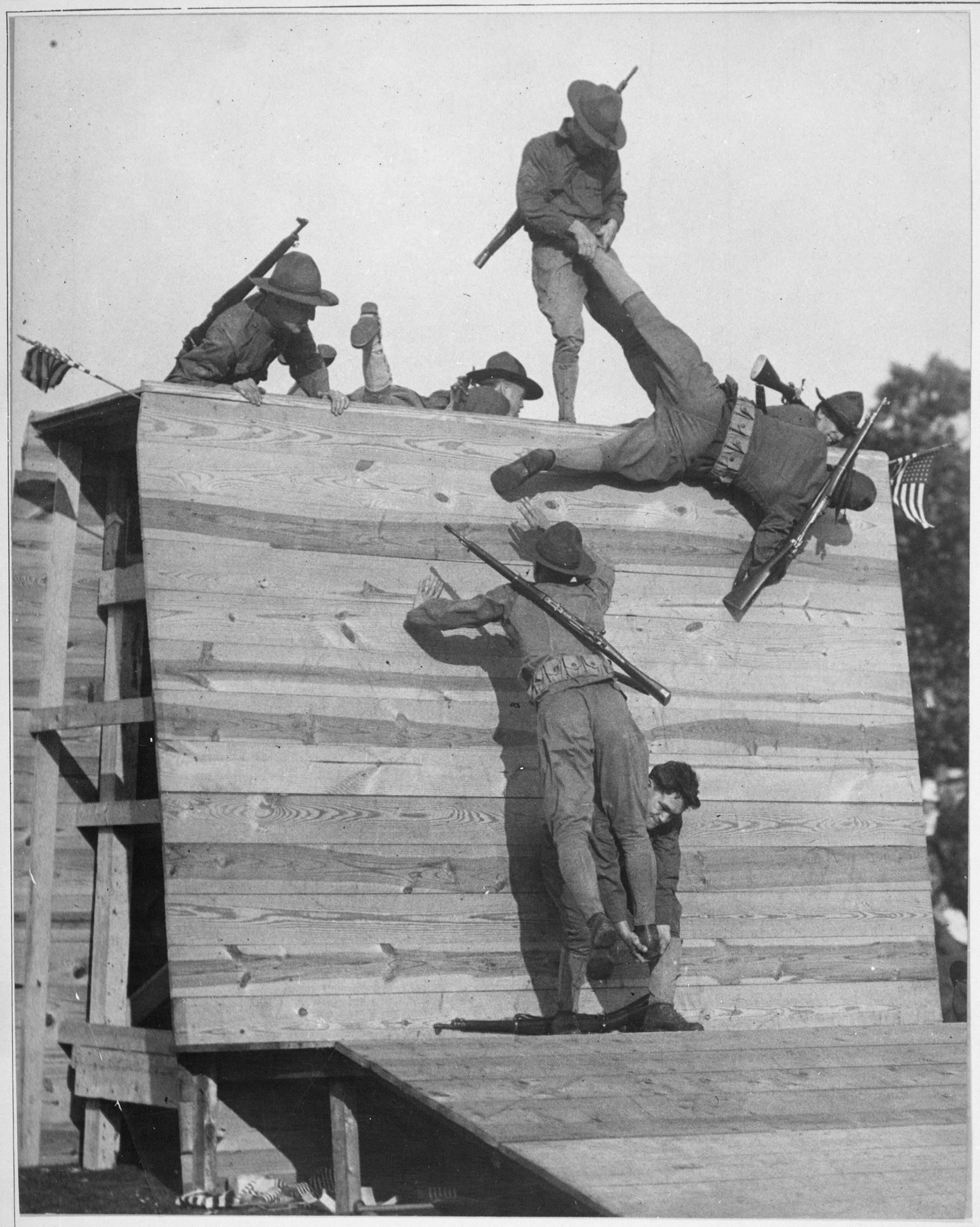
By the end of September 1917, every unit of the New York National Guard's 6th Division -- soon federalized as the 27th Division under Major General John F. O'Ryan -- had assembled at Camp Wadsworth. Training ran the full spectrum: individual drill, bayonet practice, and unit-level maneuvers that tested commanders' ability to plan and execute large-scale operations. Live fire ranges were established in the Glassy Mountain area of Greenville County, where soldiers gained rifle, machine gun, and field artillery experience required for front-line service. The camp also invested in morale: YMCA and YWCA buildings hosted education programs, a post theater staged live performances, and gymnasiums and athletic fields kept soldiers active. The 27th Division departed for France in May 1918, trained and combat-ready.
The 369th and the Color Line
The most charged episode at Camp Wadsworth involved the 15th New York Infantry Regiment -- African-American soldiers led by white officers -- later federalized as the 369th Infantry Regiment. Local Spartanburg leaders had been assured no Black soldiers would train there. When the 369th arrived, tension with the community flared immediately. The Army's solution was swift and revealing: rather than confront the racial hostility, it shipped the 369th to France to finish its training. There, the regiment was assigned to the 93rd Division and integrated into French Army brigades. The 369th went on to become one of the most celebrated American units of the war. Henry Johnson, a private in the regiment, earned the French Croix de Guerre avec Palme -- France's highest valor award -- for single-handedly repelling a German raiding party, becoming one of the first Americans so honored. Needham Roberts, involved in the same action, also received the Croix de Guerre. Johnson would be posthumously awarded the Medal of Honor by President Obama in 2015, after a decades-long campaign to recognize his valor with America's highest military decoration. Bandleader James Reese Europe, who had led the regimental band at Camp Wadsworth, became one of the most famous musicians of his era.
A Constellation of Soldiers
Camp Wadsworth's roster reads like a cross-section of early twentieth-century American life. Hamilton Fish III served as an officer in the 369th and later became a longtime congressman from New York. Cornelius Vanderbilt III, scion of America's wealthiest family, served in the 22nd New York Engineers. Edward Streeter, who trained with the 27th Division, would go on to write the novel that became "Father of the Bride." The camp also organized the Slavic Legion, a proposed regiment of non-naturalized Balkan volunteers -- an experiment that ended when the Armistice removed the need for more soldiers. The 96th Division was organized and training at Camp Wadsworth when the war ended; it demobilized there in early 1919 without ever deploying. Army doctor Frederick Detrick, stationed at the camp hospital, would later give his name to the Army's biological research installation at Fort Detrick, Maryland.
Vanished into Suburbia
The Armistice of November 11, 1918, sealed Camp Wadsworth's fate. Beginning in February 1919, the War Department conducted salvage operations, redistributing usable equipment to posts that remained open. Buildings were sold; purchasers hauled them to new locations across the county. The temporary city of tents, warehouses, and training grounds that had hummed with the activity of tens of thousands of soldiers simply dissolved. Today, most of the land that was Camp Wadsworth lies within Spartanburg's city limits, developed as the Wadsworth Hills residential neighborhood. The rolling plateau where New York guardsmen drilled bayonet charges and the 369th Infantry briefly trained before being sent across the Atlantic is now quiet streets and single-family homes. Only the name survives.
From the Air
Camp Wadsworth's former site is at approximately 34.940N, 81.986W, now within the Spartanburg, South Carolina city limits, developed as the Wadsworth Hills neighborhood. From the air, look for the residential area roughly three miles from downtown Spartanburg, bordered by what was Fairforest Creek to the east. Nearest airports include Spartanburg Downtown Memorial Airport (KSPA) and Greenville-Spartanburg International Airport (KGSP), approximately 10 miles northeast. The terrain is rolling Piedmont plateau. The former Glassy Mountain live-fire ranges are in Greenville County to the northwest.