Camp X: The Spy School That Trained the Free World
The camp opened on December 6, 1941 - one day before Pearl Harbor changed everything. On a stretch of Lake Ontario shoreline between Whitby and Oshawa, Ontario, a collection of unremarkable buildings quietly became one of the most important training facilities of the Second World War. Special Training School No. 103, known informally as Camp X, taught Allied agents the dark arts of clandestine warfare: sabotage, lock picking, explosives, silent killing, radio communications, and the recruitment of partisans. Its existence was kept so secret that Canadian Prime Minister William Lyon Mackenzie King himself was unaware of the facility's full purpose. Today, the buildings are gone. The site is a park named Intrepid, after the code name of the man who made it all happen.
The Man Called Intrepid
Sir William Stephenson was a Canadian from Winnipeg, Manitoba, and a close confidant of both Winston Churchill and Franklin Delano Roosevelt. As Director of British Security Co-ordination, Stephenson established Camp X to serve a purpose that went beyond training spies. The camp was designed as a secret link between Britain and the United States at a time when American neutrality laws forbade direct involvement in the war. The facility was jointly operated by the BSC and the Canadian government, with help from Foreign Affairs and the RCMP, and maintained close ties with MI6. Stephenson served as the camp's first head before handing operational command to Lt. Col. Arthur Terence Roper-Caldbeck. Colonel William 'Wild Bill' Donovan, wartime head of the American Office of Strategic Services - the forerunner of the CIA - credited Stephenson with teaching Americans the craft of foreign intelligence.
The School of Mayhem and Murder
Even before the United States entered the war on December 8, 1941, American intelligence services sent personnel to Camp X. Agents from the FBI and the OSS secretly attended in early 1942, at least a dozen receiving some training. After America's entry into the war, the OSS operated an assassination and elimination training program at the facility that George Hunter White bluntly dubbed 'the school of mayhem and murder.' Graduates went on to serve as secret agents, intelligence officers, and psychological warfare experts behind enemy lines. Many were captured, tortured, and executed. Survivors received no individual recognition. Gustave Bieler, a Montrealer of Swiss origin, trained at Camp X before working with SOE agents and the French Resistance in northern France. His group destroyed railways, bridges, troop transports, and gasoline stores before the D-Day invasion. Bieler was captured and executed by the Nazis in 1944.
Hydra's Whisper
Camp X was more than a training ground. The facility housed Hydra, a highly sophisticated telecommunications relay station that sent and received coded radio and telegraph transmissions. The camp's location on Lake Ontario, 30 miles across from the United States, made it ideal for receiving radio communications from Europe and South America. The topography of the surrounding land provided natural protection for the safe transfer of coded intelligence, and the site proved excellent for picking up radio signals from the United Kingdom. Benjamin deForest Bayly invented the Rockex, also known as the Telekrypton - a fast offline, one-time tape cipher machine for coding and decoding telegraph transmissions. The Hydra station operated in relative safety from the prying ears of German radio observers, its signals hidden among the electromagnetic noise of a continent at war.
Cold War Afterlife
Camp X closed as a training facility before the end of 1944, but its story did not end with the war. In the fall of 1945, the RCMP used the camp as a secure location for debriefing Igor Gouzenko, a Soviet embassy cipher clerk who defected to Canada on September 5 and revealed an extensive Soviet espionage network operating in the country. Gouzenko and his family lived at the facility for two years. The Canadian Forces continued to use the Hydra transmitter during the Cold War until the camp was decommissioned and sold to the townships of Whitby and Oshawa in 1969; the remaining buildings were demolished in 1977. The influence of Camp X reached further than its operators could have imagined. William Donovan modeled training centers in Maryland, Virginia, and Cairo on Camp X programs. The Virginia Quantico training center drew directly from the Canadian facility's methods.
Ghosts in the Grass
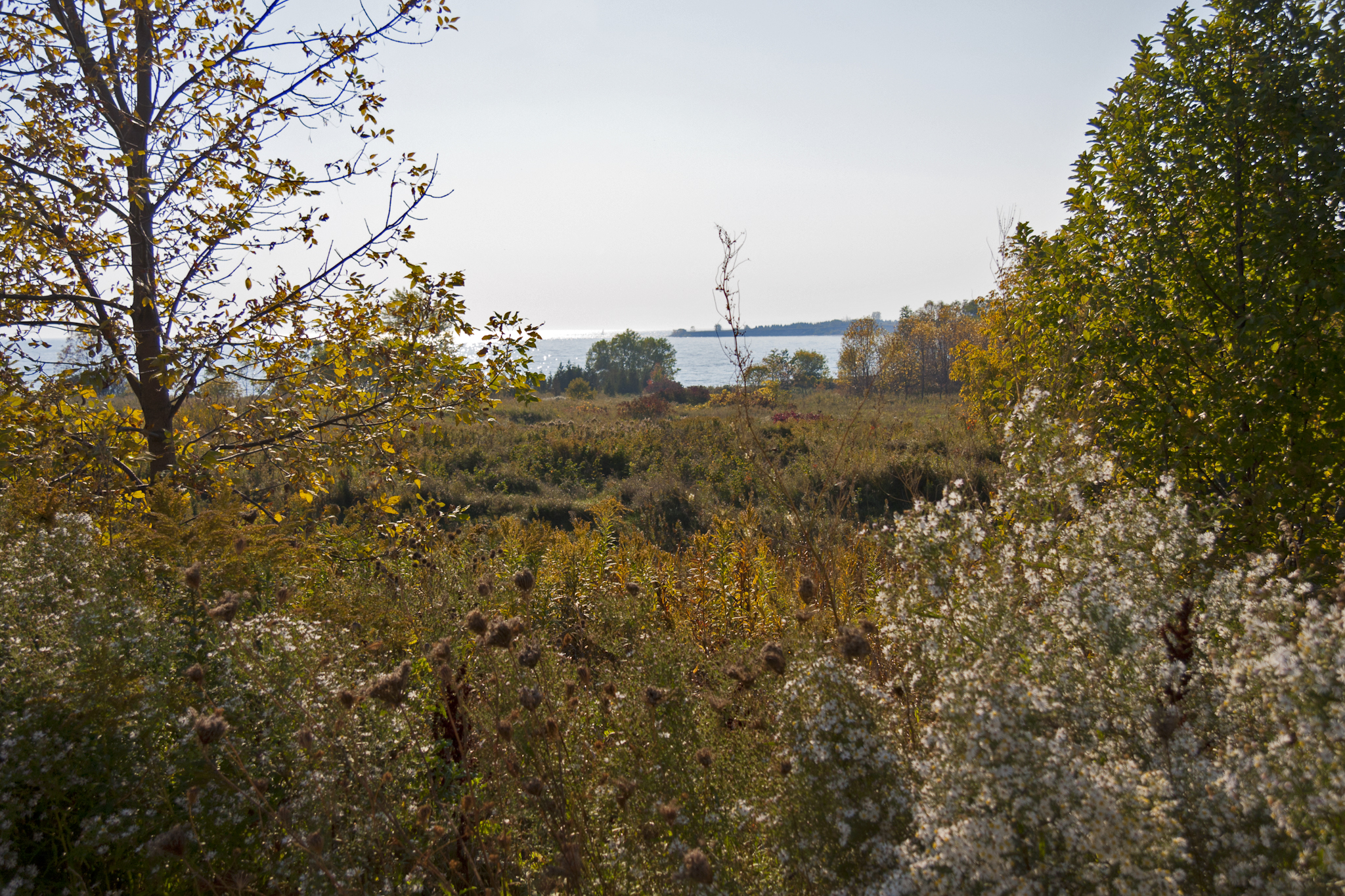
Where barracks and transmission towers once stood, Intrepid Park now occupies the Lake Ontario shoreline. A historic plaque commemorates the school that taught the techniques of secret warfare. An adjacent plaque honors Sir William Stephenson. But Camp X still surfaces in unexpected ways. In August 2016, a hobbyist scanning the park with a metal detector uncovered a rusty World War II smoke mortar round, triggering a visit from Canadian Forces Base Trenton's bomb disposal team. The park is quiet now, the kind of place where families walk dogs and joggers follow the lakeshore trail. Nothing about the landscape suggests what once happened here - which, given the nature of the work, seems entirely appropriate.
From the Air
Located at 43.85N, 78.89W on the northwestern shore of Lake Ontario between Whitby and Oshawa, Ontario. From the air, the site is now Intrepid Park - an open green space along the lakeshore with no remaining structures from the wartime facility. The Lake Ontario shoreline provides the primary visual reference. Oshawa Executive Airport (CYOO) is approximately 8 km to the northeast. Toronto Pearson International Airport (CYYZ) is about 75 km to the west. The park sits between the urban areas of Whitby and Oshawa, with residential development visible to the north. The flat terrain along the lakeshore explains why this location was chosen for its radio transmission capabilities.