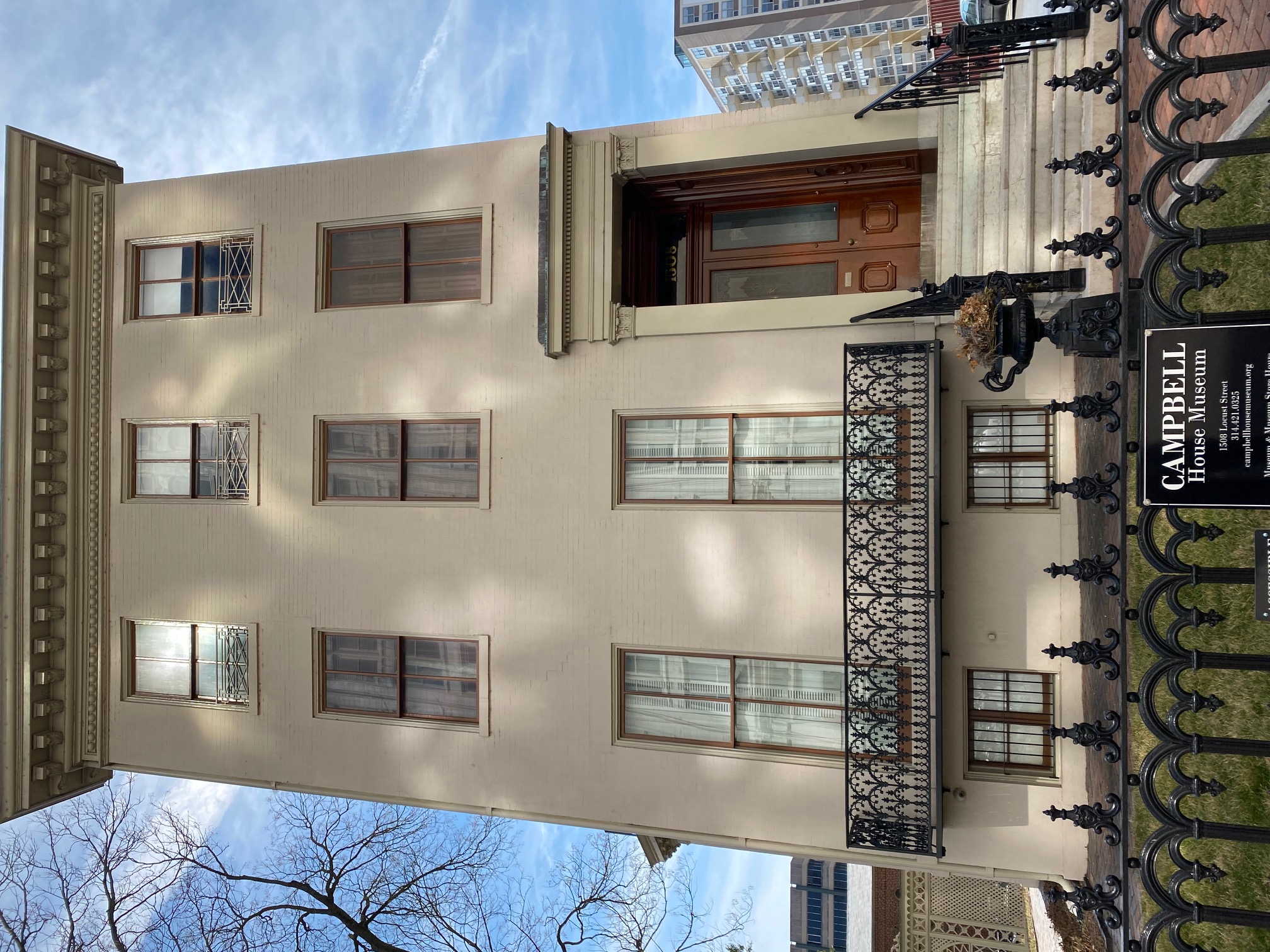
Campbell House Museum: A Victorian Time Capsule
Experts sent to appraise an estate in 1938 expected old furniture and dusty rooms. What they found inside the townhouse at 1508 Locust Street stopped them cold. "Probably nowhere in America, possible nowhere else, is such an intact and integral display of elaborate and ornate furnishings of the middle Victorian period to be found, as in the Campbell mansion," they pronounced. The house had been continuously occupied by the Campbell family since 1853, its rooms unchanged for decades, its contents untouched by the cycles of fashion that stripped most Victorian interiors bare. It was a time capsule, and it nearly ended up at auction.
The Fur Trader's Fortune
Robert Campbell was born in Ireland and came to America as a young man, making his fortune in the Rocky Mountain fur trade before settling in St. Louis. In 1853, he purchased a three-story townhouse on Lucas Place, a fashionable new residential street created around 1850 by siblings James Lucas and Ann Lucas Hunt. Campbell paid approximately $18,000 for the house and immediately began enlarging it, adding a larger kitchen, dining room, and servant bedrooms. His wife Virginia Kyle Campbell oversaw further renovations in 1867, combining the two front parlors into one grand space and adding a three-story bay window. In 1885, an exterior porch was enclosed to create a morning room. The house evolved with the family's growing prosperity, each change layered onto the last.
The Family That Never Left
Robert Campbell died in 1879, but his family remained in the house on what had been renamed Locust Street. As the neighborhood changed around them, the Campbells stayed put. The last surviving child, Hazlett Campbell, died at home in 1938, ending 85 years of continuous family occupation. During those decades, the world outside transformed utterly: electric lights replaced gas, automobiles replaced horses, Lucas Place became a commercial corridor. Inside the Campbell house, the furnishings, wallpapers, and decorative arts of the Victorian era remained largely undisturbed, accumulating the kind of authenticity that no museum recreation can replicate.
Rescued from the Auction Block
Hazlett Campbell's death set off a complex legal battle over the estate, and the Campbells' cousins who inherited the contents chose to auction everything. In February 1941, the St. Louis auction house Selkirk's conducted a three-day sale. A local history group called the William Clark Society scrambled to raise funds, managing to collect more than $6,500 in just weeks and purchasing the majority of the furnishings. Other buyers donated Campbell pieces after the auction. The Campbell House Foundation was formally incorporated that year. Then came an unexpected gift: in 1942, the St. Louis department store Stix, Baer and Fuller, celebrating its 50th anniversary, purchased the house itself from Yale University and presented it to the people of St. Louis. Yale held the deed because the oldest Campbell son, Hugh, had willed it to the university in honor of his younger brother James, a Yale attendee who died at age 30.
The Photographs in the Trash
The Campbell House Museum opened to the public on February 6, 1943, and attracted national attention, featured in Life magazine in 1945 and National Geographic in 1946. But the most important discovery came in 1973, when an album of 60 photographs was rescued from the trash of a law firm that had worked on the Campbell estate. The 8-by-10-inch photos documented every room of the house, its exterior, and surrounding neighborhood, dating from about 1885. This album became the museum's most significant artifact, providing a precise visual record that guided accurate restoration of the interiors beginning in 1980. Room by room, wallpapers were recreated to match the patterns visible in the photos, painted ceilings were restored, and false wood graining was painstakingly replicated.
Victorian St. Louis Preserved
A major restoration from 2000 to 2005 returned the house as closely as possible to its 1885 appearance, guided by those remarkable photographs. In 2019, the museum broke ground on a $1.8 million expansion adding an accessible entrance, education spaces, and an elevator. The Campbell House stands today as one of the few places where you can walk through authentically furnished Victorian rooms and understand how a prosperous 19th-century St. Louis family actually lived. Listed on the National Register of Historic Places since 1977 and designated a City Landmark in 1946, it sits in downtown St. Louis, a survivor from an era when Lucas Place was the city's most fashionable address and a fur trader from Ireland could build a fortune on the American frontier.
From the Air
Located at 38.63N, 90.20W in downtown St. Louis, Missouri, at 1508 Locust Street. The museum is a small historic townhouse within the urban grid, difficult to distinguish from altitude but situated in the Downtown West neighborhood near Washington Avenue. The Gateway Arch and Mississippi River are roughly one mile east. Nearest major airport is St. Louis Lambert International (KSTL). The building sits among modern commercial structures, a surviving fragment of the 19th-century Lucas Place residential neighborhood.