Campo de Cahuenga
On January 13, 1847, in a ranch adobe near the narrow gap in the mountains known as Cahuenga Pass, two men signed a document that transferred California from Mexico to the United States. Lieutenant Colonel John C. Frémont represented the American forces; General Andrés Pico, who commanded the Californio resistance, represented those who had tried to hold California against the American advance. The Treaty of Cahuenga was not the final legal instrument of transfer—that came with the Treaty of Guadalupe Hidalgo in 1848—but it was the practical end of the fighting. A small park now marks the spot, in the San Fernando Valley, where that pen was put to paper.
The Treaty and What It Ended
The American conquest of California had begun in 1846 during the Mexican-American War, when naval forces occupied Monterey and a party of settlers staged the Bear Flag Revolt. Californio resistance was real but uneven—forces loyal to Mexico won the Battle of San Pasqual in December 1846 before being outmaneuvered. By January 1847, the situation had reached a point where continued fighting was futile. The Treaty of Cahuenga was a ceasefire agreement, not a formal peace treaty: it guaranteed that Californios who surrendered would be treated as American citizens and would not be punished for their resistance. Andrés Pico, who had led the Californio forces, negotiated reasonable terms. Frémont accepted them. The shooting stopped.
The Adobe and Its Fate
The original adobe structure where the treaty was signed was demolished in 1900. What stands now is not the original building but a Mission Revival and Spanish Colonial Revival style replica, built in 1950 after a long campaign led by Irene T. Lindsay, then president of the San Fernando Valley Historical Society. The city of Los Angeles had purchased the property in 1923; it took another twenty-seven years and considerable political effort to get a commemorative structure built on it. The current building serves as an interpretive center, managed by the Department of Recreation and Parks in partnership with the Campo de Cahuenga Historical Memorial Association. It opens with a docent on the first Saturday of each month.
The Foundation Beneath the Street
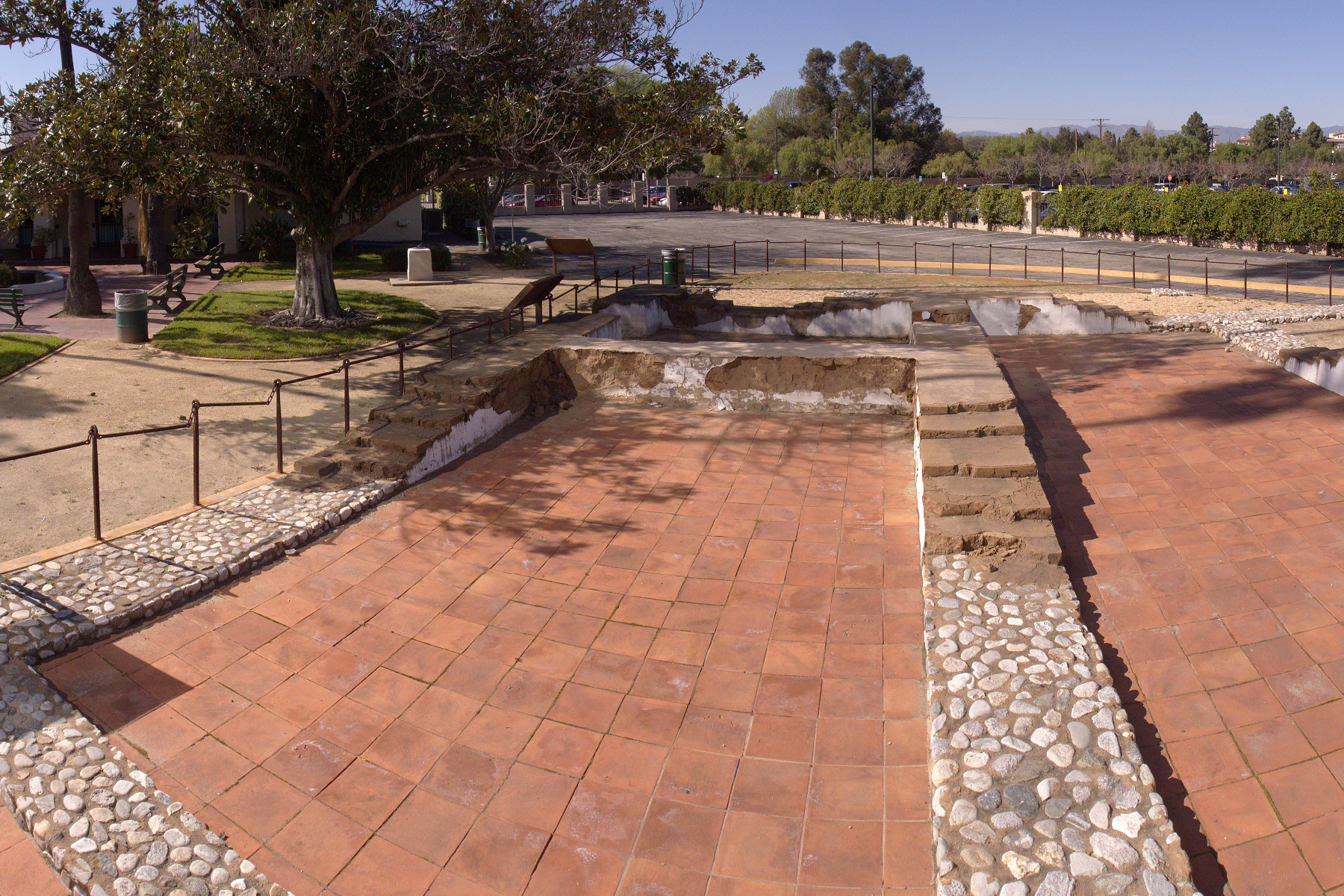
When construction crews were building the Metro B Line subway through this part of the San Fernando Valley, they unearthed something under Lankershim Boulevard: the original foundations of the 1847 adobe. The discovery required careful archaeological work, and the result was a split preservation: the portions of the foundation within the park boundary were preserved as an exhibit visitors can see today, while the "footprint" of the foundations running under the street and sidewalk is marked by decorative pavement—a subtle map of the building that no longer exists, embedded in the urban surface above it.
What the Marker Says
California Historical Landmark Marker No. 151 at the site carries an inscription written in 1898 by Jessie Benton Frémont, wife of the treaty's American signatory: "Here was made the Treaty of Cahuenga by General Andrés Pico, commanding forces for Mexico, and Lieutenant-Colonel J. C. Frémont, U.S. Army, for the United States. By this treaty, agreed upon January 13th, 1847, the United States acquired California—finally secured to us by the treaty of Guadalupe Hidalgo, made February 2nd, 1848." The language is of its time—celebratory about acquisition, silent about what was lost. The park stands near Cahuenga Pass, where the road through the mountains has carried traffic between the San Fernando Valley and Hollywood since long before there was a city on either side.
From the Air
Located at 34.14°N, 118.36°W near Cahuenga Pass in the San Fernando Valley, adjacent to Lankershim Boulevard and the Metro B Line (North Hollywood). The site is in a dense urban area visible from the air at 2,000–3,000 feet MSL. Cahuenga Pass itself—the gap in the Santa Monica Mountains connecting the San Fernando Valley to Hollywood—is clearly visible from altitude as the main corridor between the two areas. Nearest airports: KBUR (Burbank, ~6 miles north), KVNY (Van Nuys, ~5 miles west).