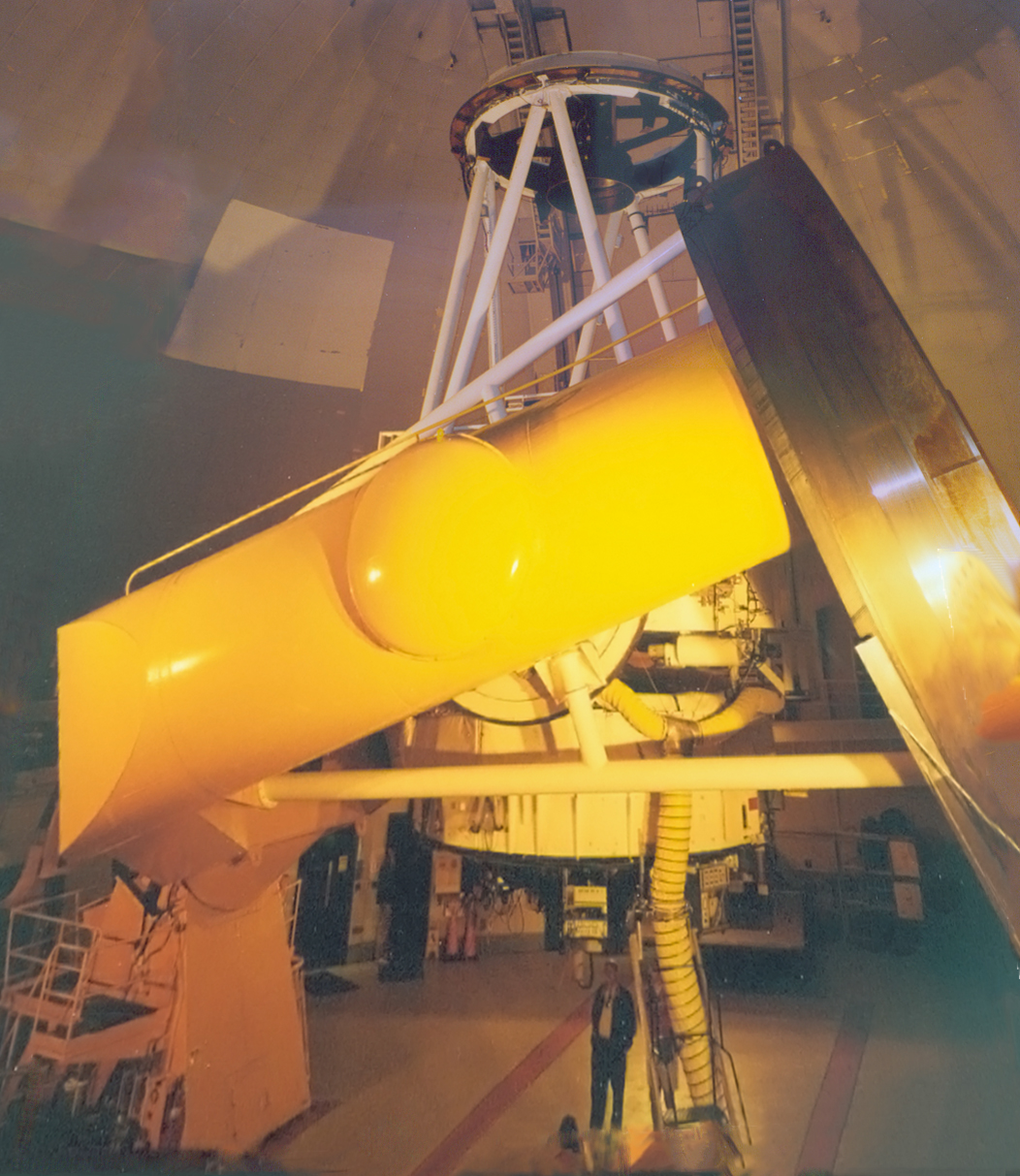
Canada-France-Hawaii Telescope
In March 2025, astronomers announced they had found 128 new moons orbiting Saturn, bringing the ringed planet's confirmed satellite count to 274 -- more than every other planet in the solar system combined. The telescope that made these discoveries was not one of Mauna Kea's famous giants. It was the Canada-France-Hawaii Telescope, a 3.58-meter instrument that has been quietly operating near the summit since 1979, outlasting funding crises, ownership disputes, and the construction of far larger neighbors on every side.
Three Flags on One Dome
The CFHT was born from a tripartite agreement between the University of Hawaii at Manoa, Canada's National Research Council, and France's Centre National de la Recherche Scientifique. When Canada and France agreed to build a 3.6-meter telescope on Mauna Kea in 1973, they were joining what was still a young and somewhat speculative astronomical outpost. The road to the summit had only been completed a few years earlier, and the mountaintop hosted just a handful of instruments. Over the decades, the partnership has expanded to include associate members from China, Taiwan, Brazil, and South Korea, and observing time is now available to astronomers from all seven partner nations. European Union researchers can also submit proposals through the OPTICON access program, making CFHT one of the most internationally accessible telescopes on the mountain.
Instruments That See Everything
What CFHT lacks in mirror diameter it makes up for in versatility. Its MegaPrime/MegaCam instrument uses a mosaic of 40 CCDs totaling 378 megapixels to capture images across a full square degree of sky -- an enormous field of view for a summit telescope. WIRCam provides wide-field infrared imaging across the J, H, and K spectral bands. ESPaDOnS, whose unwieldy French acronym stands for Echelle SpectroPolarimetric Device for the Observation of Stars, measures both the spectrum and the magnetic polarization of starlight simultaneously. SITELLE, a Fourier transform spectrograph, and SPIRou, a near-infrared spectropolarimeter designed to detect Earth-like planets around cool stars, round out a five-instrument suite that lets CFHT contribute to research areas that even the larger Keck and Subaru telescopes cannot efficiently cover.
The Best Seeing on the Mountain
CFHT occupies what measurements have shown to be the finest optical site on Mauna Kea. Its median seeing -- the measure of atmospheric blurring -- is 0.43 arcseconds, better than any other telescope on the summit. This remarkable atmospheric stability, combined with its wide-field instruments, has made CFHT a natural choice for large sky surveys. The CFHTLenS project used its data to map the distribution of dark matter across large swaths of the sky through gravitational lensing, helping to constrain models of the universe's structure. The telescope's public outreach arm, a collaboration with the Italian astronomy magazine Coelum Astronomia called Hawaiian Starlight, offers extremely high-quality images to the public, including a yearly calendar that showcases some of the most striking astronomical photographs taken from any ground-based observatory.
A Second Life as a Giant
Rather than retiring gracefully, CFHT is preparing for a dramatic reinvention. Plans call for the existing facility to be reconstructed with a new 11-meter telescope, transforming it into the Maunakea Spectroscopic Explorer. The project would retain the same base building and infrastructure -- a critical advantage given the near-impossibility of obtaining permits for new construction on the mountain -- while tripling the mirror's effective diameter. The MSE would be dedicated to multi-object spectroscopy, able to measure the spectra of thousands of objects simultaneously across a wide field. First light was originally projected no earlier than 2029, though the project was placed on hold in 2024 due to a Mauna Kea moratorium on new telescope leases. If built, the MSE would give CFHT's dome a third act: from pioneering outpost in the 1970s, to quiet workhorse for four decades, to one of the most powerful spectroscopic instruments on Earth.
From the Air
Located at 19.83N, 155.47W near the summit of Mauna Kea at 4,204 meters (13,793 feet) elevation. The CFHT dome is among the cluster of observatory structures visible from cruising altitude. It is distinguishable from its larger neighbors by its relatively modest dome size. Nearest airports: PHTO (Hilo International, 28 nm southeast), PHKO (Kona International, 40 nm west). The telescope sits on the western side of the summit complex.