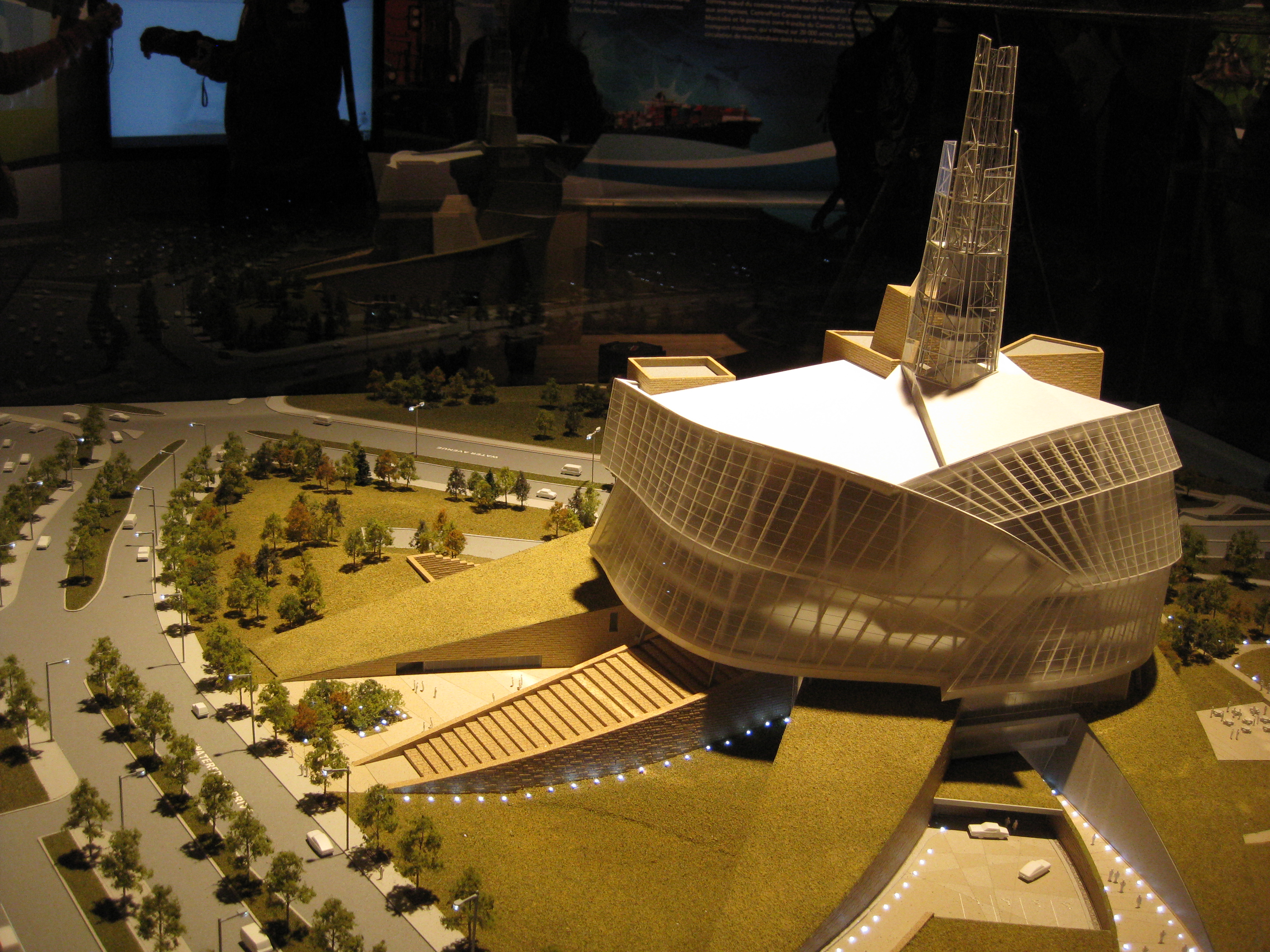
Canadian Museum for Human Rights
Embedded in its cornerstone is a fragment of Runnymede -- a piece of stone from the English meadow where the Magna Carta was sealed in 1215, personally selected by Queen Elizabeth II and unveiled on a summer day in 2010. That single gesture captures the ambition of the Canadian Museum for Human Rights: to anchor an idea as old as civilization in a building unlike anything the Canadian prairies had ever seen. The museum sits at The Forks in Winnipeg, where the Red and Assiniboine rivers have drawn people together for at least 6,000 years. Archaeologists excavating the site before construction recovered more than 400,000 artifacts dating back to 1100 CE. The ground beneath this building remembers what human gathering means.
One Man's Vision on the Riverbank
The museum exists because of Izzy Asper. A Canadian lawyer, politician, and founder of the media conglomerate Canwest Global Communications, Asper conceived the idea on July 18, 2000 -- a place where students from across Canada could come to learn about human rights, and where Winnipeg's struggling downtown could find new purpose. He spent three years commissioning feasibility studies and building political support before his death in 2003. His daughter Gail Asper took up the cause, leading private fundraising that would eventually surpass $130 million. The federal government contributed $100 million, Manitoba added $40 million, and the City of Winnipeg pledged $20 million. By the time Parliament passed Bill C-42 with all-party support in 2008, creating the CMHR as a national museum, the project had become something Izzy Asper might not have imagined: a test of whether Canadians could agree on what human rights mean.
Stone Wings and Alabaster Light
In 2003, an international design competition drew 100 submissions from 21 countries. The winner was Antoine Predock of Albuquerque, New Mexico, who later called the CMHR the most important building of his career. His design begins with a descent into the earth, through 'roots' clad in 450-million-year-old Tyndall limestone. Visitors move upward through the Great Hall and along dramatic backlit alabaster ramps -- more than 3,500 square metres and 15,000 tiles of alabaster, the largest project ever executed in that material. Over 1,300 panes of glass form a cloud-like canopy resembling a dove's folded wings on the building's southwest face. The journey culminates in the Israel Asper Tower of Hope, a 100-metre glass spire that offers panoramic views of downtown Winnipeg and the vast prairie horizon beyond. Throughout the foundation work, medicine bags created by elders at Thunderbird House were placed into the holes drilled for piles and caissons, honoring the ground that was being broken.
Ten Galleries, Countless Stories
The museum opened on September 20, 2014, two years behind schedule and $41 million over its original budget, at a final cost of approximately $351 million. Inside, ten core galleries explore human rights from multiple perspectives. Indigenous perspectives occupy a central space, including a circular film about First Nations concepts of rights and responsibilities. The museum's largest gallery is dedicated to Canadian content -- the internment of Japanese Canadians during World War II, the Chinese head tax, the Underground Railroad, the Komagata Maru incident, and the Winnipeg General Strike of 1919. A dedicated Holocaust gallery introduces the 1948 Universal Declaration of Human Rights, drafted in direct response to those horrors. A Garden of Contemplation offers still-water pools set among dramatic black Mongolian basalt. On the fifth floor, the Carte International Reference Centre serves as the museum's library, devoted to human rights research.
The Weight of the Mission
A museum dedicated to human rights was always going to face scrutiny about whose rights it represents. Ukrainian Canadian organizations protested what they saw as insufficient attention to the Holodomor. Palestinian Canadians called for inclusion of the Nakba. The museum's grand opening itself was marked by protests from groups who felt their histories had been excluded or inaccurately depicted. Internal struggles proved equally difficult: between 2015 and 2017, management sometimes directed staff to hide LGBT content from certain tour groups, including religious schools and diplomatic visitors. The 2020 resignation of CEO John Young amid allegations of censorship, harassment, and racism forced a public reckoning. An independent review and a formal apology followed. The controversies have not diminished the building's power -- if anything, they have underscored its central premise: that the work of human rights is never finished.
From the Air
Located at 49.891N, 97.131W at The Forks in Winnipeg, Manitoba, at the confluence of the Red and Assiniboine rivers. The 100-metre Tower of Hope is a prominent visual landmark from the air -- look for the distinctive glass spire rising from an angular, mountain-like structure near the river junction. Nearest major airport: Winnipeg James Armstrong Richardson International (CYWG), approximately 8 km west-northwest. Recommended viewing altitude: 3,000-5,000 ft AGL. The museum's glass cloud canopy is especially visible in afternoon sunlight.