Canal du Midi
Pierre-Paul Riquet was sixty-three years old, had no engineering degree, and had spent most of his career collecting the salt tax in Languedoc. None of this stopped him from proposing the most audacious civil engineering project in seventeenth-century Europe: a canal linking the Atlantic Ocean to the Mediterranean Sea across the hills of southern France. The Canal du Midi, completed in 1681, stretches 240 kilometers from Toulouse to the Etang de Thau near Sete. It includes 63 locks, 126 bridges, 55 aqueducts, and the first canal tunnel ever built. Riquet died during construction and never saw a boat travel its full length.
The Tax Collector's Vision
The dream of a cross-France waterway was centuries old -- the Romans had considered it, and Riquet's own father sat on a committee that studied the idea. The central problem was always the same: how to supply water to the canal's highest point at the Seuil de Naurouze, where the land rises between two drainage basins. In 1660, Riquet found his answer in the Montagne Noire, a region receiving twice the rainfall of the surrounding plains. He proposed capturing mountain streams and channeling their water across kilometers of constructed waterways to feed the summit. To prove it could work, he built a test channel from the river Sor to the Seuil de Naurouze, completing it in 1665. When the royal commission of experts saw water flowing where nature had never intended, Louis XIV gave the project his blessing.
Women, Gunpowder, and Oval Locks
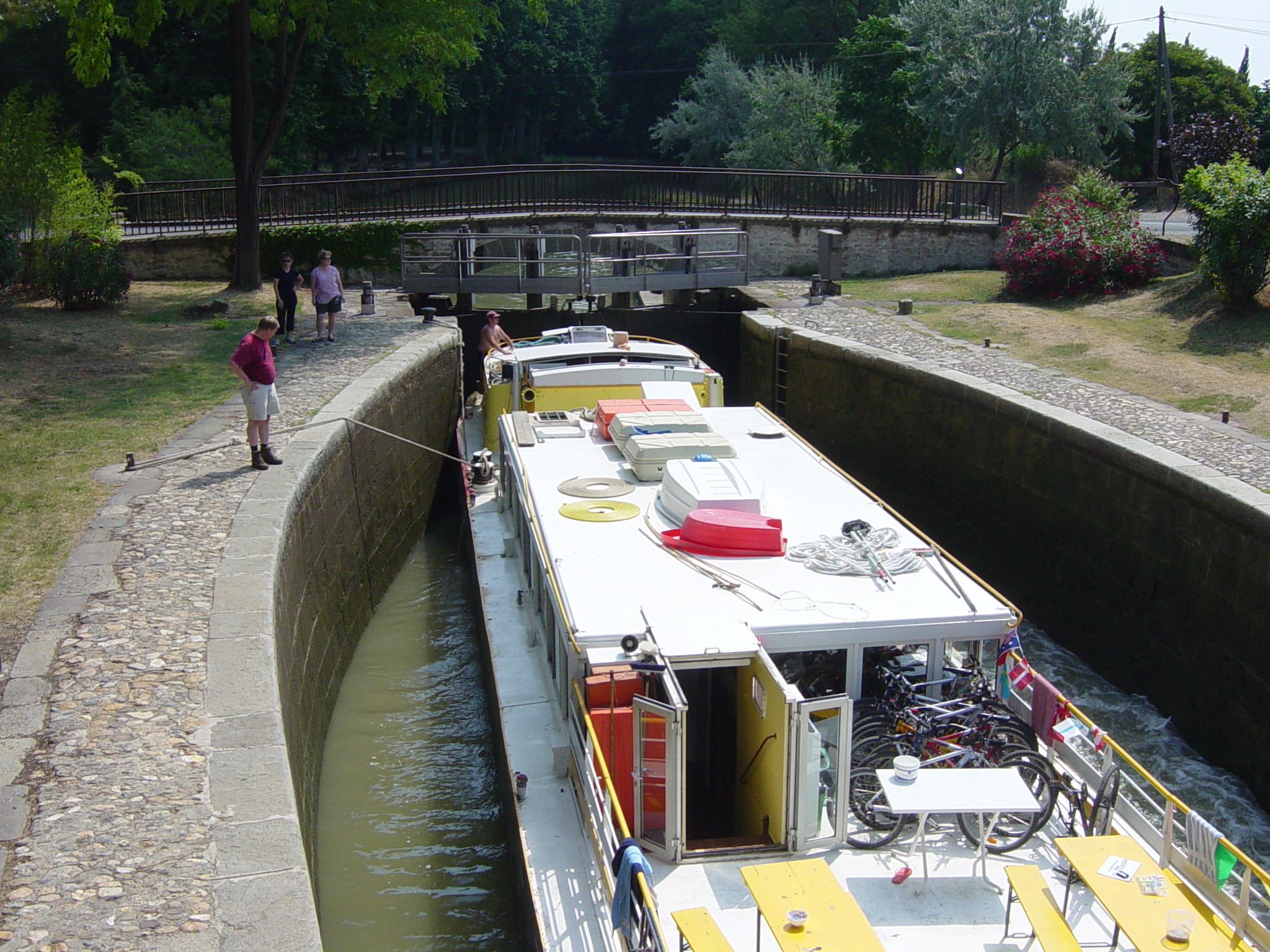
For fifteen years, nearly 12,000 workers dug with shovels and pickaxes. Among them were women from former Roman bath colonies in the Pyrenees who carried living knowledge of classical hydraulic methods. Hired initially to move earth at the great dam of Saint-Ferreol, their expertise in water management soon proved indispensable. They helped perfect the supply system, threaded the canal through the mountains near Beziers with remarkably few locks, and contributed to building the famous eight-lock staircase at Fonserannes. Riquet's early rectangular locks collapsed under lateral soil pressure, so he redesigned them with rounded walls thick enough to resist the earth -- the distinctive baroque-style oval locks that remain the canal's signature. The Malpas Tunnel, 173 meters through solid hill, became the first canal tunnel in history.
A Dam Like No Other
The Bassin de Saint-Ferreol was the project's engineering marvel and its greatest gamble. The dam -- 700 meters long, 30 meters above the riverbed, and 120 meters thick at its base -- was the largest work of civil engineering in Europe and only the second major dam built on the continent, after one in Alicante, Spain. It impounded 6.3 million cubic meters of water from the Montagne Noire, fed by a contour channel over 20 kilometers long. When Riquet died in October 1680, just months before the canal's completion, his family inherited both the waterway and enormous debts that took over a century to repay. The total cost reached between 17 and 18 million livres, split roughly between the king, the province, and Riquet's own fortune.
From Wheat Barges to Houseboats
For two centuries the canal carried the commerce of Languedoc: wheat from the Lauragais, wine from Minervois, soap from Marseille. Passenger boats made the Toulouse-to-Sete journey in four days, later reduced to 32 hours with relay horses changed every ten kilometers. The year 1856 saw peak traffic with over 110 million tonne-kilometers of cargo and nearly 100,000 passengers. Then the railways arrived. The Bordeaux-Sete line opened in 1857, and canal traffic halved within two decades. The last commercial barges, the wine carrier Bacchus and the grain carrier Esperance, ceased operations in 1989. Today the canal draws two million visitors annually, busier than the Seine for leisure traffic, with 80 percent of passengers coming from abroad.
A Living Heritage Under Threat
UNESCO inscribed the Canal du Midi as a World Heritage Site in 1996, recognizing not just the waterway itself but its complete system of locks, aqueducts, and bridges as a masterwork of seventeenth-century engineering. Yet the canal faces a quiet crisis. Since 2006, canker stain caused by the fungus Ceratocystis platani has been killing the 42,000 plane trees that have shaded its banks since the Napoleonic era. Within fifteen to twenty years, all of them will need to be felled and replaced with resistant species. The canal also still irrigates 40,000 hectares of farmland and supplies drinking water to 185 communes -- practical roles that Riquet, who imagined the waterway as a tool of commerce and royal power, could never have foreseen.
From the Air
The canal runs 240 km from Toulouse (LFBO) southeast to the Etang de Thau near Sete. At 43.35N, 1.83E the Seuil de Naurouze marks the canal's highest point at 189 m elevation. The tree-lined ribbon of water is clearly visible from 5,000 ft AGL. Carcassonne-Salvaza (LFMK) and Beziers-Vias (LFMU) are convenient midpoint airports.