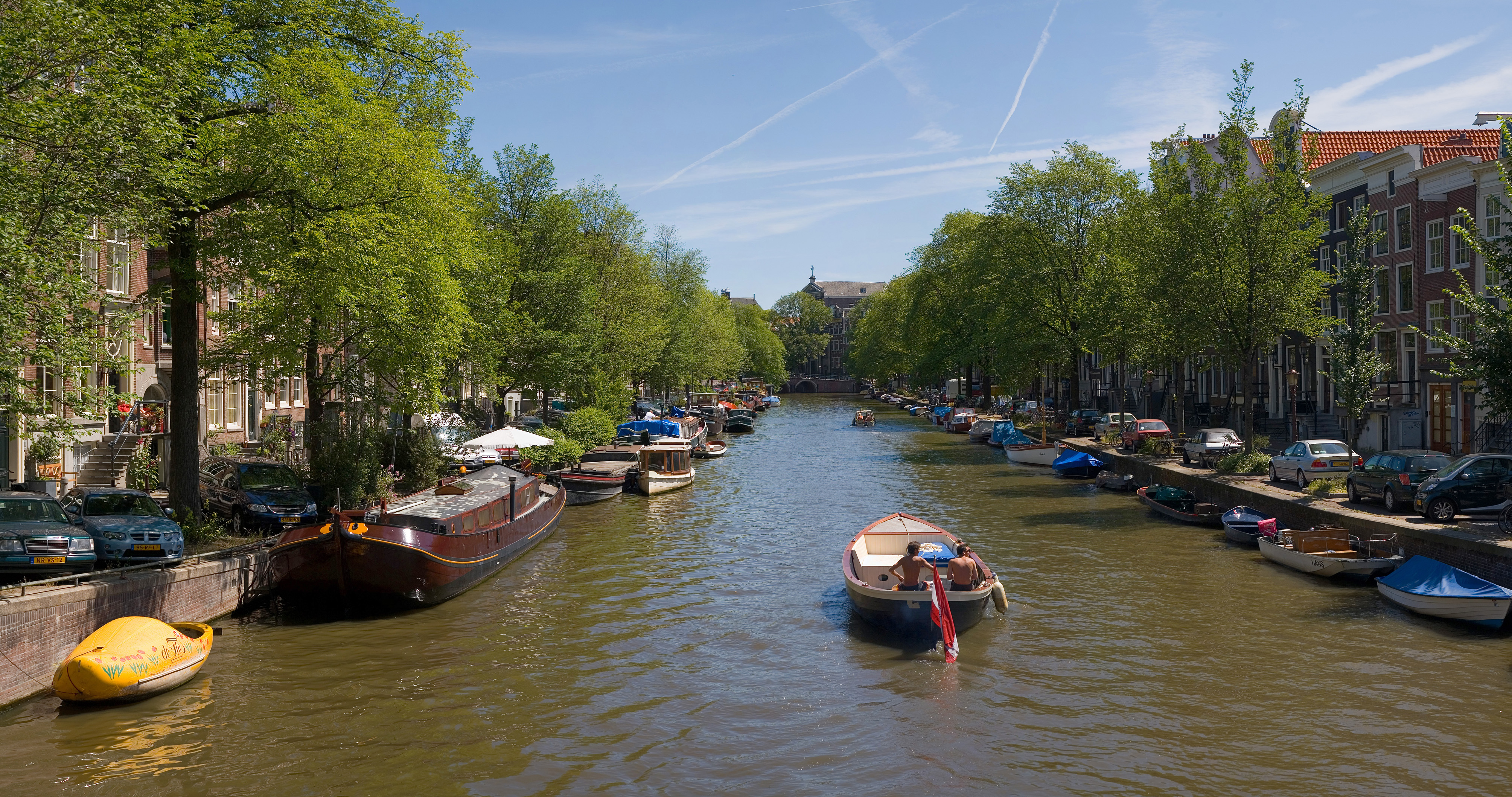
Canals of Amsterdam
Imagine you are a city planner in Amsterdam in 1612. The population is exploding because the Republic has just become the wealthiest country in Europe, Protestants are fleeing the southern Netherlands, Sephardic Jews are arriving from Iberia, and there is nowhere to put any of them. You have, at most, a couple of years to figure out what to do before the marshland west of the medieval core gets squatted, fenced off, and developed into a slum. So you do something that, on paper, looks absurd. You decide to dig four concentric half-circles of canal into the bog. You will build, simultaneously, the largest urban planning project in European history, an immense flood control system, a transport network, and a residential district for the rich. You will start in 1613. You will mostly finish by the 1660s.
The Plan
The historian Geert Mak likes to point out that the canals were not dug from the inside outward, the way the popular myth has it, but across the city like a gigantic windshield wiper, sweeping from west to east in a single coordinated push. Construction of the north-western sector began in 1613 and was finished around 1625. The southern sector started after 1664, slowed by an economic depression. The eastern sector - between the Amstel and the IJ - never got finished as originally drawn, and instead filled in over the centuries with parks, theaters, and the Botanical Garden. What did get built was a quadruple ring: the inner Singel, then the Herengracht for the patricians, the Keizersgracht for the emperor (Maximilian I, Holy Roman Emperor, whose imperial crown still tops the spire of the Westerkerk), and the Prinsengracht for the Prince of Orange. Wrapping the outside was the Singelgracht, which served as moat and water management.
The Golden Bend
If you want to know what seventeenth-century Dutch wealth looked like, walk the Herengracht between Leidsestraat and Vijzelstraat. This curve is called the Gouden Bocht, the Golden Bend, and it is lined with double-wide mansions, inner gardens, and coach houses. Peter the Great visited Amsterdam to learn shipbuilding from the Dutch the way wealthy outsiders have always learned things from the Dutch - by paying close attention and writing it all down. Tradition places him at Herengracht 527, though he actually spent most of his time near the shipyards of the Oostenburgergracht. John Adams lived on the Keizersgracht. Daniel Fahrenheit worked there. Heinrich Schliemann, the man who eventually dug up what he claimed was Troy, spent three years at Keizersgracht 71. The canal houses were built tall and narrow because the city taxed by frontage width, which produced an entire architectural tradition - hoist beams under the gables, furniture going in through windows - that survived because the tax did.
Bicycles in the Water
Between twelve and fifteen thousand bicycles are pulled out of the canals every year. The Dutch have a word for this, fietsen vissen, bike fishing. Some are dumped by thieves disposing of evidence. Some fall in. Some get pushed in by drunk students. The canal authority maintains a fleet of dredging boats specifically to fish them out. Until 1879 the canals were essentially open sewers, full of refuse, dead fish, and human waste. That year the Gemaal Zeeburg pump station went into operation, flushing the canals with water from the Zuiderzee. In 1935 the inner city got its first sewer connection. The Grachtengordel itself was not fully connected to the sewer system until 1987 - which means that into the late twentieth century, houses along the world's most photographed canals were still releasing their wastewater directly into the water below.
Swimming the Keizersgracht
Since 2012, on a Sunday in September, a few thousand people put on wetsuits and swim two kilometers from the Nieuwe Herengracht to the Keizersgracht, raising money for ALS research. The Amsterdam City Swim is part endurance event, part civic pageant. In 2018 the swim portion had to be canceled because heavy rains overwhelmed the sewer system and pushed E. coli levels too high. The next year it ran fine. Locals know the rules: do not swim after a thunderstorm, do not swim near houseboats, and check the bacterial counts the city publishes. The water is not what it was in the seventeenth century - which is to say, it is much better.
Why UNESCO Said Yes
In 2010, UNESCO inscribed the seventeenth-century canal ring on the World Heritage List. The citation runs to several pages, but the central argument is simple: this is the largest, best-preserved example of a planned Renaissance city expansion still functioning as a city. Fifteen hundred monumental buildings line the Grachtengordel. About ninety islands sit between the channels. Around fifteen hundred bridges - the count varies depending on who is doing the counting - link the islands together. The newest canals in Amsterdam are on Java Island, constructed in 1995 along with the canal-house revival designed by nineteen young Dutch architects. Each house is four and a half meters wide, four or five stories tall, and modern. They do what the originals did: stand tall, lean slightly forward, and reflect themselves in the water. The plan was always to keep building. The plan still is.
From the Air
The Grachtengordel sits at 52.365N, 4.888E, the four concentric canals visible as a half-moon hugging the medieval core of Amsterdam. From the air on a clear day the pattern is unmistakable - one of the most legible city plans on earth. Nearest airport: Amsterdam Schiphol (EHAM), 14km southwest. Best viewing altitude: 1,500 to 4,000 feet. Morning light on the water is exceptional; late afternoon the buildings cast long shadows across the canals.