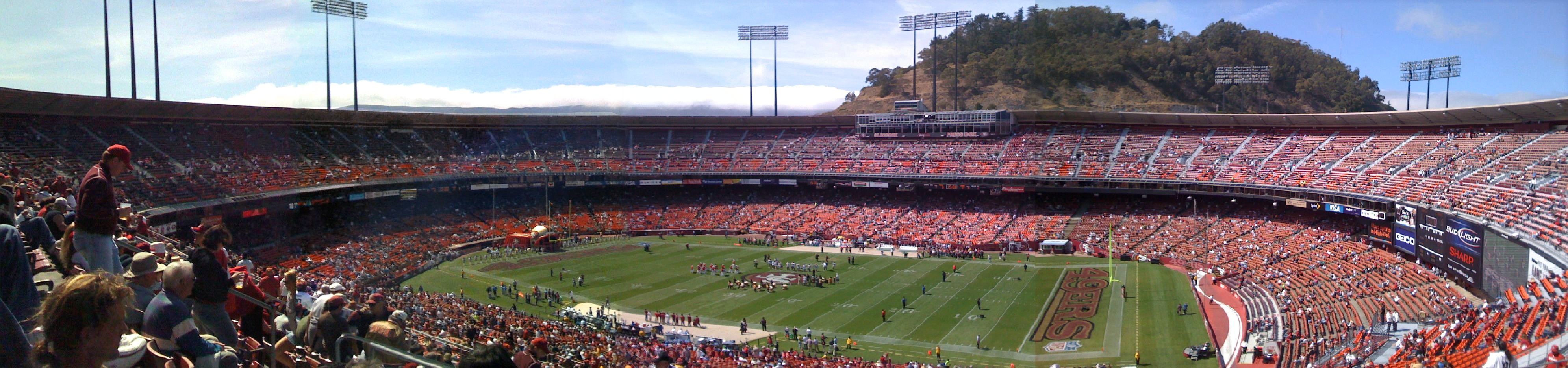
Candlestick Park
Veni, Vidi, Vixi. I came, I saw, I survived. That was the motto printed on the Croix de Candlestick, a pin awarded to baseball fans who sat through extra-inning night games at Candlestick Park and lived to tell about it. The joke landed because the wind at Candlestick was no joke. Built on a point jutting into San Francisco Bay, the stadium channeled gusts that could blow a pop fly foul, chill a summer crowd to the bone, and turn a routine grounder into an adventure. For more than fifty years, Candlestick Park was the most famously miserable venue in American professional sports -- and the place where two of San Francisco's most beloved teams played their hearts out anyway.
A Point Named for Shorebirds or Ships
Nobody agrees on how Candlestick Point got its name. Some say it came from the long-billed curlew, a shorebird once abundant here and known colloquially as the "candlestick bird" for its elongated beak. Others point to an eight-foot pinnacle rock, noted by the De Anza Expedition in 1781 and the U.S. Geodetic Survey in 1869, that disappeared around 1920. A third theory holds that the name derived from the 19th-century practice of burning abandoned sailing ships in the bay -- as they sank, their flaming masts resembled lit candlesticks. Whatever the origin, the name stuck to this windswept promontory on San Francisco's southeastern shore.
Home of the Giants and the 49ers
Candlestick Park opened in 1960 as the home of the San Francisco Giants, who had moved from New York two years earlier. The stadium's bayside location delivered stunning views and punishing weather in equal measure. Stu Miller, pitching for the National League in the 1961 All-Star Game, was famously blown off the mound by a gust of wind -- or at least appeared to be, committing a balk. The Giants played here through the 1999 season before moving to the new Pacific Bell Park (now Oracle Park) downtown. The San Francisco 49ers shared the stadium from 1971 through 2013, when they relocated to Levi's Stadium in Santa Clara.
The Last Beatles Concert
On August 29, 1966, the Beatles played their final full concert at Candlestick Park, ending their touring career on a stage buffeted by the same winds that bedeviled outfielders. The show lasted just 33 minutes -- eleven songs for a crowd of roughly 25,000, well short of the stadium's capacity. The band was exhausted from touring, unhappy with the screaming that drowned out their music, and ready to become a studio act. They chose Candlestick almost by accident, but the venue's raw, exposed character gave the farewell a poetic edge. The last note of the Beatles' last concert dissolved into the San Francisco wind.
Earthquake and Demolition
The 1989 Loma Prieta earthquake struck during Game 3 of the World Series between the Giants and the Oakland Athletics, shaking Candlestick Park on live television. The stadium suffered only minor damage, but the image of a swaying ballpark became iconic -- a reminder that San Francisco's relationship with the earth beneath it is never settled. Candlestick hosted its final NFL game on December 23, 2013, and demolition began in 2015. Today the site is being redeveloped with housing and commercial space. The stadium that gave fans hypothermia and Latin-motto pins, that hosted the Beatles' last show and shook during a World Series earthquake, has been reduced to a graded lot awaiting its next incarnation.
From the Air
Located at 37.7136°N, 122.3861°W at Candlestick Point on the western shore of San Francisco Bay. The former stadium site is clearly visible from the air at the southeastern tip of San Francisco. Best viewed at 1,500-3,000 feet AGL. Nearest airports: KSFO (San Francisco International, 5 nm south), KOAK (Oakland International, 10 nm east). Adjacent to Candlestick Point State Recreation Area.