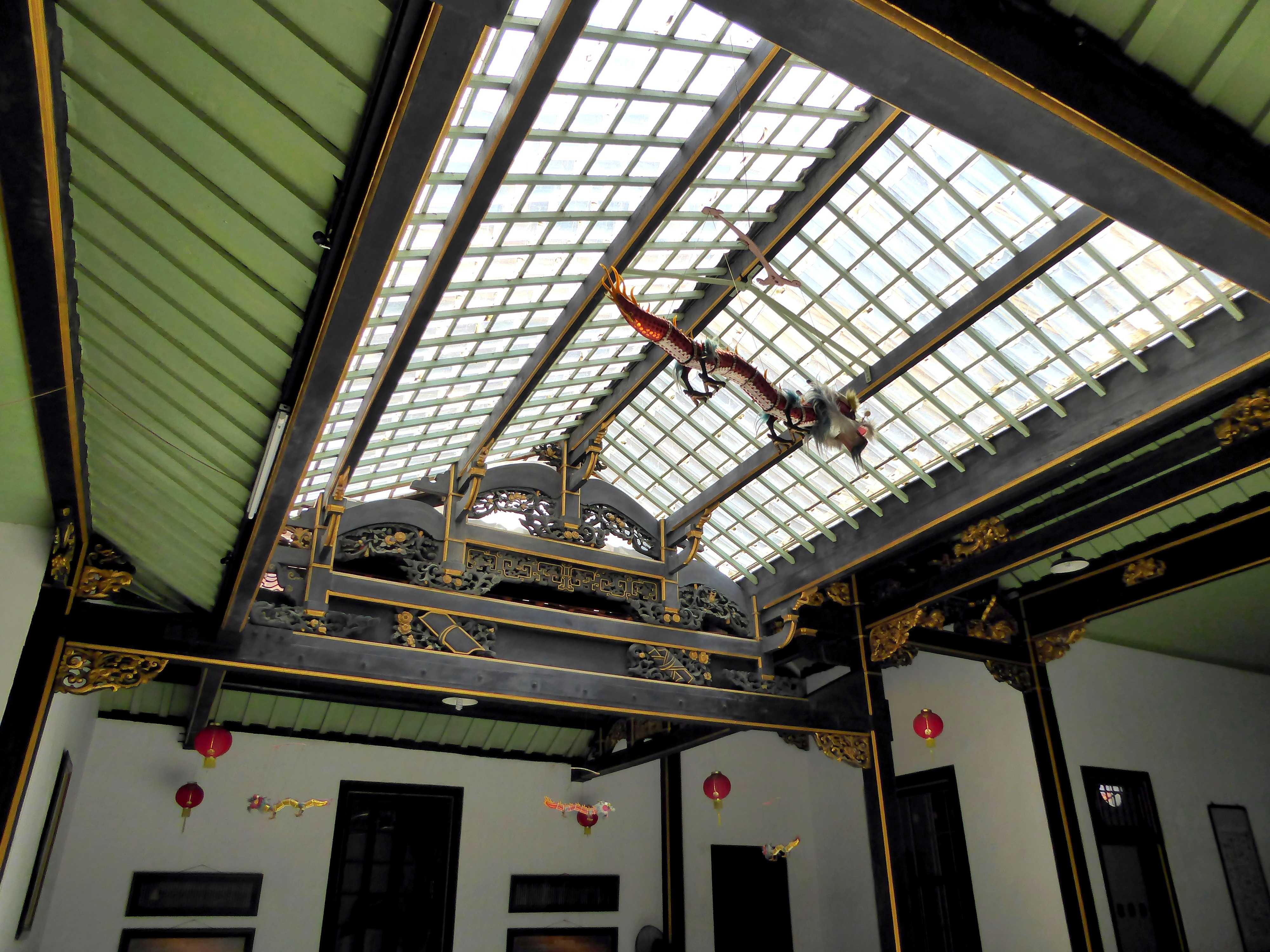
The Majoor's House
They called it Rumah Majoor - the Majoor's House - after the man whose authority once extended over every Chinese resident of colonial Batavia. Candra Naya sits on Jalan Gajah Mada in central Jakarta, a compound of curving roofs and moon gates wedged between modern towers, as improbable as a grandmother sitting quietly in the middle of a construction site. Built in the early 19th century on the foundations of an even older country estate, the house served for generations as the seat of the Khouw family of Tamboen, a dynasty of Chinese-Indonesian magnates whose wealth grew alongside the city itself. That it stands at all today is something close to a miracle. In 1995, bulldozers took down most of the compound. What remains is the result of protests, compromise, and an economic crisis that halted the wrecking ball mid-swing.
From Country Estate to Urban Palace
The Khouw family's story in Java begins with Khouw Tjoen, an 18th-century migrant from China who arrived first in Tegal, Central Java, before making his way to Batavia. His son, Khouw Tian Sek, transformed the family's fortunes. Rural landholdings along the Molenvliet canal - once marginal property on Batavia's outskirts - became prime urban real estate as the colonial capital expanded southward. By the time of his death in 1843, Khouw Tian Sek was one of the colony's wealthiest men, and his family had built three grand compounds along what is now Jalan Gajah Mada. Of those three, Candra Naya alone survives. One became a state school after independence. Another became the Chinese embassy. Both are gone now, replaced by newer structures that carry no memory of the families who built them.
The Last Majoor
The house's most famous resident gave it the name that stuck. Khouw Kim An inherited Candra Naya from his cousin, Kapitein Khouw Yauw Kie, and went on to become the last Majoor der Chinezen of Batavia - the highest Chinese civil authority in the colony. He held the position from 1910 to 1918, then again from 1927, navigating the complex politics of Dutch colonial rule as an intermediary between European administrators and the Chinese community. The Majoor lived at Molenvliet West 185, the address that would become Candra Naya. When the Japanese occupied Indonesia during the Second World War, they suppressed the system of Chinese officers entirely. Khouw Kim An was apprehended by the occupying forces and died in a concentration camp in 1945. His house outlived him, but just barely.
New Light From Old Walls
After the war, the Khouw family's heirs passed the house to Sin Ming Hui - the 'New Light Society' - a Chinese social and educational organization that put the grand rooms to unexpected use. The reception halls became classrooms for an institute that would grow into Tarumanagara University. A medical clinic operated from the compound, eventually evolving into Sumber Waras Hospital. Sports groups and photography clubs met beneath the traditional Tou-Kung roof frames. In 1965, under nationalist pressure to adopt Indonesian names, Sin Ming Hui became the Candra Naya Social Union - the name that finally attached itself to the building. During the 1960s and 1970s, the compound served as one of Jakarta's most popular wedding venues, its courtyards and halls hosting celebrations that merged Chinese tradition with Indonesian modernity. Heritage protections followed: the city of Jakarta declared it a cultural property in 1972, the Ministry of Education and Culture confirmed the designation in 1988, and the National Cultural Heritage Law of 1992 explicitly included it.
Bulldozers and Bargains
Legal protection, it turned out, offered limited defense against determined developers. In 1993, descendants of the Khouw family claimed ownership, and the building was sold to Modern Group, a conglomerate owned by Samadikun Hartono. The plan was straightforward: demolish the compound, erect a superblock of offices and apartments called Green Central City. An alternative proposal would have relocated the entire compound to Taman Mini Indonesia Indah, the government's cultural theme park - preservation through exile. In 1995, three of the original buildings fell to demolition crews. Heritage organizations erupted in protest. The compromise that followed was imperfect but functional: the main buildings would be retained and incorporated as the lobby of the new development. Then the 1997 Asian financial crisis devastated Indonesia's property market, and Hartono's plans stalled. The compound sat in limbo - partially demolished, partially saved, fully uncertain.
Reassembled, Not Restored
In February 2012, the main buildings of Candra Naya were finally reassembled after being temporarily dismantled for construction. The ancillary buildings and gazebo were rebuilt as well, though as reproductions rather than originals. The rear private building - where the Khouw family once lived - was never reconstructed. What stands today is a compromise made physical: the one-floored reception hall is the only truly original structure, its curving roofline and moon gates intact. The rest is careful reconstruction surrounded by the towers of Green Central City. From the air, the old compound is barely visible between the high-rises, its low rooflines a whisper among shouts. But step inside the courtyard and the scale shifts. The verandah, the pool and fountain, the dragon skylight overhead - these speak to a time when a Chinese family's house could be the most important address in a colonial capital, and when the title of Majoor still meant something more than a word in old documents.
From the Air
Located at 6.147°S, 106.815°E on Jalan Gajah Mada in central Jakarta. The compound is nearly invisible from altitude, surrounded by the high-rise towers of the Green Central City development. Look for the low traditional roofline among modern buildings along the major north-south boulevard. Nearest airport is Soekarno-Hatta International (WIII), approximately 22 km northwest. Halim Perdanakusuma Airport (WIHH) lies about 15 km southeast. Best viewed at 2,000-3,000 feet where the contrast between colonial-era and modern structures is most apparent. Jakarta Bay visible to the north.