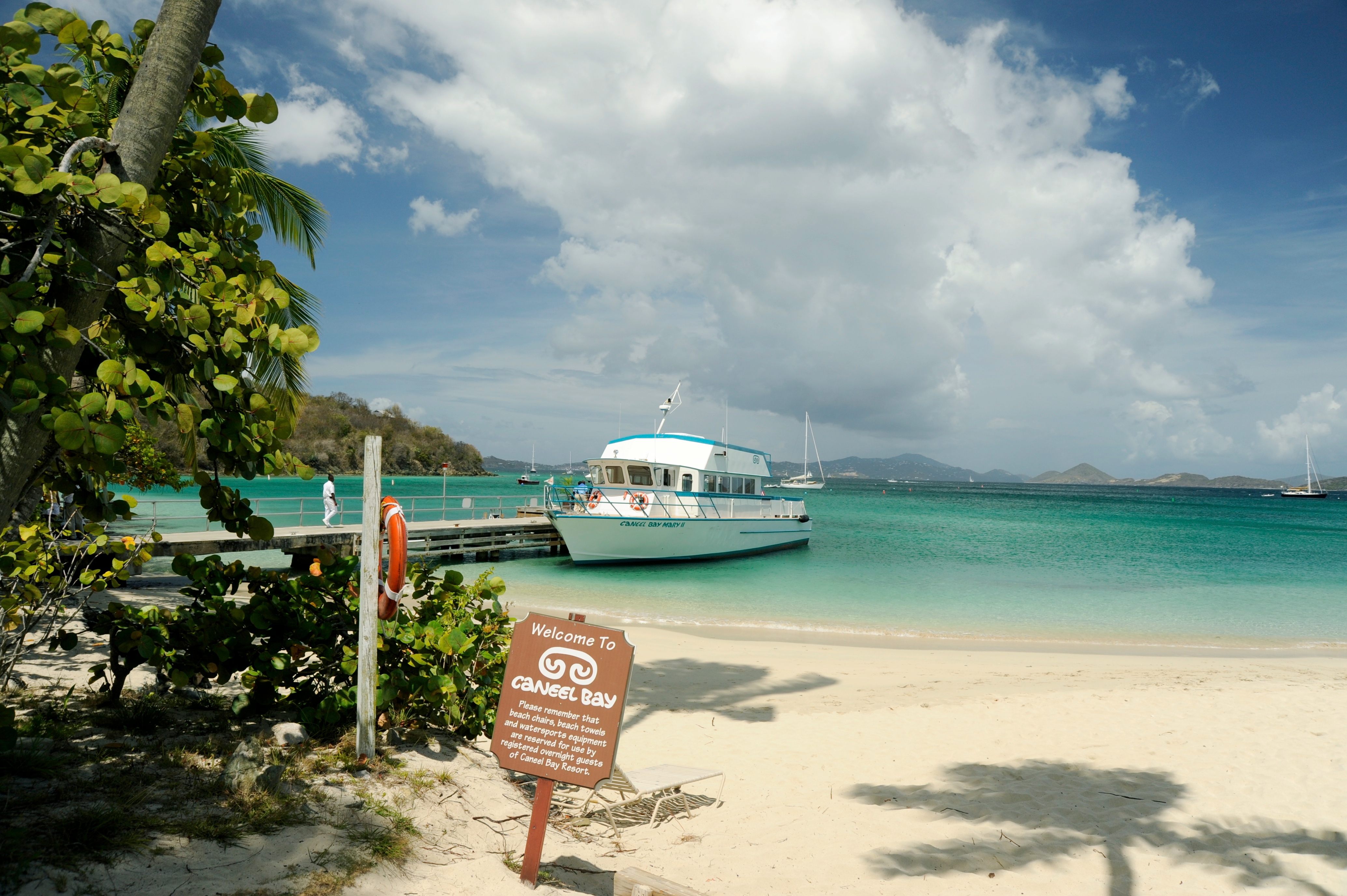
Caneel Bay
Laurance Rockefeller came to St. John in 1952 and fell so completely for the island that he bought most of it. Then he gave it away. Roughly 60 percent of St. John -- forests, beaches, hillsides, reefs -- went to the US government, becoming the Virgin Islands National Park in a ceremony on December 1, 1956. But Rockefeller kept one piece for himself: a 170-acre peninsula on the northwest shore where he built what he called the first environmentally friendly resort in the Caribbean. Caneel Bay became one of the most celebrated hotels in the West Indies, a place where buildings were designed to vanish into the landscape and the lighting was kept indirect so guests could see the stars. In September 2017, Hurricane Irma tore it apart. The resort has not reopened since.
Before the Resort, the Plantation
Long before Rockefeller's arrival, the peninsula was a sugar plantation called Little Cinnamon Bay, owned by a Danish colonist named Peter Durlo. The wealth that plantations like this one produced -- sugar, rum, cotton -- was built entirely on the labor of enslaved people. During the 1733 slave insurrection, when 150 enslaved Akwamu people seized control of most of St. John, some of Durlo's neighbors fled to his plantation seeking refuge. The estate passed through generations of the Durloo family, eventually reaching Johannes Durlo, who sold it and moved to Denmark in the early 19th century. Claims of slave quarters on the property have led some to argue that Caneel Bay deserves World Heritage Site designation -- an acknowledgment that the land's history runs far deeper than resort brochures suggest. The contrast is stark: a place once sustained by forced labor became, two centuries later, one of the most exclusive vacation destinations in the Caribbean.
Rockefeller's Bargain
What Rockefeller created at Caneel Bay was genuinely unusual for its time. The resort's architecture deferred to the landscape rather than dominating it. Cottages were low-slung, tucked into vegetation, their presence subordinate to the seven beaches that ring the peninsula. The property operated for decades under a "retained use estate" agreement with the National Park Service -- a legal arrangement Rockefeller himself helped draft. After 2004, the resort operated tax-free and rent-free on national parkland. Rockefeller intended the arrangement to be temporary, with the land eventually reverting fully to the park. "Caneel Bay is a very special site of outstanding scenic beauty which we believe should be protected and made available to the public as part of Virgin Islands National Park," he wrote. "Ultimately, your successors will determine whether and when the public will have the opportunity to enjoy the site as we intended." Those words would prove prophetic.
What the Wind Left Behind
Hurricane Irma struck St. John on September 6, 2017, with winds exceeding 185 miles per hour. A week later, Hurricane Maria followed. Between them, the storms devastated Caneel Bay -- roofs torn off, structures collapsed, the careful landscaping shredded. The resort that had operated ten months a year, offering snorkeling over reefs where parrotfish and sea turtles drifted among bright sea fans, went silent. The property's owner, CBI Acquisitions, announced plans to rebuild in an environmentally sustainable manner to "honor Laurance Rockefeller's legacy," but conditioned any reconstruction on a new long-term lease from the National Park Service. The existing lease was set to expire on September 30, 2023. Years of legal wrangling followed, with competing visions for the site -- some arguing for a rebuilt luxury resort that would provide jobs and economic stimulus, others insisting the land should return to the park as Rockefeller had originally intended.
Returning to the Park
In April 2024, a US District Court ruling affirmed the federal government's ownership of the Caneel Bay land, and the National Park Service began the process of transitioning the property to full park management. On August 1, 2024, Caneel Bay Beach opened to the public -- the first time in decades that visitors could walk the sand without being resort guests. The peninsula's future is still being shaped, but the trajectory points toward something closer to what Rockefeller envisioned when he handed most of St. John to the nation: a place where beauty is public, not private. Wild donkeys still roam the overgrown grounds. The ruins of the resort sit quietly among the trees, joining the older ruins beneath -- plantation walls, possible slave quarters -- in the long layering of human ambition that defines this particular stretch of Caribbean coastline.
From the Air
Located at 18.34N, 64.79W on the northwest coast of St. John, US Virgin Islands. The Caneel Bay peninsula is visible as a distinct promontory extending into the Caribbean, with multiple small beaches visible along its shoreline. The property sits within Virgin Islands National Park, which covers most of St. John's green, mountainous interior. Nearest airport is Cyril E. King Airport (TIST) on St. Thomas, approximately 5nm west across Pillsbury Sound. The resort ruins are partially visible from lower altitudes among dense tropical vegetation. Hawksnest Bay is immediately to the east. Approach from the northwest for the best view of the peninsula and its ring of beaches.