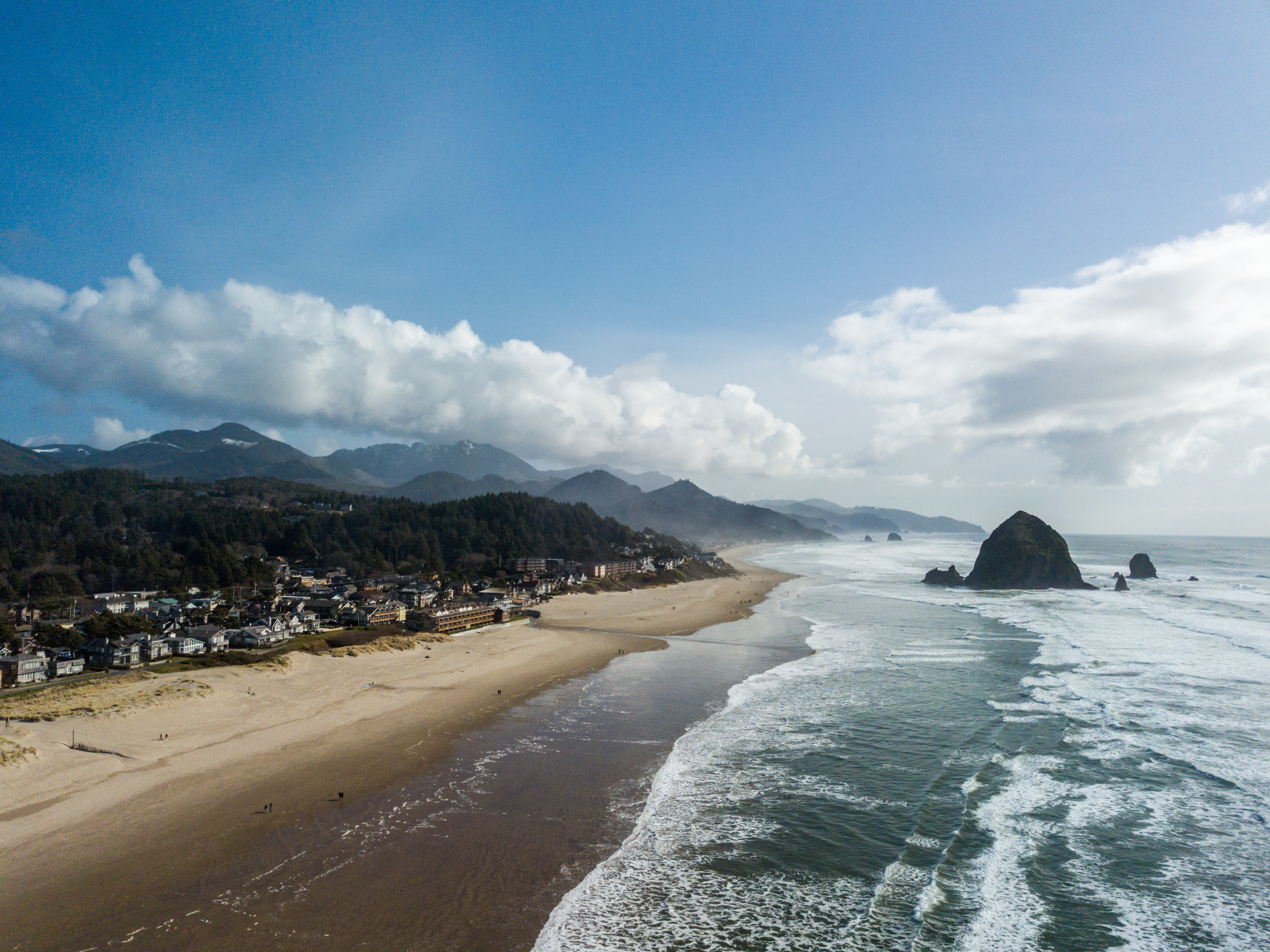
Cannon Beach, Oregon
A cannon from a wrecked Navy schooner gave this town its name, but it took a tsunami to give it its identity. In 1964, the Good Friday earthquake sent a wall of water surging ashore along the Oregon coast, washing out the Highway 101 bridge that connected Cannon Beach to the outside world. Cut off from the highway and facing economic isolation, the town did something unexpected: it threw a sandcastle contest. That annual competition still draws thousands every June, and it captures something essential about Cannon Beach - a community of fewer than 1,500 people that has turned its remoteness, its weather, and its dramatic geology into assets rather than liabilities.
Clark, Sacagawea, and the Whale
William Clark arrived here on January 10, 1806, at the end of a three-day journey from Fort Clatsop. He had come to see a beached whale. Clark and his companions - including Sacagawea, who had insisted on making the trip - found a group of Tillamook people boiling blubber for storage on the shore. The expedition bartered with them, trading goods for 300 pounds of blubber and several gallons of whale oil before turning back. Clark named the creek that emptied onto the beach Ekoli, a Chinook word meaning whale, which later became Ecola Creek. From a headland above the beach, Clark surveyed what he called "the grandest and most pleasing prospects which my eyes ever surveyed, in front of a boundless Ocean." That viewpoint, now dubbed Clark's Point of View, is still accessible by trail from Indian Beach in Ecola State Park.
The Cannon That Named a Town
The USS Shark, a Navy schooner, wrecked while attempting to cross the Columbia Bar in 1846 - the treacherous river mouth already known as the Graveyard of the Pacific. Debris scattered southward along the coast, and a carronade, a short naval cannon, washed ashore near Arch Cape, a few miles south of the settlement then called Elk Creek. The cannon was rediscovered in 1898 and became a local landmark. By 1922, the Post Office Department had grown tired of confusing Elk Creek with Eola, a town in the Willamette Valley, and insisted on a name change. The community became Cannon Beach, reflecting the eight-mile sweep of sand stretching from Ecola Creek south to Arch Cape. Two more cannons from the Shark surfaced on Arch Cape in February 2008, more than 160 years after the wreck - the Pacific reluctant to surrender its souvenirs.
Haystack Rock and the Needles
Haystack Rock is the town's unmistakable landmark, a 235-foot sea stack of dark basalt rising from the beach southwest of downtown. At low tide, especially in summer, you can walk right up to its base and peer into the small cave system that penetrates its igneous core. Tidepools ring the rock, dense with anemones, sea stars, and mussels. The formation is protected as part of the Oregon Islands National Wildlife Refuge, and events are prohibited within a hundred feet of either side. Nearby, the Needles - two slender rock pillars - rise straight from the surf, remnants of the same volcanic activity that built Haystack Rock millions of years ago. National Geographic named Cannon Beach one of the world's hundred most beautiful places in 2013, and Haystack Rock is the reason most people can picture it.
A Town That Refuses Chains
Cannon Beach has deliberately kept itself small. Chain stores like Safeway and McDonald's have been discouraged from building here, a conscious decision to preserve the local economy and the town's character. Hemlock Street, the main road, runs the length of the city from north to south, lined with galleries, bookshops, and restaurants rather than franchise signs. The town hosts a Spring Unveiling arts festival on the first Sunday in May, a Fourth of July parade featuring a Lawn Chair Brigade, and the Stormy Weather Arts Festival each November, when Pacific Northwest artists fill the galleries and auction their work. Portland residents treat Cannon Beach as a weekend escape - close enough for a day trip, far enough to feel like somewhere else entirely.
Hollywood's Favorite Beach
If Cannon Beach looks familiar, it should. The Goonies filmed here in 1985, using the view from Ecola State Park for one of the film's most recognizable shots. Free Willy followed in 1993, then Point Break in 1991, Twilight in 2008, and the B-movie Hysterical in 1983. The combination of photogenic sea stacks, moody skies, and dense coastal forest gives filmmakers a landscape that reads as wild and remote while sitting just ninety minutes from Portland. Ecola State Park, perched on the headland north of town, provides the dramatic clifftop angles, while the broad beach below offers the wide-open framing. The town has learned to live with film crews the way it lives with winter storms - as part of the scenery, arriving in bursts and leaving the beach unchanged.
From the Air
Located at 45.89N, 123.96W on the northern Oregon coast in Clatsop County. Haystack Rock (235 ft) is the dominant visual landmark - a massive dark sea stack visible well offshore, standing alone on a wide sandy beach southwest of the small downtown. The town stretches along an 8-mile beach from Ecola Creek south to Arch Cape. Ecola State Park and its forested headlands are visible to the north. Highway 101 runs just inland, parallel to the coast. Nearest airports: Seaside Municipal (private), Astoria Regional Airport (KAST) approximately 20 nm north, Portland International (KPDX) about 80 nm east-southeast. Expect frequent coastal fog and marine layer, especially June through August. The Columbia River mouth is visible to the north, with its distinctive jetties marking the entrance.