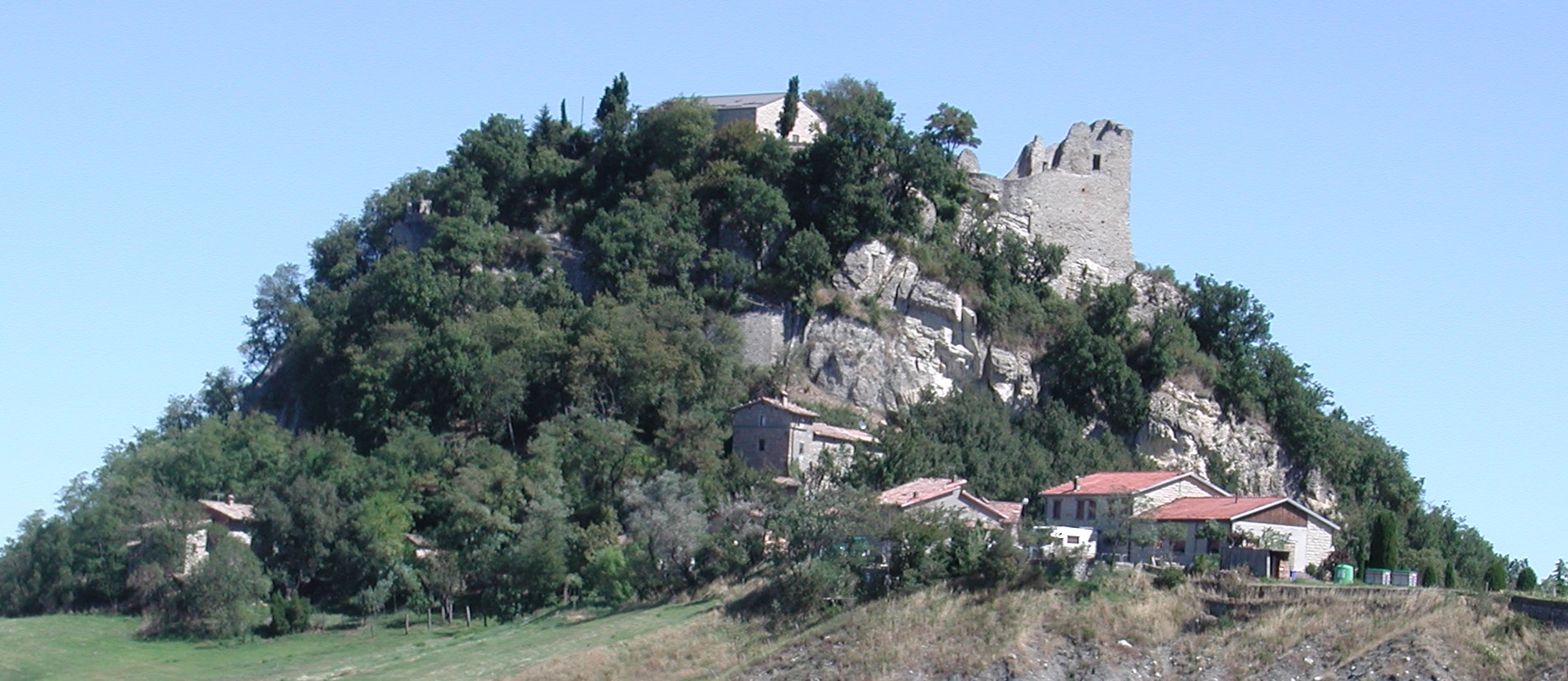
Canossa Castle
In January 1077, Henry IV, Holy Roman Emperor, stood outside these walls in the snow. He was barefoot, dressed in the rough wool of a penitent, and he waited for three days. Inside the castle, Pope Gregory VII considered whether to lift the excommunication that had stripped Henry of his authority and turned his own princes against him. The woman who controlled access to both men was Matilda of Tuscany, the castle's owner and one of the most powerful women in medieval Europe. After three days, Gregory relented. Henry knelt, the excommunication was lifted, and a phrase entered the German language -- 'den Gang nach Canossa antreten,' to go to Canossa -- meaning to humble yourself before a superior power. Otto von Bismarck would invoke it eight centuries later during the Kulturkampf, declaring 'Nach Canossa gehen wir nicht' -- we are not going to Canossa. The ruins on this hilltop in the province of Reggio Emilia are slight. The story they carry is immense.
A Fortress on a Rocky Crown
Adalbert Atto, the first Count of Canossa, built the castle around 940 AD on the summit of a rocky hill, choosing a position that was virtually impregnable. His father, Sigifredo of Lucca, was a nobleman, and the fortification reflected Lombard military thinking: a triple line of walls enclosing not just the residence but a convent with twelve Benedictine monks and the church of Sant'Apollonio. Barracks and servants' quarters filled the space between the outer two rings of defense. During the Middle Ages, it earned a reputation as one of the most formidable castles in Italy. In 950, Adelaide of Italy -- widow of King Lothair II -- fled here for protection. When Berengar II of Ivrea besieged the castle to capture her, he failed. The siege lasted three years. The walls held.
The Walk to Canossa
The Investiture Controversy was a power struggle that shook the foundations of medieval Christendom: who had the right to appoint bishops and abbots, the Pope or the Emperor? Gregory VII insisted on papal authority. Henry IV refused to comply. Gregory excommunicated him. The German princes, seizing the moment, told Henry that unless the excommunication was lifted within a year, they would elect a new king. Henry had no choice but to seek absolution, and Matilda of Tuscany -- who supported Gregory and controlled the Alpine passes -- arranged the meeting at her castle. The scene has been reimagined countless times: the emperor in the January cold, the pope behind stone walls, the countess mediating between two visions of authority. Whether Henry's penance was sincere or merely tactical -- he would later resume the fight against Gregory -- the moment crystallized a question that would haunt European politics for centuries: does spiritual authority trump temporal power?
Matilda's Legacy and the Castle's Long Decline
Matilda of Tuscany established that her lands should pass to the Church after her death in 1115. Her heirs disagreed. In 1255, troops from Reggio destroyed both the castle and the church, a brutal resolution to disputes over control. The property returned to the Canossa family, then passed to Reggio again after Giberto da Correggio died in 1321. In 1402, three members of the Canossa family regained it, only to cede it to the House of Este in 1409. The Estes held it for nearly four centuries, interrupted briefly when Ottavio Farnese, Duke of Parma, claimed it in 1557. In 1502, Ercole I d'Este appointed the poet Ludovico Ariosto -- author of Orlando Furioso -- as castellan. Ariosto resided here for six months, presumably finding inspiration in the views and the legends soaked into every stone. Later the castle was assigned as a fief to the Counts Rondinelli, then entrusted to the Valentini family, who were themselves expelled in 1796 when the local population rose up and joined the Republic of Reggio.
Ruins and Remembrance
What survives today is fragmentary. The Italian State acquired the castle in 1878 and declared it a national monument, but centuries of destruction, neglect, and reuse had left only portions of walls and foundations standing. The setting, however, remains extraordinary. The castle's hilltop position still commands sweeping views over the eroded badlands -- calanchi -- of the Emilia-Romagna foothills, a landscape of clay ridges and ravines that emphasizes just how exposed Henry IV must have felt approaching this fortress in winter. The nearby Castle of Rossena, in better repair, helps visitors imagine the network of fortifications that once guarded these hills. Walking among the ruins, you can trace the outlines of the triple walls that held off Berengar's three-year siege, imagine the church where monks prayed while armies camped below, and stand roughly where a pope and an emperor negotiated the relationship between heaven and earth. The stones are broken, but the argument they witnessed has never been settled.
From the Air
Located at 44.576N, 10.456E in the hills south of Reggio Emilia, in the foothills of the northern Apennines. The castle ruins sit on a prominent rocky hilltop surrounded by distinctive badland terrain (calanchi) that is highly visible from the air. Best viewed at 2,000-4,000 feet AGL. Nearest airports: Parma (LIMP), approximately 40 km northwest, and Bologna (LIPE/BLQ), approximately 90 km east. The nearby Castle of Rossena on an adjacent hill provides a useful visual reference.